


At a Glance (China Coffee Network): Luckin Coffee released its Q3 2026 financial report: net revenue rose 17.0% year on year to 17.9 billion yuan, and GAAP operating profit rose 55.1% year on year to 2.8 billion yuan.
In essence, it’s a bunch of exam-whiz grinders pushing themselves to the limit, grabbing prime locations and squeezing rivals out.
Full text: 3,135 words, about 8 minutes to read
Authors | Jia Yang, Luo Lixuan, Wang Xiaoling
Luckin has been digesting the results of the food-delivery war all year, and judging by the Q3 report released a few days ago, that effort has borne fruit.
The report shows Luckin Coffee (OTC: LKNCY) posted total net revenue of 17.9 billion yuan this quarter, up 17% year on year, with non-GAAP net profit of 2.14 billion yuan, up 50.9%, a record high for a single quarter.
This year most catering companies’ financial reports have been affected to varying degrees, with the same decline in same-store sales and much the same explanations at earnings calls.
Luckin is a company with consistently strong self-drive, now frantically opening stores and running brand marketing, willing to sacrifice same-store sales in order to convert the traffic brought in by the delivery war into its own scale expansion.
This runs counter to the industry’s broad trend of slowing store openings and protecting individual stores. What new war is Luckin fighting?
Record Profits, and the Three Accounts Behind Them
The factor no Q3 data of any catering company this year can ignore is the “interference” from last year’s delivery war; specifically, the fading of delivery subsidies has had both positive and negative effects.
Luckin saved about 1.1 billion yuan in delivery fees this quarter. Less delivery, soaring profits.
The report shows Q3 delivery fees were 1.79 billion yuan, down 38.1% sharply from 2.89 billion yuan in the same period last year, about 1.1 billion yuan less spent over the year.
The reason behind it is a significant change in order structure: the share of delivery orders fell while the share of pickup orders rose. This improved store-level profit margins. In Q3, the operating margin at Luckin’s self-operated store level was 23.3%, up 5.8 percentage points year on year.
Guo Jinyi said that as the delivery share and delivery costs fell substantially, the profitability of self-operated stores kept improving, and store-level margins were not only significantly higher than the same period last year but had basically recovered to pre-delivery-war levels.
But the other side of improved profits is pressure on same-store sales.Same-store sales growth: -11.1%.
For this key indicator of same-store sales, Luckin’s growth in the first three quarters of this year was negative across the board: Q1 at -0.1%, Q2 at -5.3%, and Q3 breaking into double digits, versus 14.3% in the same period last year.
At the earnings call, Luckin CEO Guo Jinyi said that because July and August last year were the peak of the delivery war, the high base had a more pronounced effect on this year’s Q3 same-store sales. After delivery platform subsidies faded this year, Q3 data were of course also greatly affected.
Monthly average transacting customers exceeded 112.3 million.
Up 9.6% year on year, a record high for a single quarter. This is presumably also a figure Luckin attaches great importance to, as it was written into the headline of the original report.
The 9.6% growth is truly not easy, achieved on top of an already extremely high growth in user numbers during last year’s delivery war. In Q3 last year, Luckin’s monthly average transacting customers exceeded 112.3 million, up 40.6% year on year, with over 42 million new transacting customers, both indicators hitting record highs.
One factor that cannot be ignored is that Luckin has been frantically opening stores, and new stores bring new users. In Q3 2025, Luckin net-added 2,979 stores in the China market, bringing the total to 29,096, up about 36% year on year.
This year, Luckin’s total store count in the China market has reached 38,630, up about 33% year on year.
Compare the two and it’s not hard to see that last year Luckin’s customer growth outpaced its store growth, while this year it’s exactly the reverse. The key factor is that the delivery war effectively amounted to the platform funneling traffic to Luckin, with many new users stimulated by subsidies to place orders.
Overall, a large share of the users pulled in by subsidies last year stayed. At the same time, relying on a larger store network and higher store density than peers, it brought users back to the high-margin pickup channel.
But volume is growing, while per-cup price may not have clearly recovered. Luckin did not separately disclose an exact average ticket in Q3, though it can be inferred from the report data.
First, GMV growth was lower than revenue growth. Q3 GMV was 20.734 billion yuan, up 19.7% year on year; total net revenue was 17.891 billion yuan, up 17.0%. The gap between the two narrowed, indicating that post-subsidy actual prices or structure dragged on revenue, and average ticket most likely weakened slightly year on year.
Second, self-operated same-store sales were -11.1% year on year, and management explicitly noted that last year’s delivery war pushed up “delivery cup volume and overall per-cup price”; after subsidies stepped down this year, both volume and price came under pressure.
The delivery war permanently reshaped the mental map of coffee price bands, and repairing it may take a very long time.
Luckin’s Core Strategy Remains “Opening Stores Is Everything”
Luckin kept frantically opening stores in Q3.
Store count grew 33% year on year, with global stores reaching 38,909, of which about 38,630 were in mainland China and Hong Kong.
But monthly average transacting customers grew only 9.6% over the same period, with store growth clearly faster than user growth. This shows new stores are still diluting traffic at old stores. More critically, self-operated same-store sales have declined for three consecutive quarters: Q1 -0.1%, Q2 -5.3%, Q3 -11.1%.
By common logic, continuously worsening same-store sales should mean slowing down, but Luckin is still opening stores at high speed instead. During last year’s Q3 delivery-war peak it opened more than 3,000 stores in one go. This Q3 it net-added 2,599, a slight dip from the more than 2,700 in Q2.
Keep in mind that peers that once opened stores aggressively have basically all slowed their expansion pace.
Mixue Bingcheng CEO Zhang Yuan said it would “give up quantity growth and shift fully to high-quality operations and optimization of existing stores.” Guming management said bluntly that “opening large numbers of poor-quality stores dilutes the business of existing franchisees.” CHAGEE positioned 2026 as a “year of adjustment and stabilization,” with franchised stores instead net-decreasing by 82 in the first half while directly operated stores increased by 268.
Data from public reports
But Luckin has barely slowed. This means Luckin’s current choice is not “fix same-store sales first, then expand,” but “seize locations first, then repair efficiency.”
Seizing every possible location is the primary goal. Management is quite candid: to meet constantly growing market demand, Luckin maintains an industry-leading store-opening speed, “with long-term market share as the most core task.”
What is the logic supporting this judgment by Luckin?
After delivery recedes, pickup is becoming the mainstream method with certainty. And pickup fulfillment costs almost nothing. So the closer you open to users, at subway entrances, downstairs from office buildings, and at community entrances, and the denser the stores, the better they can absorb fragmented demand. Delivery fee ratios are expected to keep falling and be diluted across same stores; as long as store-level profit margins are still improving, this densification strategy is rational.
Moreover, the metric for Luckin’s rapid expansion is no longer same-store sales but monthly average transacting customers continually setting records, while “overall per capita cup volume still rises steadily” as it keeps attracting large numbers of new customers.
Luckin appears very optimistic, saying coffee penetration is still very low.
But in reality it has already entered a fight over existing market share. Huayuan Securities once estimated, based on 2024 urban residents’ per capita disposable income, that Luckin’s theoretical upper limit for store openings in China was about 39,000. With 38,630 stores in mainland China and Hong Kong now, it is already close to that level, and the room to keep expanding purely on natural increment is very narrow.
The competitive structure also imposes constraints. Research from Tencent Research Institute once pointed out that coffee consumption growth is mainly concentrated in tier-1 and new tier-1 cities, with limited increment in lower-tier cities.
For it to expand, the only significant increment will come from rivals.
Luckin is betting on “seize the spot first, repair later,” but the time window is not unlimited. Scale cannot guarantee the health of individual stores. Lucky Cup is already plugging holes over a similar problem.
It had relied on low prices and rapid store rollout to announce surpassing 10,000 stores in November 2025, but subsequently franchisees saw losses, closures, and pleas for help, and store scale fell back to around 8,000. In July 2026, Lucky Cup made clear it would keep full-year new store additions within 2,000 and shift focus to high-potential commercial districts at the prefecture-level city and above, raising average ticket to ensure single-store profitability.
In the fairly homogenized affordable coffee-and-milk-tea chain industry, many capabilities have no barriers, nor is there a business model like Coca-Cola’s where getting it right once means winning forever. Every player must keep polishing the upstream supply chain, improving store and labor efficiency, and constantly developing new flavors.
And the efficiency of this system, reflected at the terminal, is being able to give individual stores healthy sales and profits and let franchisees earn money along with it. Only then does a brand have the strength to pass through cycles and hold its market share.
King of Involution
Facing such fierce competition, to achieve more differentiation, Luckin is also working hard to raise its brand appeal.
What consumers feel most obviously is the co-branding campaigns, frantic in both number and imagination. In 2025 Luckin’s co-branding reached as many as 23 times, ranking first in the industry; and this year it has already co-branded 26 times.
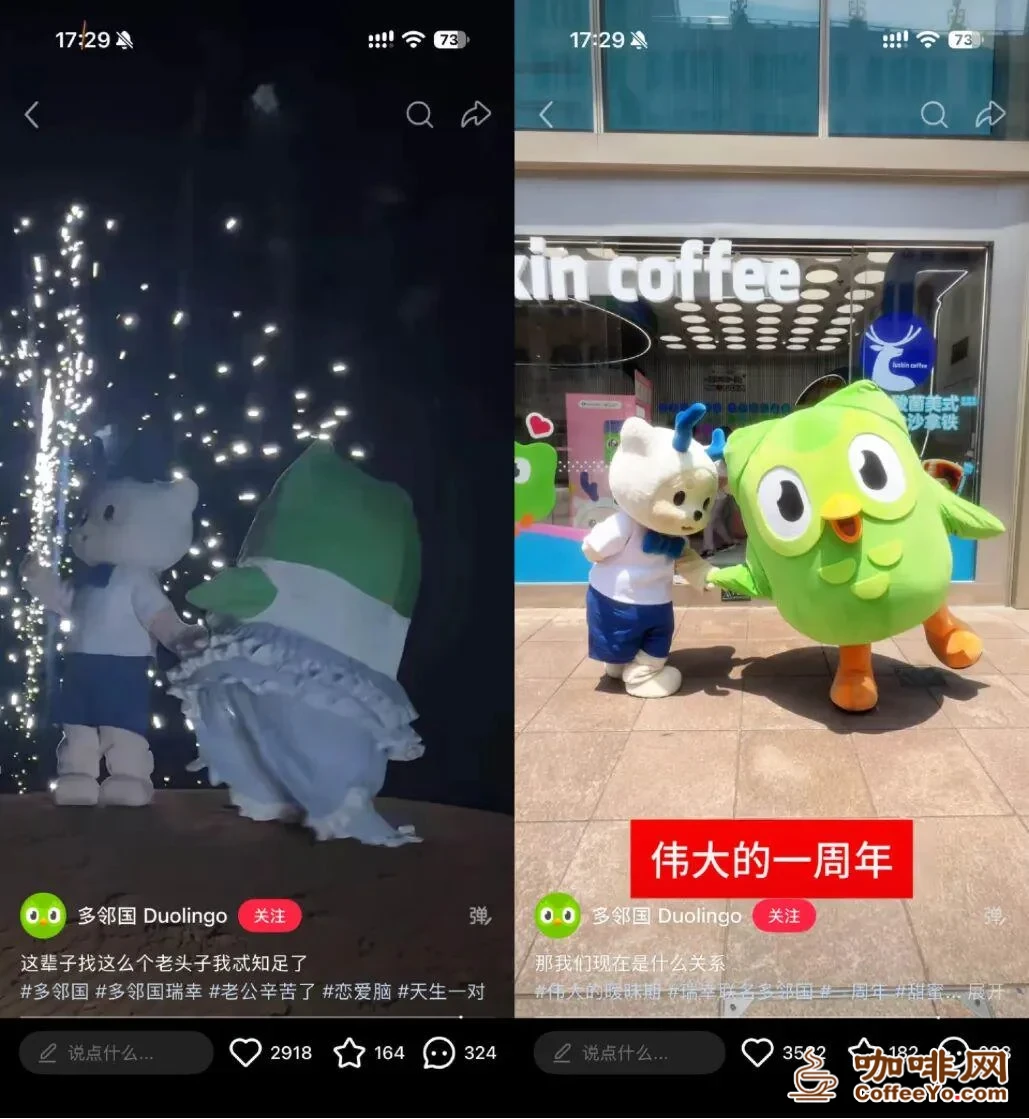
There are plenty of both successful and controversial cases. Among the successes are the collaboration with “Black Myth: Wukong,” last year’s Duolingo collaboration that even staged a wedding between Luckin’s mascot the little deer and Duolingo’s mascot Duo, and this year’s collaboration with the Disney Villains series.
One highly controversial case is the current much-criticized collaboration with the “Honor of Kings” professional league KPL, with cups printed with the “official top ten annual memory figures.” But because outsiders have no idea who these players are, people complained “why is there an unfamiliar fat guy printed on the cup” and “it ruins my appetite,” and requests to switch to a regular cup were refused by staff.
A very important reason is that Luckin, co-branding twice a month, has turned it into a content assembly line, a mandatory move for routine launches and an important means of stabilizing revenue. But Luckin’s demand is so large that substantial, recognizable IPs are simply no longer enough. Even if there’s controversy, it doesn’t matter, since in two weeks it may have changed again.
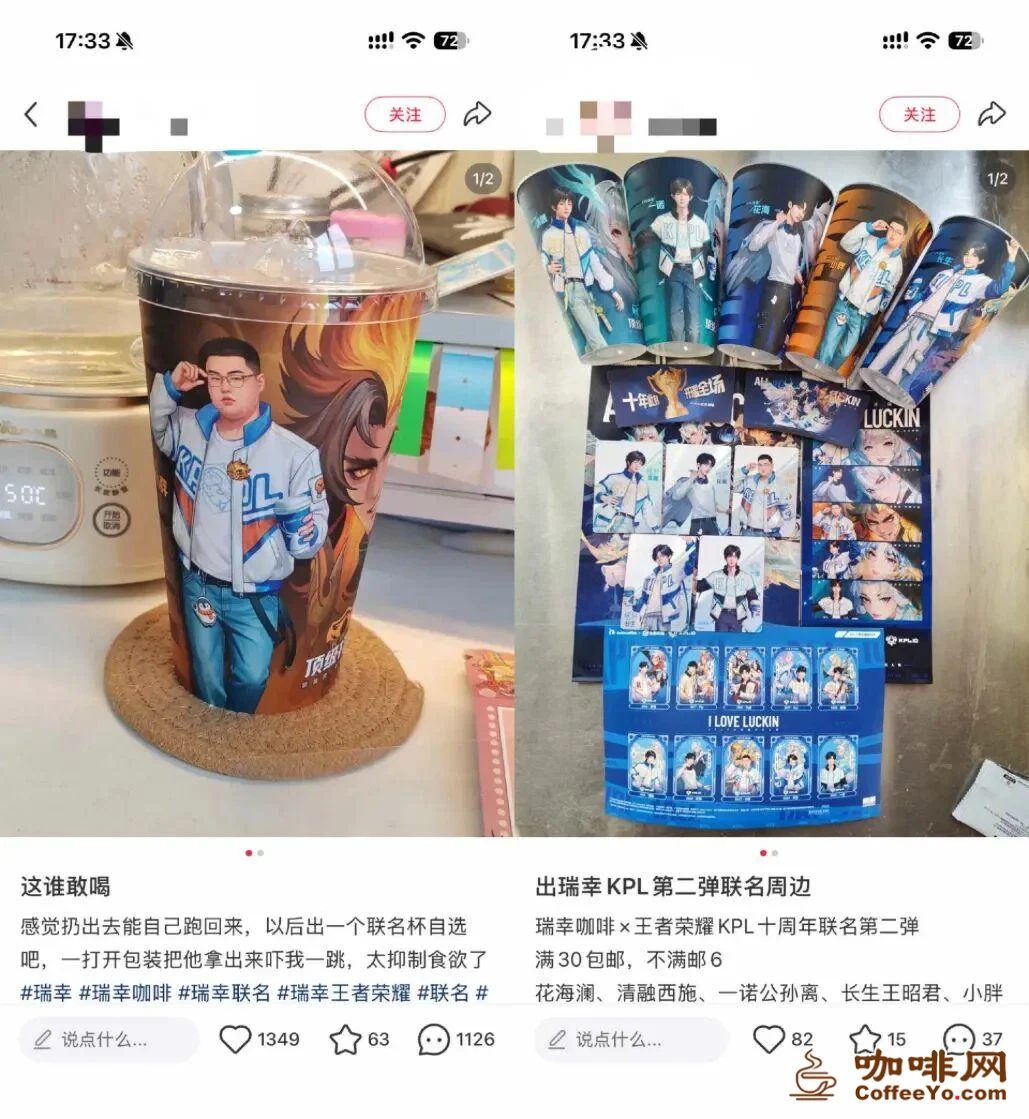
Forcing niche IPs to break into the mainstream gives consumers a baffled feeling and easily invites backlash.
Another obvious change is that the drinks themselves are changing too. First is a comprehensive shift toward health; at the same time it is also covering more categories, such as yogurt smoothies, iced milk series, freshly muddled fresh-fruit drinks, and high-end signature creations.
Luckin CGO Yang Fei summarized to Yicai in July this year that the first shot of Luckin’s health transformation was the “4 zeros”: zero trans fats, zero hydrogenated vegetable oils, zero non-dairy creamer, and zero aspartame across the entire drink line. At the same time, Luckin internally proposed a new concept, the “100-Calorie Club,” requiring that as many drinks as possible be kept under 100 kcal.
By now, the Orange C Americano once mocked as a “calorie assassin” is “roughly just the calories of one apple.”
Yang Fei said, “Of the 100 products consumers can drink today, perhaps 1,000 were killed internally, either because the calories were too high or the formula wasn’t clean enough.”
He also mentioned that Luckin, which had achieved mass-market adoption by turning coffee into a beverage, chose this shift because more and more customers, especially “those who have drunk Luckin for more than three years,” are turning to low-burden drinks.
Beyond drinks, to raise average ticket and also to attract more foot traffic during morning and evening peaks, Luckin’s light-meal and baked products have also joined the fray.
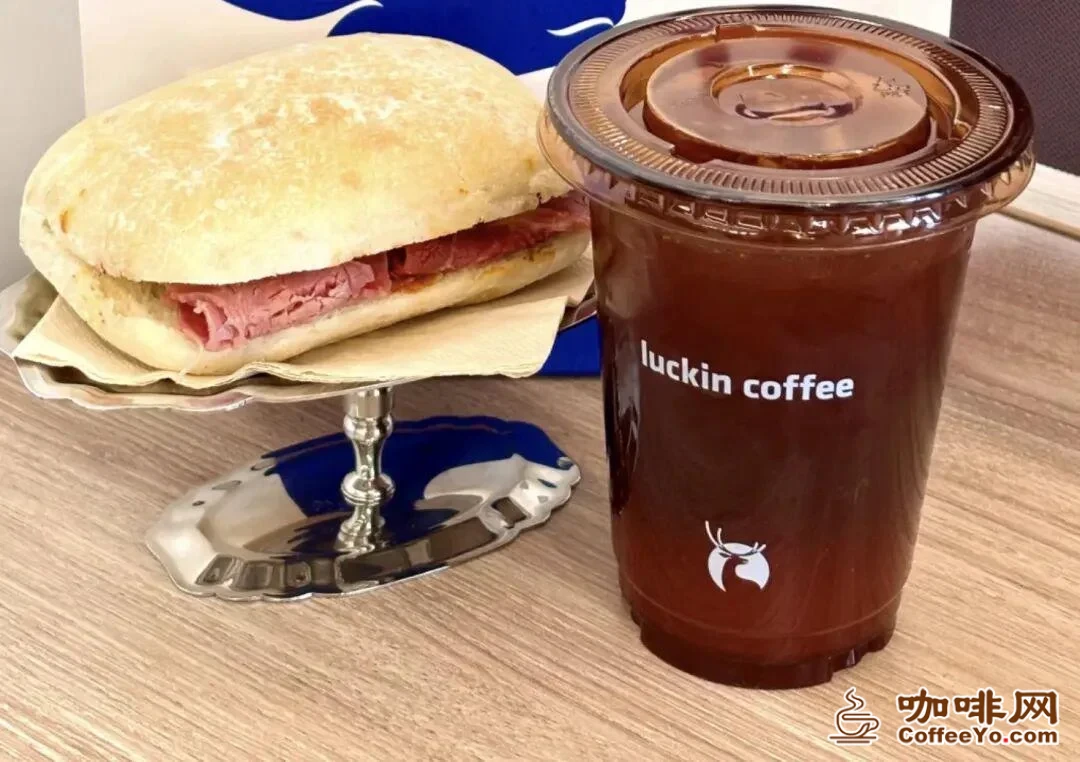
In Q3 2026, while launching 41 limited drinks, Luckin also launched more than 20 light-meal items, a record number, with pricing that can be called conscientious. The Xinjiang spicy-pepper beef ciabatta launched last month costs just 8.9 yuan, far below the ciabatta prices at many bakeries.
Beyond store business, Luckin also launched its own bottled drink products in Q2, commissioned from a contract manufacturer under Uni-President Group. The first batch is three hit products that have sold over 1.2 billion cups in stores: Classic Americano, Pomelo C Americano, and Coconut Latte. Priced at 6-7 yuan per bottle, they cover convenience stores, supermarkets, snack discount chains, and mom-and-pop shops.
Ifeng noted that clearly Luckin’s bottled ready-to-drink line trades low gross margin for distribution speed, to cover the market as quickly as possible. For products of the same specification, Starbucks distributors’ gross margin is about twice Luckin’s.
But the expansion of on-site made and on-site heated categories may grow revenue, yet the actual execution pressure falls on employees. At many stores, staff procedures have become more complex and their pressure has multiplied.
According to All Weather Technology, a Luckin store employee said that when they first joined, they only needed to prepare two kinds of tea broth plus matcha and cocoa premix; now they must prepare four kinds of tea broth and two kinds of milk foam, handle two kinds of fruit, and also complete tasks such as hauling ice and preparing disinfectant. And although baking only requires reheating in an oven, the nightly cleaning requirements add another burden to an already heavy closing routine.
The danger here is that continuously improving operating efficiency can indeed squeeze out profits through large-scale stores and supply chains, but it cannot all be expected to come from infinitely squeezing labor. Last year’s CHAGEE staff bare-hand operation incident and the earlier Manner staff-customer conflict both warn of the backlash from extreme exploitation.
Reposting Notice and Disclaimer
- This article was compiled and edited by Coffeeyo.com and reposted from 20 She’s article “How Did Luckin Pull Off a Comeback Against the Odds”. The original copyright belongs to 20 She and the original author. This site reposts it solely for sharing coffee industry information and does not represent the site’s position; the data and views in the article are subject to the original text. We thank the original author for creating and sharing it.
- Read the original: 20 She: “How Did Luckin Pull Off a Comeback Against the Odds”
- For matters involving content authorization, attribution, copyright, or other issues, please contact this site in a timely manner; we will verify and cooperate at the first opportunity. Coffee companies and industry media are also welcome to contact us for contributions and exchanges.
- Coffeeyo.com contact: Tel 400-0000-641 (+86-18288016826), Email 478203668@qq.com, Address: Jinghong City, Xishuangbanna, Yunnan Province
Related Reading
- Arabica Coffee Prices Plunge as Exchange Stocks Surge to 28-Year High
 Global coffee prices fall across the board: Robusta drops for a 10th straight session below $2,900, hitting a two-year-nine-month low
 Global coffee prices plummet, production in 2026/27 may set a record
 After 38909 stores, Luckin Coffee began to make money on "structure"
 Lincang Specialty Coffee Association Issues 2026/2027 Coffee Cherry Purchasing Initiative
 Coffee prices on November 12th: Arabica continues to fall to lowest point in nearly 5 months


 Liaoning ICP Security No. 21122402000217