


At a Glance (China Coffee Network):CNR, Beijing, July 20 (Reporter Chen Yue): Open CHAGEE’s ordering mini program and attentive consumers will notice that the tea drink display on the menu has recently added a “caf.
CNR, Beijing, July 20 (Reporter Chen Yue): Open CHAGEE’s ordering mini program and attentive consumers will notice that the tea drink display on the menu has recently added a “caffeine dashboard” label. Light green, green, yellow, orange, and red color bands are arranged in sequence from left to right along an arc on the dashboard, with specific numbers also marked below it, clearly indicating the caffeine content of that drink’s standard preparation.
This tiny interface change is a microcosm of the freshly made tea drink industry’s accelerated push to make health information transparent.
It is reported that the “caffeine dashboard” has now been launched simultaneously across CHAGEE’s ordering mini program, food delivery platforms, stores, and other channels. When ordering, consumers need only a quick glance at the dashboard to grasp at a glance the caffeine content characteristics of their target drink.
At a CHAGEE store in Fengtai, Beijing, the reporter met consumer Ms. Lin who was placing an order. She said she is usually sensitive to caffeine, and drinking milk tea in the afternoon often affects her sleep that night. “I used to only dare take a few sips in the afternoon and had to order blind; now the caffeine content is clear from the menu at a glance, which is much more convenient.” Ms. Lin ultimately chose a “low-caffeine” product marked green.
According to store staff, the “caffeine dashboard” mainly consists of the specific tea drink name and the caffeine content information of the standard preparation, with the caffeine content presented through specific numbers and corresponding color bands. The dashboard is divided into 5 color-band labels: 0-50 mg per cup is labeled light green, and 51-100 mg per cup is labeled green; both are classified as the “low-caffeine” tier, indicating relatively low caffeine content and suitable for those wishing to reduce caffeine intake. 101-150 mg per cup is labeled yellow, advising drinkers to pay attention to drinking time and personal physical sensitivity; 151-200 mg per cup is labeled orange, advising drinkers to consume it in the morning or earlier afternoon; above 200 mg per cup is labeled red, advising special groups to choose cautiously and avoid drinking it in the evening as much as possible.
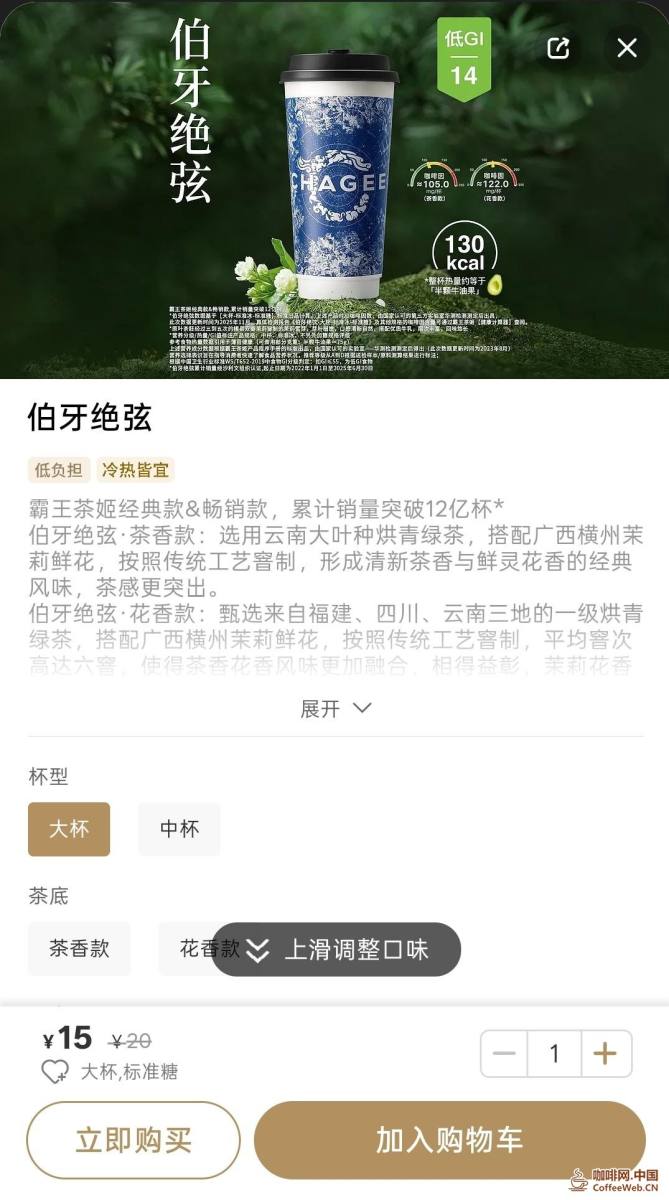
The caffeine contents of the two versions of Boya Juexian tea drink are respectively “tea-aroma version 105 mg per cup” and “floral-aroma version 122 mg per cup” (reporter screenshot, courtesy of CNR)
Jiang Han, senior researcher at the Pangu Think Tank, said: “The launch of this ‘caffeine dashboard’ is essentially a key move by CHAGEE to solve the problem of market information asymmetry. Through the intuitive division of red, yellow, green, and other color bands, CHAGEE converts complex physical and chemical indicators into a ‘decision dashboard’ that consumers can easily understand. To some extent this lowers consumers’ decision-making costs, breaks down the insider barriers that have long troubled the industry, and shifts consumption behavior from ‘feeling-driven’ to ‘data-driven’.”
According to statistics, in 2025 the national tea drink market reached 187 billion yuan, up 6.4% year on year, and the number of tea drink stores nationwide reached 449,000, up 3.5% year on year. Advancing in step with the rapid expansion of market size is the continuous improvement of the industry standard system. In recent years, as consumer health awareness keeps rising, information disclosure in the freshly made tea drink industry is gradually extending from indicators such as calories and GI values to more dimensions. However, one reality that cannot be ignored is that China currently has no mandatory labeling regulation for caffeine in freshly made tea drinks; existing national standards mainly target pre-packaged tea beverages, and the freshly made tea drink sector remains outside standard coverage.
On January 12, 2026, the China Chain Store & Franchise Association (CCFA) held a kick-off meeting in Shanghai for three group standards, formally launching the drafting of the Guidelines for Graphical Labeling of Nutritional Components in Freshly Made Beverages. Representatives of more than 30 leading industry enterprises and professional institutions, including Starbucks, Yum China, CHAGEE, Guming, and HEYTEA, attended. It is reported that the standard focuses on the standardized delivery of nutrition information, draws on advanced domestic and international experience, and covers labeling scope, core indicators, design specifications, and more. The core discussion revolved around three aspects: first, clarifying the scope of indicators such as energy, sugar, and caffeine to be included; second, balancing the professionalism and accessibility of graphical design and unifying visual specifications; third, establishing a dynamic labeling mechanism for the nutritional components of personalized drinks.
At the same time, CHAGEE has participated in formulating the CCFA’s Grading Standard for Caffeine Content in Freshly Made Tea Drinks. For the first time, this standard sets a clear content threshold for “low-caffeine tea”, namely caffeine content of no more than 50 mg per cup, with plans to pair it with a unified label.
The caffeine content of a cup of tea drink is jointly affected by multiple factors —— tea variety, brewing concentration, extraction technique, cup size, amount of ice, and so on all cause fluctuations in the final content. Products differ considerably, making it hard for consumers to judge from a unified dimension; previously they often had to order by experience or intuition. According to the Chinese Consumer Caffeine Awareness and Attitude Survey (2023) by the China Food and Health Information Communication Center, nearly 90% of consumers want to know the caffeine content in their drinks, and more than 70% believe their daily caffeine intake needs to be controlled.
A relevant CHAGEE staff member said: “In recent years consumers have paid growing attention to healthy and transparent consumption. This time, CHAGEE uses the familiar dashboard format to display complex caffeine calculations in a more visual and vivid way. Consumers can more conveniently make more reasonable consumption decisions based on their own circumstances and needs when ordering.”
Jiang Han further believes that brands beginning to proactively establish nutrition grading, calorie calculators, and even caffeine dashboards shows the industry has upgraded to building “service experience” and “professional trust”. It marks freshly made tea drinks gradually shaking off extensive growth and moving toward a new stage of refined operations centered on consumers’ health rights and interests; for the long-term healthy development of the whole industry, this is undoubtedly a positive attempt to break through. This approach of making implicit information explicit and complex standards accessible not only strengthens the brand’s own moat, but also provides a practical model for the industry to build a transparent, standardized information disclosure system, promoting standardization across the entire industrial chain.
Reprint Notice & Disclaimer
- This article has been edited and compiled by China Coffee Network. The information and images therein come from public sources and the copyright belongs to the original author. This reprint is intended solely for information sharing within the coffee industry and does not represent the views of this website; all data and opinions are subject to the original article. Our thanks to the original author for creating and sharing it.
- For matters concerning content licensing, attribution, copyright or otherwise, please contact us promptly and we will verify and cooperate in handling them as soon as possible. We also welcome coffee origins, brands and industry media to exchange ideas and contribute articles.
- Contact China Coffee Network: Tel 400-0000-641 (+86-18288016826) | Email 478203668@qq.com
Related Reading
 Asia Pacific Connection in a Cup of Coffee
- A Cup of Coffee Connecting Asia-Pacific
 ICE agricultural futures main contracts mostly closed higher, while coffee futures rose 1.84%
 The coffee market is experiencing two extremes! Arabica inventory drops to 27 year low, but Robusta plummets to two-week low
 Financial Observation: Why is Generation Z from the United States flocking to coffee and tea shops in China
 ‘All-Ice’ Coffee Goes Viral! Will the Next Hit Be Your Personal Favorite?


 Liaoning ICP Security No. 21122402000217