


At a Glance (China Coffee Network):According to Xinhua, on August 13 the Colombian National Disaster Risk Management Unit issued its latest disaster briefing, saying that as of 17:00 local time on the 13th, the.
According to Xinhua, on August 13 the Colombian National Disaster Risk Management Unit issued its latest disaster briefing, saying that as of 17:00 local time on the 13th, the earthquake had caused 281 deaths, 3,971 injuries, 379 missing, and 348 rescues.
Earlier, Colombian President Abelardo del Espleya declared a state of economic emergency to respond to the earthquake crisis. Del Espleya said the emergency is aimed at speeding up assistance to affected people, allocating resources for reconstruction, and implementing measures to revive the economy.
According to estimates by Oxford Economics, the earthquake could cause Colombia direct economic losses of between US$990 million and US$1.98 billion, but the impact on GDP growth may be relatively limited. The institution kept its economic growth forecast unchanged at 3% for 2026 and 2.5% for 2027, because public government spending on rescue and reconstruction will offset most of the decline in private demand.
Aurora Macro Strategies said in a report that the earthquake may help del Espleya consolidate his political position, but the economic cost of reconstruction could complicate the austerity fiscal plan he has promised.
Epicenter in Colombia’s poorest province
According to Colombia’s Geological Service, a 7.4-magnitude earthquake struck western Colombia at 7:34 local time on the 10th (20:34 Beijing time). It is the strongest earthquake in the country this century. The U.S. Geological Survey’s updated information showed the epicenter was 5 km south of San José del Palmar in Chocó Department, at a depth of 110.3 km.
Chocó borders the Pacific Ocean and is a remote area with extensive tropical rainforest. According to government statistics, its population is mainly Afro-Colombians and Indigenous people, and more than two-thirds live in poverty. San José del Palmar, about 400 km west of the capital Bogotá, has a resident population of about 4,800.
Due to its remoteness, more than 30% of Chocó’s population lacks access to tap water, and about 80% is not covered by sewage treatment systems. Moreover, Chocó has the most backward medical conditions in Colombia; its capital Quibdó has only one hospital.
According to Spain’s El País, transportation among Chocó’s 31 municipalities relies mainly on water and air transport; its fragile road network cannot connect all municipalities, and links with the rest of Colombia also face many problems. This state of isolation from the outside world has made the area a stronghold for armed groups.
From the Colombian civil war to the present, the unrest in Chocó has never been fundamentally eased amid the ongoing conflict between the leftist guerrilla group “National Liberation Army” (ELN) and the right-wing paramilitary “Gulf Clan” (AGC). The ELN and AGC have continuously fought over territory, illegal trade routes, economic control, and the important smuggling corridor to Panama. The area’s abundant illegal drug trade, along with important natural resources such as timber, platinum, and gold, further fuels the struggle.
“Even before the earthquake, local communities were already facing armed conflict and severe poverty,” Nicole Casta, director for Colombia, Venezuela, and Ecuador at the global nonprofit International Rescue Committee, told the media. Natural disasters will make it even harder for Chocó residents to access health care and other basic services, exacerbating their predicament.
“Coffee Triangle” provinces hit hard
Valle del Cauca and Risaralda, bordering the epicentral area, are the other two most severely affected departments.
The capital of Valle del Cauca, Cali, is Colombia’s third-largest city, with a population of about 2 million. Mayor Alejandro Eder said at least 30 buildings collapsed, with many people trapped. The mayor’s office said that, due to structural damage, seven major medical centers including hospitals, clinics, and laboratories have been evacuated and may remain closed. Another 25 medical centers may suffer structural damage, and the city has issued a red alert for its hospital system.
According to Xinhua, Risaralda, located in Colombia’s “Coffee Triangle,” was severely hit. According to the National Federation of Municipalities, at least 60 people died in its capital, Pereira, alone. In Manizales, capital of Caldas Department, also in the “Coffee Triangle,” a side tower of the city’s landmark neo-Gothic cathedral collapsed.
It is currently Colombia’s coffee harvest season. Major producing areas include southern departments such as Cauca, Nariño, Valle del Cauca, and Huila, with a considerable portion of coffee typically exported via the port of Buenaventura in Valle del Cauca.
Citing a statement from the National Federation of Coffee Growers of Colombia, the Financial Times reported that the docks at the port of Buenaventura have temporarily halted operations to inspect infrastructure. Meanwhile, multiple roads leading to the port have been blocked by the earthquake, particularly around tunnels along the Cali–Buenaventura highway. Port dock managers are assessing damage and have suspended or restricted the receiving of coffee cargo.
Colombia is the world’s third-largest coffee producer after Brazil and Vietnam, and the largest producer of high-quality washed Arabica beans.
Because the global coffee industry heavily depends on Colombian beans, the earthquake has become another variable affecting international coffee prices. Amid market concerns that El Niño could affect yields in major producing regions, Arabica coffee futures prices have risen about 30% since early June. After the quake, Arabica futures briefly rose on the 11th to their highest level in weeks, at US$3.26 per pound (about 22 yuan), before pulling back. The industry is now closely watching how the earthquake will affect the supply of Colombian beans.
Right-wing president faces severe economic test
Britain’s Economics Observatory wrote that after Gustavo Petro, a leftist politician, was elected president in 2022, Colombia’s economy did not experience the feared “hard landing” but remained basically stable, mainly reflected in an improved current account (Current Account, also called the “cash item,” a major component of a country’s balance of payments) and a stronger peso.
Thanks to increased public spending, domestic consumption growth, and raised subsidies and minimum wages, Colombia’s unemployment and poverty rates have both declined, with unemployment falling to its lowest level this century and the Multidimensional Poverty Index (note: an indicator system established to precisely define and evaluate poverty) dropping to single digits for the first time.
Former Colombian Finance Minister José Antonio Ocampo wrote that these achievements reflect improvements in education, health, public utilities, and housing conditions, rather than a substantial rise in residents’ incomes. At the same time, large-scale government spending has also raised public debt and the fiscal deficit. Since 2024, Colombia’s fiscal deficit has exceeded 6% of GDP, among the highest in Latin America. In 2025, public debt as a share of GDP exceeded 60%, a record high.
According to Oxford Economics, the earthquake will hit the Colombian economy in the short term. The institution expects the August “Economic Tracking Indicator” (ISE) to weaken and third-quarter growth to slow. Some analyses suggest that after the quake some businesses lost their premises, while others lost inventory and capital. Business failures will have a chain reaction, leading to higher unemployment and pressure on the financial sector, with many families falling into greater difficulty.
The U.S. Geological Survey estimates reconstruction could require US$1 billion to US$10 billion, up to 7% of Colombia’s GDP. Currently, Colombia has secured US$450 million under the World Bank’s “Disaster Risk Management Development Policy Loan” contingency credit line, about 0.1% of its GDP, and obtained US$400 million from the Inter-American Development Bank’s contingency mechanism. Andrés Pardo Amesquita Pardo, macro strategy director at XP Investments, a U.S.-based financial services firm, believes these buffer funds can only address emergency needs.
According to Oxford Economics’ assessment, after a brief downturn, Colombia’s economy will rebound driven by post-disaster reconstruction. However, this recovery comes with a major challenge: rebuilding damaged housing, schools, hospitals, and infrastructure may add extra pressure to the budget of a Colombian government that already faces a huge fiscal deficit.
Before the quake, Oxford Economics expected Colombia’s fiscal deficit at about 7.1% of GDP in 2026 and 5.5% in 2027. As reconstruction spending rises, the institution now expects to raise these forecasts.
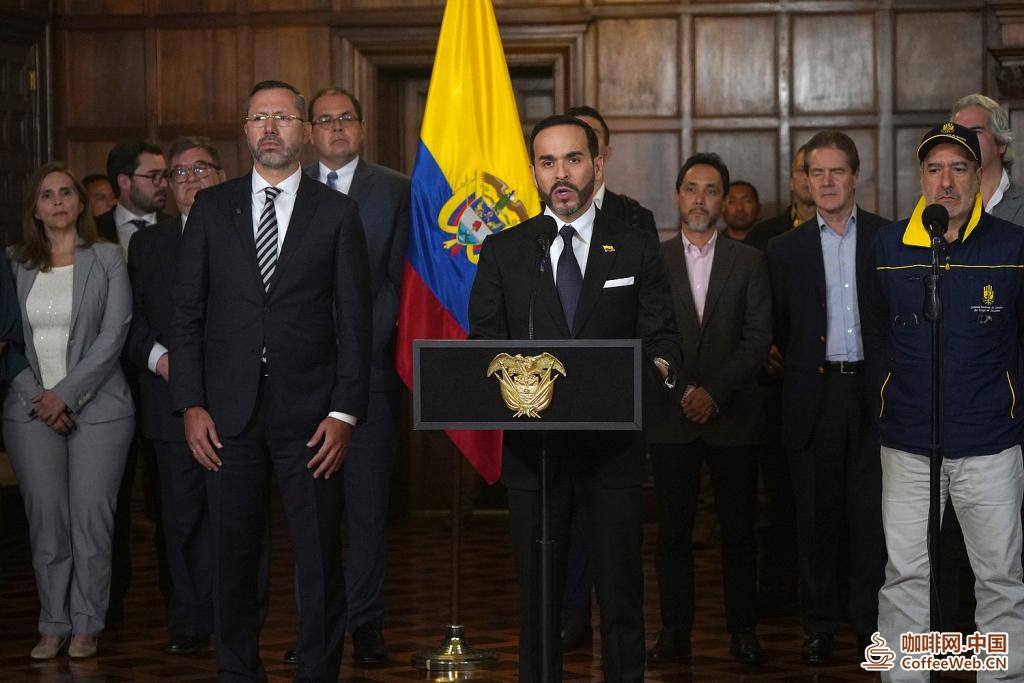
On August 13, 2026, in Bogotá, Colombia, President Abelardo del Espleya (center) attended a press conference together with Daniel Tamayo, director of the National Disaster Risk Management Unit (right), and Jaime Andrés Beltrán Martínez, Minister of Housing (left third).
Del Espleya, who took office on August 7, belongs to the far right, advocates cutting about 40% of national public spending, promotes tax reform, boosts investment and employment, while retaining the social welfare programs set by the previous administration. To increase fiscal revenue, he also supports expanding oil and gas exploration, including “developing responsible and sustainable hydraulic fracturing technology.”
Del Espleya, who promised to reduce public spending, will have to face high reconstruction costs, and his fiscal-austerity plan will face even greater challenges. On August 10, he announced in Chocó that the government had distributed emergency economic assistance to more than 1,400 families, and allowed affected families to defer utility payments such as water and electricity and postpone income-tax filings. In addition, provincial governments will provide temporary rental subsidies to families with damaged housing.
James Bosworth, author of the Latin America Risk Report, wrote on the 11th local time: Recovery from the earthquake is difficult, and del Espleya has no experience governing the country. But he is fortunate that Colombia has a professional civil service that can provide assistance. However, the public will blame any mistake on the president.
Source: The Paper News
Source: The Paper News
Reprint Notice & Disclaimer
- This article has been edited and compiled by China Coffee Network. The information and images therein come from public sources and the copyright belongs to the original author. This reprint is intended solely for information sharing within the coffee industry and does not represent the views of this website; all data and opinions are subject to the original article. Our thanks to the original author for creating and sharing it.
- For matters concerning content licensing, attribution, copyright or otherwise, please contact us promptly and we will verify and cooperate in handling them as soon as possible. We also welcome coffee origins, brands and industry media to exchange ideas and contribute articles.
- Contact China Coffee Network: Tel 400-0000-641 (+86-18288016826) | Email 478203668@qq.com
Related Reading
 How a Small City Hand-Roasts One-Tenth of Global Instant Coffee Capacity
 Asia Pacific Connection in a Cup of Coffee
- A Cup of Coffee Connecting Asia-Pacific
 ICE agricultural futures main contracts mostly closed higher, while coffee futures rose 1.84%
 The coffee market is experiencing two extremes! Arabica inventory drops to 27 year low, but Robusta plummets to two-week low
 Financial Observation: Why is Generation Z from the United States flocking to coffee and tea shops in China



 Liaoning ICP Security No. 21122402000217