
Brief (coffeeyo.com): In a Chengze Forum keynote, Columbia University professor Wei Shangjin argues that tea once triggered two world-changing wars and was the target of a 19th-century British “de-Sinicization” plot, while today a “re-Sinicization” is unfolding through Chinese milk tea and Yunnan coffee — with lessons for how not to fear AI-driven disruption.
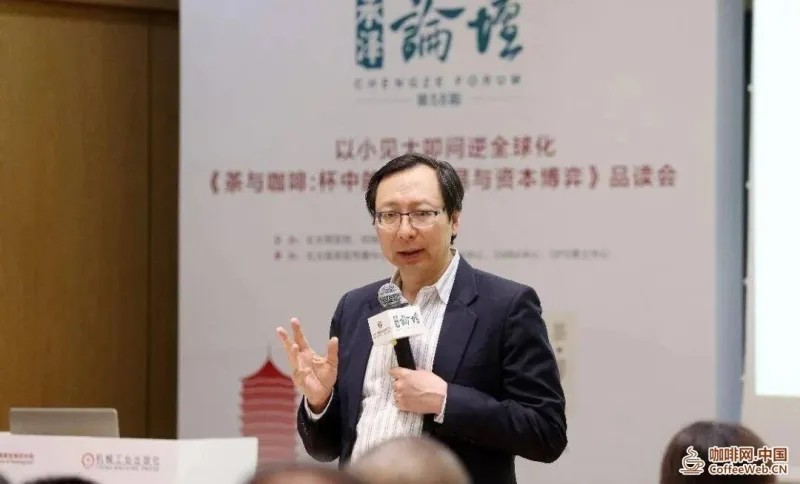
Epigraph: On August 2, 2026, the 58th “Chengze Forum,” co-hosted by Peking University’s National School of Development (NSD) and China Machine Press, was held at the school’s Chengze Garden. This article is compiled from the keynote speech by Wei Shangjin, visiting academic professor at Fudan University’s International School of Finance, tenured chair professor at Columbia University, and author of “Tea and Coffee: Global Trade and Capital Games in a Cup.”
Do you agree with these three statements? First, tea once triggered two wars that changed world history; second, historically there was a thrilling “de-Sinicization” movement around tea; third, a “re-Sinicization” revolution is underway in the realms of tea and coffee.
Two Important Wars Triggered by Tea
Why is it said that tea once triggered two wars that changed world history?
Take the first war: this year marks the 250th anniversary of the founding of the United States. How did the U.S. come to be founded? Before its founding, there was a movement known in world-history textbooks as the “Boston Tea Party.” At the time, consumers including those in North America and Europe were obsessed with tea, and China was the only tea exporter. Coffee had reached North America and Europe, but drinking it then was very inconvenient — the various coffee machines in use today were invented in the early 20th century. So if people wanted a quality beverage, tea remained the main choice. And to drink tea, one could only buy from China.
The British saw profit in this and decided to monopolize the tea trade. They ruled that tea sold to North America could come only from British state and quasi-state enterprises. Once the monopoly was secured, the British could levy taxes through these enterprises. This enraged the North American colonists. Hence what came later: late at night, colonists sneaked into Boston Harbor and dumped into the sea all the tea that British enterprises had just purchased from China and not yet unloaded. After the incident, Britain’s harsh response ultimately triggered the American War of Independence. Thus we see this profound link between the American War of Independence and tea produced in China.
The second war is closer to us. The Opium War can also be called the “Tea War.” As noted, Europeans including the British were obsessed with Chinese tea, and China was then the sole tea exporter. Moreover, under the Qing government, China accepted only silver when selling tea to Britain, unwilling to accept other British goods. So in Sino-British trade, Britain ran a large deficit for a long time while China held a huge surplus. To resolve the imbalance, the British sold opium to China, and this vile means triggered the Opium War.
The History of Tea’s “De-Sinicization”
This history has a little-known sequel, extensively covered in the book “Tea and Coffee.”
Before revisiting that history, one point must be emphasized: the whole world loves tea, yet tea was for ages produced only in China. Two indirect pieces of evidence can be cited.
First, there are more than 6,000 languages in the world, yet in all of them the word for tea has only two pronunciations: “cha” and “tea.” “Cha” derives from northern Chinese pronunciation, while “tea” comes from the Southern Min dialect. The divergence in pronunciation arose from the different channels and source regions through which countries obtained tea; and the reason there are only two pronunciations is fundamentally that tea was produced only in China.
Second, the Latin botanical name of tea is Camellia sinensis. Here Camellia denotes a flowering tree (rendered in Chinese as the genus Camellia), while sinensis in Latin means “Chinese.” The plant’s scientific name directly contains the attribute “China,” indirectly confirming that tea originated in China.
Returning to the history itself: to change the huge trade deficit with China caused by tea, the British launched the Opium War and considered themselves victorious, but soon they realized that even after winning the Opium War, the Sino-British trade pattern would ultimately return to Britain running a large deficit and China a large surplus. Why? Previously, Britain earned silver by selling opium to buy Chinese tea, on the premise that China did not grow opium domestically. After the Opium War, however, since the Qing government could not ban the opium trade, it most likely would not ban domestic opium cultivation either. The poppy is a plant of extremely strong vitality, easy to grow. So the British believed that once the opium trade was legalized, Britain would soon return to a large trade deficit and again fall into the predicament of scouring the globe for silver to buy tea.
How to break this deadlock? In today’s Western discourse, the British believed they had to launch a thorough tea “de-Sinicization” movement. By “de-Sinicization” is meant using extreme industrial policy to steal tea seeds, tea plants and tea-making craft from China, thereby breaking China’s exclusive monopoly on the tea industry.
At the time, the outside world was entirely unfamiliar with the form of the tea plant and the craft of tea-making; ordinary people simply could not accomplish the theft, so Britain had to send professionals to infiltrate China. The British paucity of tea knowledge is glimpsed in the scientific literature: then, British and even European academia debated whether black tea and white tea came from the same plant or belonged to different species. In fact, all categories of tea come from the same plant. Any crop that can be called “tea” necessarily belongs to the species Camellia sinensis. Different tea categories arise mainly from differences in processing. Yet in Britain and other European countries then, people had seen only finished tea leaves, never the tea plant itself, and even experts could not sort out this question.
Thus stealing tea-related technology had to be entrusted to professionals. Britain selected Robert Fortune, director of a London botanical garden, who was both botanist and administrator. The British government proposed to Fortune, citing national interest, that it wished to commission him to lead a team to China to retrieve tea seeds, tea seedlings and tea-making craft and complete the task of freeing tea from Chinese control.
Fortune initially refused, saying that as a botanist he should not sneak into another country to steal. After the British government offered to raise his salary fivefold, he finally agreed. Considering the high transport cost of tea seeds and seedlings, the British state enterprise East India Company promised that as long as Fortune could bring the tea-related goods and technology out, it would provide free shipping whether the destination was Britain or other British colonies. Britain also deployed the then-newest portable glass-greenhouse technology to solve the problem of low plant survival on long ocean voyages.
In 1848, dispatched by the East India Company, Fortune shaved his head and grew a queue, assumed the alias “Xing Han,” and disguised himself as a Chinese merchant, breaching the ban to penetrate core tea-producing regions such as Wuyi Mountain and Huangshan. Along the route of Shanghai, Hangzhou, Huizhou and Wuyi Mountain, he successfully stole 20,000 quality tea seedlings and 13,000 precious tea seeds, covering core varieties such as Zhengshan Xiaozhong and Longjing. He did not merely take plants away; he also systematically recorded the full process of fixation, rolling, fermentation and drying, hand-drew key tea-making tools and process details, and converted the craft into replicable text and images. Fortune also used large sums to entice eight Chinese craftsmen skilled in tea-making to go to India, directly teaching practical skills in tea gardens at the foot of the Himalayas and ensuring the technology landed.
Britain had tried to grow tea domestically, but the climate was unsuitable, so it sought suitable producing regions in its colonies, finally settling on Darjeeling and Assam in India, as well as then-Ceylon (today’s Sri Lanka) and Kenya, as tea-growing areas. These regions have subtropical climates similar to China’s tea regions.
Under the sustained effort of Britain’s tea “de-Sinicization” movement, just three years later Assam, India produced its first batch of black tea, completely shattering China’s millennial global monopoly on tea.
Seeing Industrial Iteration From Tea’s Rise and Fall
Tea was vitally important to Britain and Europe; what did tea mean to China at the time?
In the mid-19th century, the period when the British were plotting to steal tea seeds, tea exports accounted for about 60% to 70% of the Qing government’s total exports, and in some years even more. In other words, tea far exceeded the sum of all other goods such as porcelain and silk, indisputably the absolute export mainstay. Simply put, China’s exports then were almost equivalent to tea exports.
How successful was Britain’s “de-Sinicization” campaign? After a few years of cultivation outside China, the tea seeds and seedlings began to yield, with output rising year by year. By the late 19th century, Britain and Europe still had large tea-procurement needs, but the source had changed dramatically: China not only lost its status as the world’s sole tea supplier, but even lost the title of world’s largest tea exporter, often unable to hold even second place. At the time, the world’s top two tea exporters were British India and British Ceylon. Even today, checking international trade data shows that in some years China’s total tea exports rank only 4th globally, behind Kenya (whose domestic consumption is limited, so its export volume is chronically higher than China’s).
There was a time when tea was almost synonymous with China’s exports, and only China could export it. But by the late 19th century, large volumes of tea consumption in Europe and North America had broken free of China. From Britain’s perspective, this “de-Sinicization” movement was highly effective.
From China’s perspective, this was undoubtedly a huge negative shock, comparable in impact to today’s AI technology shock to the industrial landscape. In the mid-19th century, China’s exports relied almost entirely on tea. If someone then had predicted that in the future tea would no longer be China’s main export, and that other countries’ exports would surpass China’s, then on what goods would China rely to sustain exports? This question resembles the confusion people face today: if AI replaces human jobs, what jobs remain in the economic system? At the time, such a situation was hard to imagine.
Extending a bit, what can China still export today? Do we need to worry about this? The answer is no. China’s current export value and volume are not only at China’s own historical high, but also rank first in the world. Meanwhile, China’s annual trade surplus exceeds $1.2 trillion, the largest in China’s economic history and unprecedented in world economic history. What is the composition of China’s exports today? Under the international-trade classification of tradable goods, there are about 6,500 categories of tradable goods in total. According to customs statistics, China exports about 5,000 product categories, and for half of them China ranks among the global top three in both export value and volume, having become the world’s largest exporter of many goods.
Comparing this history with today’s hotly debated AI, we can find: even if today we cannot foresee what new jobs will emerge after AI becomes widespread, historical experience tells us we probably need not worry excessively — a large number of jobs we cannot imagine today will appear. Just as history has told us that China, having lost its tea-export monopoly, can still become the export powerhouse with the strongest comprehensive strength.
The New Wave of Tea’s “Re-Sinicization”
Next, we enter the second half of the tea story — “re-Sinicization.”
Beyond the British-led “de-Sinicization” movement, multiple external factors also contributed, such as coffee entering the Chinese market and shifts in young people’s lifestyles and consumption preferences, causing tea not only to decline in China’s export sector but also to face many challenges in the domestic consumer market. Large numbers of young people embraced coffee, gradually drifting away from tea, even viewing tea-drinking as a habit of older generations, because coffee symbolizes modernization and globalization and is more convenient and fast.
But in recent years, several changes have appeared, bringing many opportunities for tea’s “re-Sinicization,” most prominently the rise of Chinese milk tea.
From the perspective of Chinese tea enterprises and consumers, milk tea is a relatively new form of tea production, sales and consumption. Many milk-tea brands such as Chagee and Mixue Bingcheng not only have huge chain scale but have also successfully gone public. Some brands have begun to expand overseas; today in Los Angeles, San Francisco, Chicago, New York, London, Kuala Lumpur, Singapore and elsewhere, one can find stores of Chinese milk-tea brands, and often see many people queuing just to buy a cup of Chinese milk tea. The queuing crowds include not only Chinese and ethnic Chinese but consumers from all over the world.
A cup of milk tea has, through this brand-new form of production, sales and consumption, suddenly raised the status of Chinese tea in the hearts of young people and international consumers. China’s tea exports achieved double-digit growth in 2025, and Chinese milk-tea enterprises expanding overseas most likely deserve much of the credit.
Milk tea is completely different from the tea we traditionally know. Young people love milk tea partly for its convenience, and although it is called “tea,” the drinking experience is very different. Who originated this form of milk-tea production and consumption? The answer is already hinted in the earlier story — English milk tea was invented by the British. Why did the British invent milk tea? Because after completing the “de-Sinicization” of the tea industry and spreading tea cultivation to India, Sri Lanka, Kenya and elsewhere, local British multinationals made several “improvements” to tea-making, one very important one being a switch to machine tea-picking.
In Chinese tea gardens, tea-picking is basically manual. The reasons behind this have multiple interpretations, one being that Chinese consumers, when choosing tea, prefer intact leaves and few tea stalks. The good tea in our cognition values one bud with one leaf, or one bud with two leaves; precious varieties like Jinjunmei, which pick only bud material, owe their high price largely to this. The core requirement is intact leaves and not too many stalks, because stalks make the brew bitter.
The British used machine tea-picking, to pursue production scale and control costs (using less labor), inevitably with two side effects: first, it cannot guarantee intact leaves — the tea is likely picked into pieces; second, tea stalks easily mix into the leaves, and re-sorting stalks from leaves costs much more. The multinationals were unwilling to bear the sorting cost, so how to solve it? One method was to “educate consumers,” guiding European consumers to accept that “the correct way to drink tea is to add sugar and milk.” Once sugar and milk are added, the bitterness of the stalks is no longer a problem — in fact it is just right.
The source of the tea flavor in milk tea is precisely related to the stalks. Observing the raw-material procurement of domestic milk-tea brands, it is not hard to find that whether the leaves are intact does not matter to them, and they even deliberately purchase stalks. Because these milk-tea enterprises know that only by adding stalks to the milk tea, bringing a slight bitterness, then diluting it through sugar and milk, will consumers feel the milk tea has a full tea flavor. If one used premium one-bud-one-leaf tea to make milk tea, consumers would instead feel the tea flavor too weak. Stalk cost is far below that of leaves and buds, so milk-tea enterprises are happy to use them.
In short, the milk-tea drinking style was originally invented by the British, and now our milk-tea enterprises have taken this craft back, greatly reducing tea-making cost, making quality stability more controllable, and providing consumers a convenient way to drink tea, so more and more young people are willing to order a milk tea at hand. Tea consumption, especially its share among young people, has thereby risen substantially.
Over the past 200 years, overseas consumers went from mainly drinking tea, to tea and coffee in parallel, to coffee consumption exceeding tea; yet now, suddenly, large numbers of European and American consumers, especially young ones, have begun to love Chinese milk tea. This is well worth attention.
The “Sinicization” of Coffee
The book “Tea and Coffee” also contains much about coffee; here I briefly note a few points. From the perspective of China’s link to globalization, coffee is interesting. China once neither grew nor drank coffee; later coffee came to China as an imported good. From Lu Xun’s diaries and essays we can see that although he criticized coffee culture and spoke of the drawbacks of “taking-ism,” he bought a cup of coffee every morning.
To this day, many Chinese cities already have a huge number of coffee shops. According to relevant data, Shanghai’s number of various coffee stores has surpassed London and New York to become the city with the most coffee shops in the world, bar none. Thus from the angle of consumption habits, the change is already very significant.
Also worth attention and more research-worthy is that China once grew no coffee at all and coffee was not seen as China’s comparative advantage. Yet now, coffee plantations have appeared on Hainan Island, and Yunnan’s coffee cultivation scale is even more considerable, having become China’s most important coffee-producing region.
Why is Yunnan suitable for growing coffee? There is a little-known fact: experience shows that regions suitable for tea are usually also suitable for coffee, and vice versa. This rule was first discovered by the British. In the 19th century, after the British stole tea seeds, seedlings and tea-making technology from China, they immediately searched the globe for suitable tea-growing regions, with Sri Lanka being one. Sri Lanka was originally planned by the British Empire as a coffee-growing area. In the mid-19th century, a disaster swept Sri Lanka and nearly all local coffee trees were destroyed. When the British planned to import new coffee seedlings, they suddenly adjusted the task, making tea cultivation a higher-priority strategic task. So Sri Lanka cleared the remnants of its original coffee plantations and switched to tea, and tea cultivation ultimately succeeded. Sri Lanka’s tea cultivation and sales were also run by British multinationals, giving rise to several well-known tea brands such as Dilmah. India’s tea industry, likewise run by British multinationals, produced several well-known brands.
Yunnan, from never growing coffee to gradually developing a coffee industry, has now achieved remarkable results with considerable output. That domestic emerging coffee chain Manner Coffee uses large amounts of Yunnan coffee beans in its raw materials is a typical example of Yunnan’s coffee industry rise. Several European friends have evaluated that this brand’s coffee is lower-priced than Starbucks yet superior in quality and taste. Among Manner Coffee’s best-selling products, the largest-used categories of coffee beans all use Yunnan coffee. Yunnan coffee not only supplies domestic coffee chains but is also widely welcomed in the international market.
The insight this phenomenon brings is: coffee was once a category completely not considered China’s comparative advantage, yet practice has proven it can fully grow into China’s advantageous product, with Yunnan coffee as a typical example. Of course, China’s large-scale cultivation and industrialization of high-quality coffee are still in their early stages.
Domestic tea industry competition is fierce and deeply involuted. For most tea farmers, tea is hard to sell at an ideal price, and over the past several years the global average tea price has kept falling while the global coffee price has trended upward. Combined with what was said earlier — regions suitable for tea are often also suitable for coffee — perhaps in the future innovative entrepreneurs, possibly including MBA and EMBA graduates from NSD, will guide tea farmers stuck in industry competition to switch to high-quality coffee cultivation and raise their incomes.
In summary, tea and coffee are not just daily beverages, but also vehicles of capital and national fortune in contest, and mirrors reflecting the evolution of human civilization.
Source: Positioning and Business Model Research (compiled by Bai Yao; edited by Wang Xianqing).
Reprint Note & Disclaimer
- This article is reprinted from Chinese media for information and cultural exchange. The views expressed are those of the original author and do not necessarily reflect the position of coffeeyo.com.
- All trademarks, brand names and logos mentioned belong to their respective owners.
- For cooperation, reprint or correction requests, please contact coffeeyo.com.
Reprint Notice & Disclaimer
- This article has been edited and compiled by China Coffee Network. The information and images therein come from public sources and the copyright belongs to the original author. This reprint is intended solely for information sharing within the coffee industry and does not represent the views of this website; all data and opinions are subject to the original article. Our thanks to the original author for creating and sharing it.
- For matters concerning content licensing, attribution, copyright or otherwise, please contact us promptly and we will verify and cooperate in handling them as soon as possible. We also welcome coffee origins, brands and industry media to exchange ideas and contribute articles.
- Contact China Coffee Network: Tel 400-0000-641 (+86-18288016826) | Email 405854472@qq.com | Address: Jinghong, Xishuangbanna, Yunnan Province / Tieling, Liaoning Province
Related Reading
 ‘All-Ice’ Coffee Goes Viral! Will the Next Hit Be Your Personal Favorite?
- Hong Kong’s Dyee Coffee Lands in Qianhai, Building a Specialty Pour-Over Outpost
 Ken Yue Coffee Opens Egg-Tart Pop-Up in Hangzhou: Sweet Craft, Reinvented Classics
 World Cup Enters the Breakfast Slot: Can Coffee-Tea Brands Turn Traffic into Orders?
- ICE Agricultural Futures Mostly Rise at Close; Coffee Futures Up 3.28%
- ‘Sleep Cafés’ Become a New Favorite Among Seoul Office Workers




 Liaoning ICP Security No. 21122402000217