
Brief (coffeeyo.com): After winning five gold medals at the Shandong Para Games, Qingdao’s post-95 athlete Zou Yang has opened the province’s first barrier-free coffee shop—”Boundless Coffee”—turning a second act born of accident into a window for inclusive culture.
At the recently concluded 12th Shandong Provincial Para Games, Zou Yang, a post-95 young man from Qingdao, won five gold medals. Back in Qingdao, he rolled his wheelchair to a cafe next to a pocket park on Jiahe Road in Shibei District. Here he has another identity—owner of Shandong’s first barrier-free coffee shop.
Recently, our reporter visited Zou Yang’s barrier-free cafe and listened to his story—from taekwondo coach to fencer, from the arena to the bar, from the low point of an accident to restarting his life.
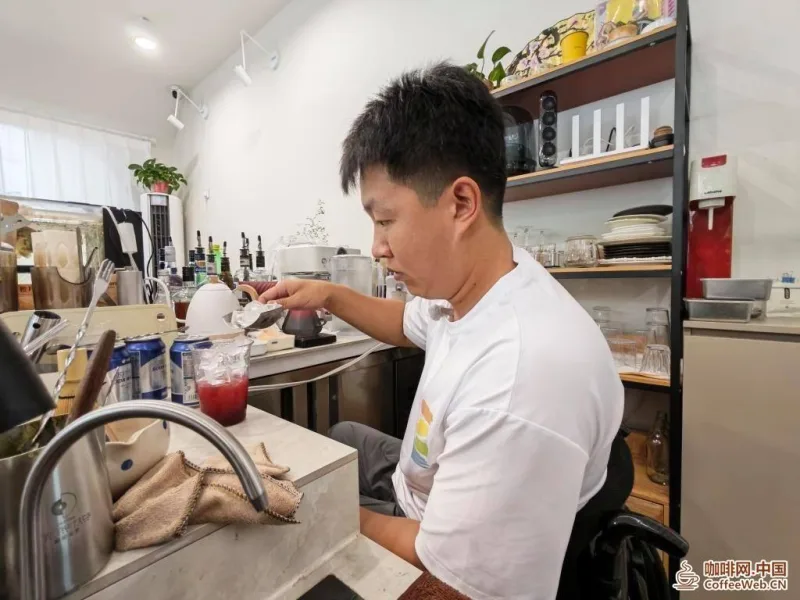
Zou Yang making a drink
The five-medal winner in a wheelchair
Speaking of the just-concluded provincial Para Games, excitement sparkles in Zou Yang’s eyes.
In the wheelchair-fencing events of the 12th Provincial Para Games and the 1st Special Olympics, Zou Yang won five gold medals at one stroke—two individual championships plus three team golds alongside his teammates.
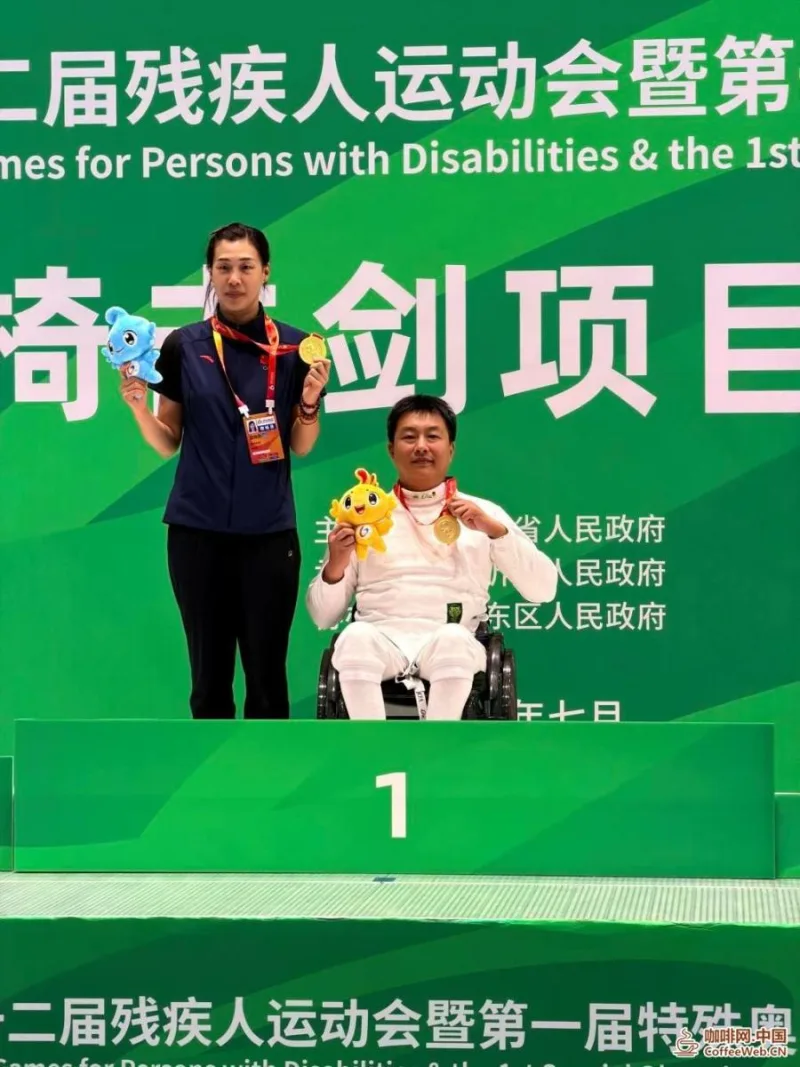
Zou Yang (right) wins gold in wheelchair fencing at the 12th Provincial Para Games
For him, the medals matter, but not only the medals. “Through the competition, I found again the feeling of athletic competition I had in my youth,” Zou Yang said. He was once a taekwondo athlete; though now it is fencing and wheelchair competition, the essence of sport is the same, as are the passion and spirit of competition.
Becoming a wheelchair fencer happened only last year. Staff from the federation for persons with disabilities approached him, valuing his past athletic foundation and physical condition, hoping he would compete as a disabled athlete in the Para Games.
Other available events included volleyball and hand-cycling, but he preferred fencing. “Wheelchair fencing mainly uses hand movements, training personal explosiveness, reaction and speed—somewhat similar to taekwondo,” Zou Yang said. “Wheelchair fencing only needs a wheelchair fixed in place to train, no running around, and it suits me better.”
After taking five golds at one stroke, that old feeling of athletic competition returned. On the field, he is still the athlete who refuses to lose. “The essence of sport hasn’t changed; only the rules and movements have.”
Even holding a cup of coffee steady is no small challenge
Zou Yang was once a taekwondo coach. In 2023, a car accident rewrote his life.
The accident caused spinal-cord injury; he lost sensation below the chest and has been in a wheelchair ever since. His taekwondo-coaching job was also forced to an end. Encouraged and accompanied by family, friends and many kind-hearted people, the naturally optimistic Zou Yang slowly walked out of the gloom brought by the accident.
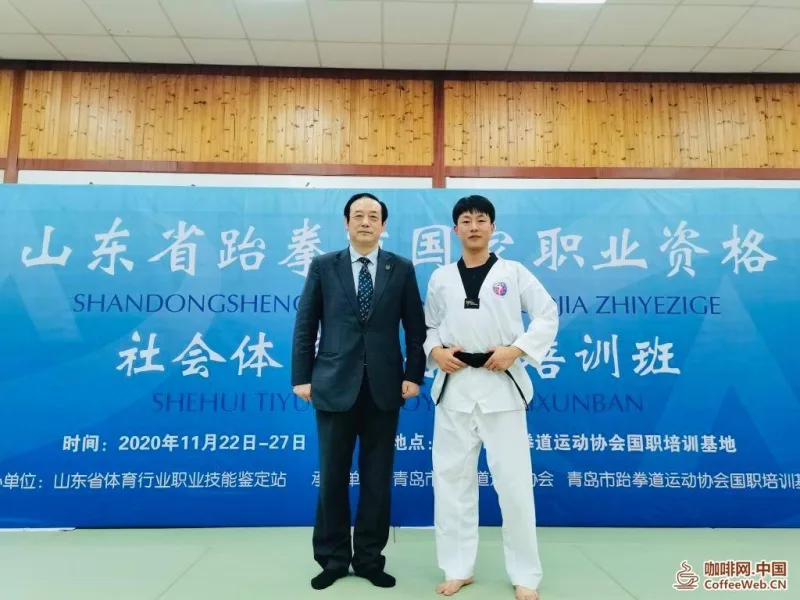
Zou Yang (right) was a taekwondo athlete before his injury
Three years have passed since the injury, and Zou Yang has adapted to his physical condition. “It feels like just changing the way I walk—except now I use a wheelchair to move my body.”
He made up his mind to go out, return to society, strive to realize his own value, complete the barrier-free modification of his vehicle, change to an adapted driver’s license, and achieve independent driving.
“There is still a long road ahead in life, and I had to do something; I thought of many kinds of jobs at the time.” But after the injury, the employment options available to him were very limited.
On December 3 last year, the International Day of Persons with Disabilities, the Qingdao Barrier-Free Environment Promotion Association organized people with disabilities to visit the Shibei Barista Craftsman Academy, built under the leadership of the Shibei District Federation of Trade Unions. At this event, Zou Yang met Cui Wei, a trainer at the academy. Cui’s superb skills and deep theory moved him. “Making coffee mainly relies on the hands, and places no excessive demands on the practitioner’s physical condition,” Zou Yang decided on the spot to sign up and learn coffee making.
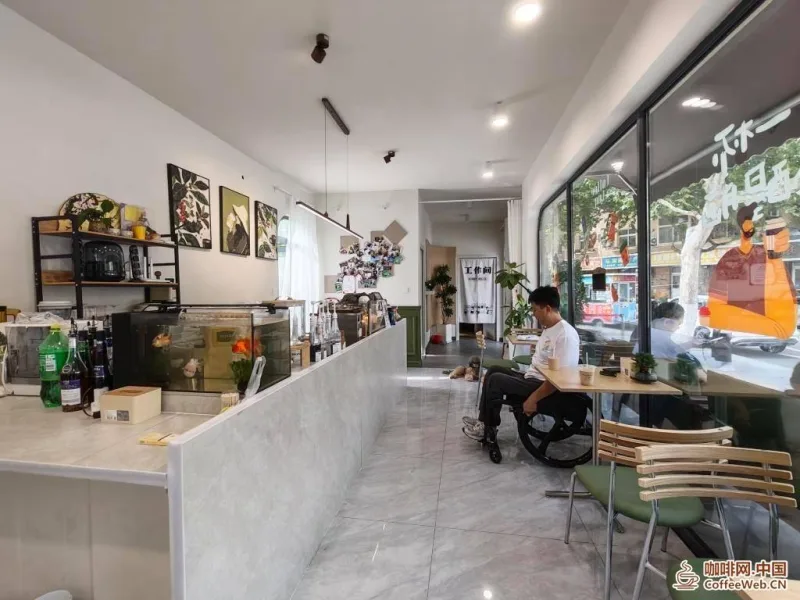
The cafe bar was lowered to a height suitable for Zou Yang operating the equipment from a wheelchair
But Zou Yang’s injury is high on the body; his waist cannot exert force, and his hands keep trembling when holding a cup. “My body is like a tumbler; I could only practice bit by bit and slowly overcome the difficulty.”
Just practicing coffee making, Zou Yang had to sweat far more than an able-bodied person, but he did not retreat.
A coffee shop “without any threshold”
A cup of coffee let Zou Yang find a new track.
Before the injury, Zou Yang had entrepreneurial experience—he had independently run a taekwondo gym. After returning to society post-injury, he conceived the idea of a second venture. Cui Wei also thought highly of him, providing three months of one-on-one specialized training, helping him obtain an intermediate barista certificate, and offering startup-incubation guidance.
After settling his entrepreneurial goal, Zou Yang looked for a location everywhere. Wang Detao, a coffee-equipment industry expert and “Shibei Craftsman,” proactively lent a hand, helping him find a suitable store next to a pocket park on Jiahe Road in the old town—about 60 square meters, with controllable rent, flat and open outdoor ground, and convenient wheelchair access.
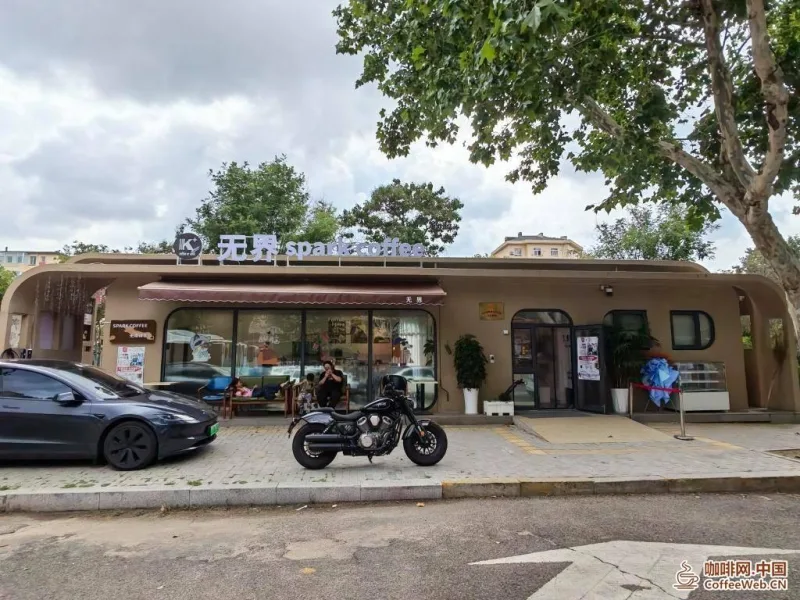
Zou Yang’s coffee shop
The interior decoration reflects barrier-free thinking in every detail: all counters are lowered to a height adapted for wheelchair users, making it easy to reach materials; the bar was deliberately dropped to 65 cm so the maker in the wheelchair can clearly see the coffee’s liquid surface; the in-store passageways are wide, with no obstruction to wheelchair turning or movement; customer tables use slim legs so wheelchairs can pull close—and a roughly 15 cm step at the shop front was transformed into a ramp.
“Without a ramp, most wheelchair users need someone to lift them over, and it’s hard to get up independently. A small step can shut us out the door,” Zou Yang said. “Creating a barrier-free environment sometimes only needs some clever ideas and minor modifications.”
On July 9 this year, “Boundless Coffee” officially opened. It is Shandong’s first barrier-free coffee shop.
When the opening news spread, “wheelchair friend groups” across the country responded enthusiastically. A woman in her forties from out of town, injured for over ten years and basically never leaving home, added Zou Yang as a friend through a WeChat group. “She said seeing me made her feel especially empowered, and asked whether she could also come out. I said, sis, you can first come sit in my shop.”
Zou Yang hopes that, through his own experience, he can inspire more friends with disabilities to find a fulcrum connecting them to society. “My coffee shop is not just a consumption space, but a place where friends with disabilities and people from all walks of life meet and gather. I hope more friends with disabilities will come often to sit.”
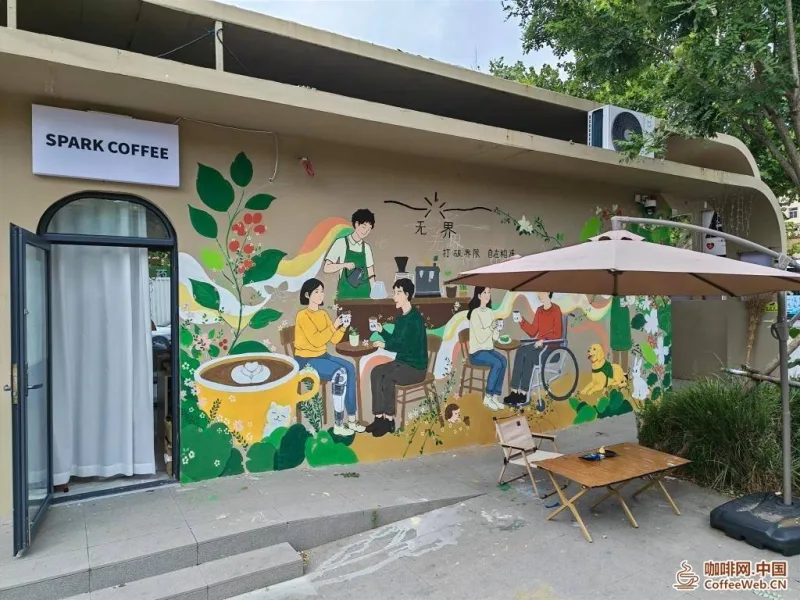
The cafe’s exterior wall depicts Zou Yang’s operating vision for the barrier-free themed coffee shop
After just over a month, the operating results exceeded Zou Yang’s expectations. “I found that this small shop can drive more disabled partners to return to society and do the things they love. That was my original wish in spreading barrier-free culture.”
“The beneficiaries of barrier-free facilities are not only the disabled; pregnant women, parents with children and the elderly also need them. I hope that with this coffee shop as a small window, more people will see that improving the barrier-free environment can benefit the whole of society,” Zou Yang said.
Many forces unite to lift up the dreams of disabled entrepreneurs
Zou Yang’s entrepreneurial path could not be separated from the help of the Shibei District Federation of Trade Unions and many caring individuals.
From site selection to formal launch, “Shibei Craftsman” Wang Detao followed the whole process—coordinating water and electricity renovation, decoration design and property-rights procedures, transforming an idle station into a coffee shop. The store rent and coffee-machine equipment were both provided at cost, and externally purchased equipment such as ovens was also helped to secure discounted prices.
“In the early stage of entrepreneurship, saving them a cent is a cent. Every sum of money must be spent where it counts,” Wang Detao said.
Wang Detao worked at the No.1 State Cotton Mill in his early years, accumulating solid mechanical-equipment maintenance skills. After changing careers he founded a coffee-machine manufacturing enterprise and the K+ Coffee brand, long providing internships and operational-experience sharing for entrepreneurs.
Last year, Wang Detao, as one of the core mentors, led the operation of the Shibei Barista Craftsman Academy. The academy was jointly built by the Shibei District Federation of Trade Unions together with the Qingdao Coffee Culture Association and the Qingdao Coffee Industry Trade Union Federation; it is a professional coffee-training base combining commercial operation with public-service. Its public-welfare segment provides skills training for three groups—unemployed youth, persons with disabilities and college students—with courses covering coffee-bean tasting, extraction-parameter tuning and equipment maintenance, spanning the entire cafe-operation chain.
Su Mengyao, deputy director of the Shibei District Worker Service Center, introduced that relying on the Barista Craftsman Academy, Shibei District has innovatively built a full-chain closed-loop incubation system of “training—employment—entrepreneurship.” For disadvantaged groups with entrepreneurial intentions, it conducts systematic skills training, with academy instructors teaching throughout, connecting entrepreneurial venues, coordinating various resources and following up with operating guidance until students smoothly open shops and operate stably.
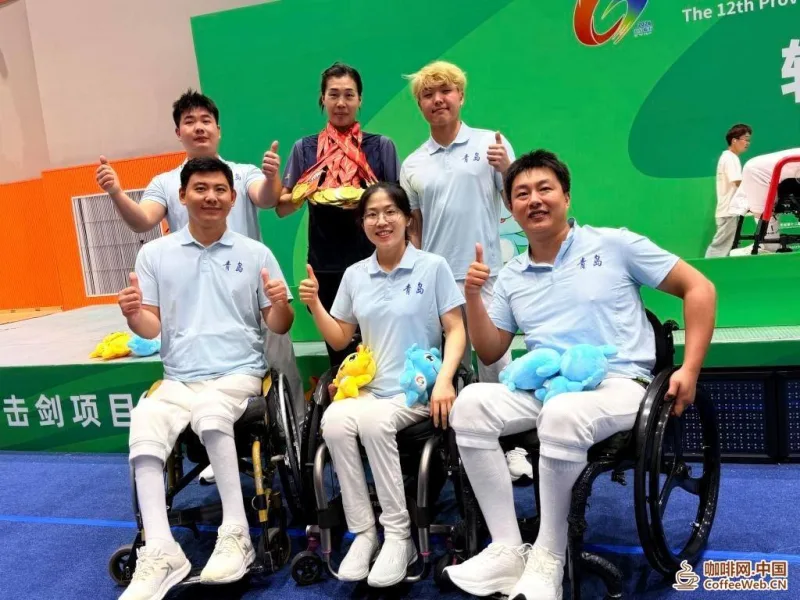
Zou Yang (front row, right) with his teammates and coach
Round after round of skills training helps persons with disabilities and those facing employment difficulty acquire a skill and lights the hope of entrepreneurship and employment.
Today, Zou Yang’s barrier-free coffee shop is officially operating. He keeps passing on the kindness he once received, hoping to drive more friends with disabilities to learn new skills and embrace a new life.
“I have always dreamed of owning a shop, creating a barrier-free cultural space that belongs both to the disabled and to society as a whole,” Zou Yang said. “Opening this barrier-free coffee shop is to drive more people to go out and return to society.”
This small coffee shop is both Zou Yang’s new starting point for restarting his life and a window for spreading the barrier-free ideal, carrying his warm and firm dream.
Source: Peninsula All-Media, reporter Zhang Changwei.
Reprint Note & Disclaimer
- This article is reprinted from Chinese media for information and cultural exchange. The views expressed are those of the original author and do not necessarily reflect the position of coffeeyo.com.
- All trademarks, brand names and logos mentioned belong to their respective owners.
- For cooperation, reprint or correction requests, please contact coffeeyo.com.
Reprint Notice & Disclaimer
- This article has been edited and compiled by China Coffee Network. The information and images therein come from public sources and the copyright belongs to the original author. This reprint is intended solely for information sharing within the coffee industry and does not represent the views of this website; all data and opinions are subject to the original article. Our thanks to the original author for creating and sharing it.
- For matters concerning content licensing, attribution, copyright or otherwise, please contact us promptly and we will verify and cooperate in handling them as soon as possible. We also welcome coffee origins, brands and industry media to exchange ideas and contribute articles.
- Contact China Coffee Network: Tel 400-0000-641 (+86-18288016826) | Email 405854472@qq.com | Address: Jinghong, Xishuangbanna, Yunnan Province / Tieling, Liaoning Province
Related Reading
 How ‘Sea-Flavored’ Coffee Blooms Across Dongtou
- Health Guide: How to Enjoy Your Coffee the Healthy Way
 Study: Regular Coffee and Tea May Lower Dementia Risk, but More Is Not Better
 Frontline Story: A ‘Mobile City Coffee Bar’ Arrives by the Grand Canal
 Yantai’s Wind Tastes of Coffee
 In Zhenyuan, a Cup of Coffee and a Waiting Train







 Liaoning ICP Security No. 21122402000217