


Brief (coffeeyo.com): In Ningbo, Shanghai’s Senyu Media backed a “Little Me” workshop that taught teens with intellectual disabilities real barista skills—ending its first coffee course with pride, and a cup poured for mom.
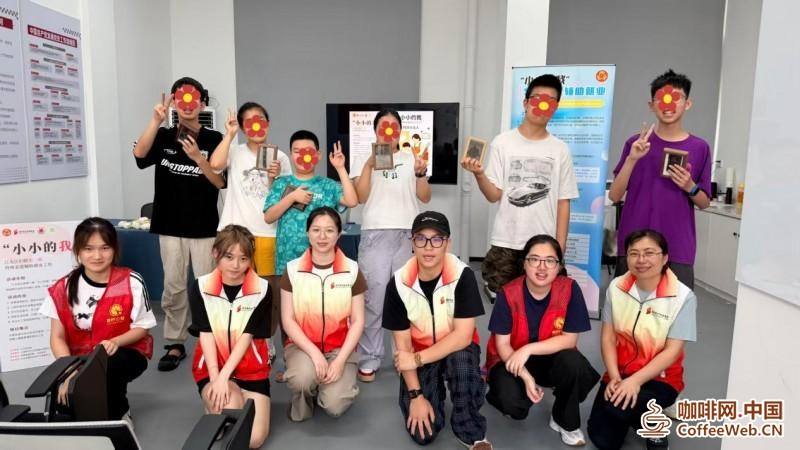
On the afternoon of Aug. 22, in a workshop in Beixin Community, Hongtang Subdistrict, Jiangbei District, Ningbo, the last round of milk foam was finished, leaving a few crooked but carefully poured “hearts” on the cup surface. This marked the conclusion of all first-term classes of the coffee vocational-skills track under the “Little Me” assisted-employment workshop 2.0—a comprehensive vocational-exploration support program for families with special needs, guided by the Jiangbei District Women’s Federation and supported by Shanghai Senyu Culture Media Co., Ltd. (hereinafter “Senyu Media”). From the July 18 start to the finale, over the course of more than a month, this Shanghai cultural enterprise used a full set of real coffee equipment and a classroom that allowed repeated mistakes to lay the first brick of vocational exploration for several families of adolescents with intellectual and developmental disabilities.
A gap, and a “version-upgraded” workshop
For many adolescents with intellectual and developmental disabilities, once compulsory education ends, the road ahead often narrows—few can continue on to further study, and even fewer have a daytime place to go or someone to guide them through tasks, leaving the heavy burden of care on their families year after year. Seeing precisely this gap, in 2025, under the guidance of the Jiangbei District Women’s Federation, the “Little Me” workshop 1.0 first landed in Beixin Community, using a dedicated space plus community inclusion to run 15 handicraft, experience, and integration activities for 10 local families.
By 2026, the workshop was upgraded to 2.0, with Senyu Media joining in. It clearly targeted the 14-to-18 age group, using more systematic, smaller, better-controlled classes to try to connect “learning in the classroom” with “using it in society”—and coffee became the first stop on this bridging path.
The three things Senyu Media added: equipment, people, and a constant companionship
Senyu Media’s investment this time targeted the three things most lacking in running a vocational class: equipment, teaching staff, and sustained companionship.
On equipment, the enterprise sent a full set of hands-on tools—coffee machines, grinders, and more—into the workshop, first filling the hard gap of “having nothing to work with.” On teaching, it invited a team of volunteer teachers from the China Democratic League (Minmeng) to help design the curriculum and assist in class, so the teaching pace follows the children’s cognitive levels. On companionship, enterprise volunteers show up every session, standing by the trainees to help them complete the chain of actions from grinding beans to latte art.
Interestingly, this is not Senyu Media’s first time doing public welfare through coffee. Before this, the enterprise joined forces with the Shanghai Cultural and Creative Industry Promotion Association and the “Fei Chang Nuan” (“Extra Warm”) Coffee Public-Welfare Special Fund of the Shanghai Soong Ching Ling Foundation to travel to Baoshan, Yunnan—a coffee-producing region—turning its attention to the children of local coffee farmers. From the mountain farms of Yunnan to the community workshop in Ningbo, from coffee farmers’ children to adolescents with intellectual disabilities, a single cup of coffee has linked two previously unrelated groups onto the same line of public welfare.
Three classes, completing a “from novice to skilled” closed loop
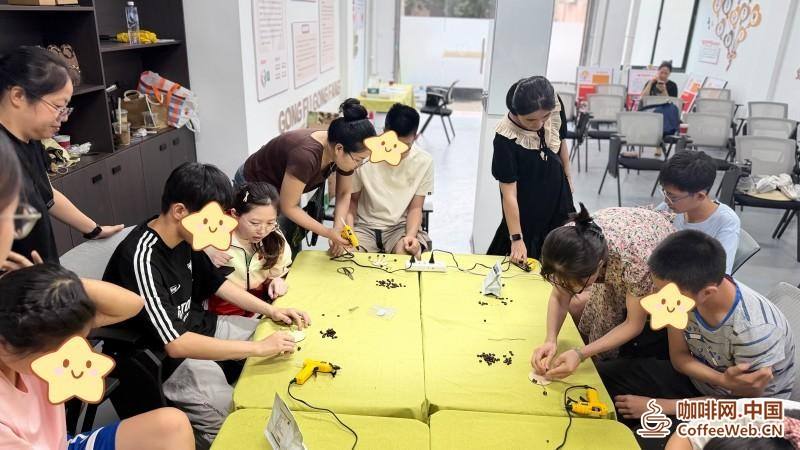
According to the project team’s course records, this term was divided into three sessions, completing a closed loop of skill awakening. The first time (July 18), the children touched pour-over for the first time: under the layered care of instructors, special-education teachers, parents, social workers, and volunteers, they ground beans, wetted the filter paper, poured water, and caught the extraction—walking through the whole process themselves. At the same time, in the “Skillful Hands Coffee House,” coffee beans were assembled into photo frames shaped like fish, moons, and vases. Where each child got stuck and who was nimble were all recorded in an “Observation Record Form” for later course adjustments.
The second time (Aug. 1), they got on the machines. Teacher Liu from Ningbo Minmeng broke grinding settings, start-up safety, and extraction temperature into step-by-step demonstrations, repeatedly stressing electricity and equipment safety. The children took turns at the machines, adjusting parameters, waiting for the liquid, and pouring their own milk to blend, each making a cup of latte. This session also added a “tidying up” component—after class, everyone cleaned the machines, put away tools, folded tablecloths, and sorted things into categories, conveying a clear message: when you come to the workshop, you are not just a guest being led around for fun, but also a little host here.
At the finale (Aug. 22), they played with coffee culture and handicrafts. The instructor broke down milk frothing: how to control milk temperature, tilt the cup 45 degrees, how to hold the steam wand, then demonstrated pouring a “heart.” It was their first attempt, hands unsteady, but the children watched intently and worked with focus; that sense of “I made this myself” was real. Then they made coasters—wooden bases, coffee beans, small beads, a hot-glue gun—sticking them together freely, turning ordinary beans into little works each with its own character.
The most touching scene happened after the technique
What moved people most across the whole term was not the technique, but what came after it. At the pour-over session, cups of coffee were made, and the children—who are usually the ones being cared for—took their own cups and walked toward their mothers. Those who had always been caught were, for the first time, handing a warmth back to the person closest to them. “We are not training baristas; we are giving them an environment where they can practice repeatedly without fear of making mistakes,” a project-team staff member said while flipping through the first term’s “Observation Record Form.”
“It used to be very hard to get him to do one continuous task, but this time he seriously made coffee from start to finish, and on the way out was already asking when he could come next.” Parents stood at the edge of the stage through all three sessions, watching their children do it themselves. Several said that normally it’s hard to get their child to finish one complete task in a row, yet in these hands-on sessions, focus and confidence grew visibly. The change isn’t written in a report; it’s visible, and the children themselves look forward to it.
Next stop: from the workshop’s counter to the city’s public spaces
Senyu Media said the enterprise will keep following up on the project’s next steps, continuing to figure out how it can step in and help with better integrating special-needs groups into society. A second-term course oriented toward “learning more deeply and being able to use it” is already in planning; following it, three outward integration activities are lined up—setting up a “public-welfare coffee corner” in enterprises, holding an “open day” back in the community, and opening a “public-welfare pop-up shop” in urban public spaces—letting the children put what they’ve learned to use in real scenarios, gradually widening their circle of contact.
For these “little me”s, every time they hold the kettle, every time they grind beans, every cup of coffee handed to a customer is a step toward the world. When practice moves from the workshop’s counter into enterprises, communities, and the city’s open spaces, the skill is no longer a single motion but a reason to connect with people and be embraced by society. What a cultural enterprise can do may not be much, but as this coffee course shows—linking these small accumulations into a long road toward independence and inclusion, so that every “little me,” at their own pace, is seen, needed, and well treated.
Source: coffeeyo.com (China Coffee Network).
Reprint Note & Disclaimer
- This article is reprinted from Chinese media for information and cultural exchange. The views expressed are those of the original author and do not necessarily reflect the position of coffeeyo.com.
- All trademarks, brand names and logos mentioned belong to their respective owners.
- For cooperation, reprint or correction requests, please contact coffeeyo.com.
Reprint Notice & Disclaimer
- This article has been edited and compiled by China Coffee Network. The information and images therein come from public sources and the copyright belongs to the original author. This reprint is intended solely for information sharing within the coffee industry and does not represent the views of this website; all data and opinions are subject to the original article. Our thanks to the original author for creating and sharing it.
- For matters concerning content licensing, attribution, copyright or otherwise, please contact us promptly and we will verify and cooperate in handling them as soon as possible. We also welcome coffee origins, brands and industry media to exchange ideas and contribute articles.
- Contact China Coffee Network: Tel 400-0000-641 (+86-18288016826) | Email 478203668@qq.com | Address: Jinghong, Xishuangbanna, Yunnan Province / Tieling, Liaoning Province
Related Reading
 Jiangxi Wuyuan: Rural Coffee Unlocks New Cultural Tourism Formats
 Jiangxi Wuyuan: Rural Cafes Unlock New Cultural Tourism Formats
 Global quality goods gather at Hongqiao Import Commodity Exhibition Center, setting "Chinese standards" for coffee
- Global premium products gather to set China's coffee standards as Hongqiao Import Commodity Exhibition Center keeps the CIIE spirit alive
- Global quality goods gather as Hongqiao Import Commodity Exhibition Center and CIIE forge lasting partnership to set China's coffee standards.
 Zhejiang "Science Cafe" Promotes Embodied Intelligence in Real-World Scenarios


 Liaoning ICP Security No. 21122402000217