
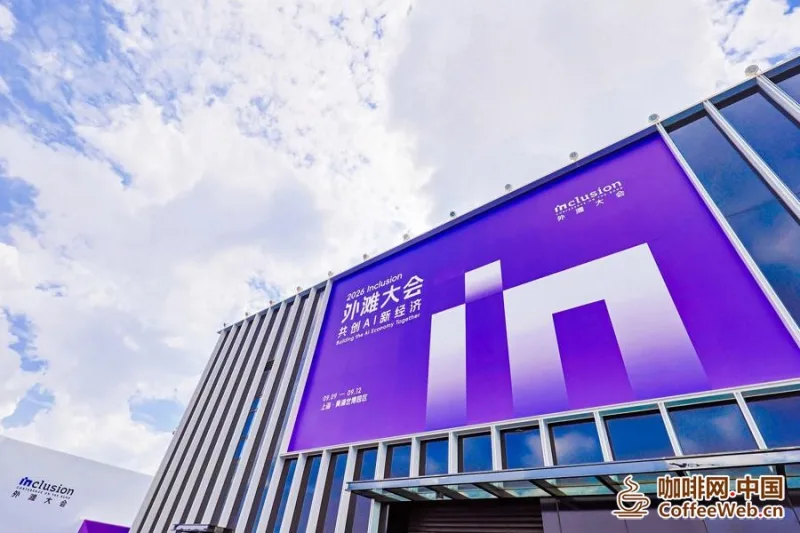
Brief (coffeeyo.com): Walk the 2026 Inclusion·Bund Summit and coffee is in every attendee’s hand. That cup has become a running symbol of shifting paradigms — from fintech for inclusion, to embodied intelligence going physical, to an AI economy turning technical variables into economic growth.
Walking the 2026 Inclusion·Bund Summit, you see coffee in the hands of attendees everywhere.
One rich cup of coffee runs through the whole lifecycle of the Bund Summit. The coffee is the same coffee, but the paradigm behind it keeps iterating. At the first Bund Summit in 2020, a cup of coffee stood for financial inclusion, giving distant coffee farmers a cross-border business; at last year’s summit, a cup of coffee was made by a humanoid robot, a stand-in for AI moving into the physical world; this year, a cup of coffee stands for the AI economy, with agents doing the work for people and AI becoming the foundational substrate of the ecosystem.
These paradigm shifts build on one another. Today, fintech is more tightly bound to economic and social development, becoming its foundation; embodied intelligence is booming, becoming a breakthrough front in frontier technology; and the AI economy is beginning to explore how artificial intelligence turns from a technical variable into economic increment.
Fintech: the inclusive starting point of a cup of coffee
Six years ago, at the first Bund Summit, a coffee shop suddenly appeared on the main forum, with speakers sitting around drinking coffee. That cup carried weight — the beans came from Rwanda. Rwandan small and medium enterprises, using a global trade platform, sent that coffee all the way to Shanghai. And once Rwandan farmers began selling coffee directly to the market, they earned 4 yuan more for every kilogram sold. That cup showed the power of fintech.
Over the past six years the fintech paradigm has kept evolving, and especially in this wave of AI, AI has become not only the substrate of finance but the bedrock of inclusive finance. During the summit, Zhang Jianhua, director of the Research Center for Financial Development and RegTech at Tsinghua University’s PBC School of Finance, shared a set of figures: China’s overall “AI + finance” market reached 1.8 trillion yuan in 2025, with half of listed banks publicly disclosing deployed large-model applications; he expects the market to top 3 trillion yuan this year, with a compound annual growth rate above 30% in the coming years.
AI agents in finance are also exploding. IDC’s July report, “China Financial Industry Large-Model Platform, Agent Application and Service Market Share,” shows China’s overall financial large-model, agent application and service market surpassed 2.4 billion yuan in 2025. Zhao Wenbiao, CEO of Ant Digital, revealed that in finance Ant Digital has launched over 300 agents, serving all state-owned and joint-stock banks, more than 60% of local commercial banks and hundreds of financial institutions.
The fintech paradigm shift took a new turn at this summit: once AI “grows” the ability to act, it will inevitably reach payments, accounts, goods and services. The old internet-commerce logic was “people find goods,” “people click buttons,” “people complete payment”; in the future, an entire commercial infrastructure may change — a person states a goal, the agent finds the plan, compares prices, calls the service and completes the transaction.
Embodied intelligence: the physical leap of a cup of coffee
Last year’s Bund Summit featured a robot town, and as embodied intelligence “blew up overnight,” humanoid robots made coffee for visitors.
That cup represented frontier technological capability. Over the past year embodied intelligence has stayed in the “spotlight,” and Shanghai is not only a national high ground for the industry but has explicitly set a goal of “pushing the core industry scale of embodied intelligence past 50 billion yuan by 2027.”
At this year’s Bund Summit, embodied intelligence remained the focus, with more than 40 manufacturers on show and robots placed into more and more concrete scenarios. Kepler Robotics moved into a coffee shop, independently completing cup fetching, drink making and cleaning; Fudan University’s Moushen Intelligence brought a wheeled dual-arm robot that can recognize a washing-machine bolt structure and assembly holes and autonomously complete the whole process of grasping, positioning, plugging and tightening; Chang Lin, co-founder and CEO of Leju Robotics, believes robots have already started “really working” in production, from parts loading and unloading to carton de-palletizing, partly easing real problems like hiring difficulty and high staff turnover.
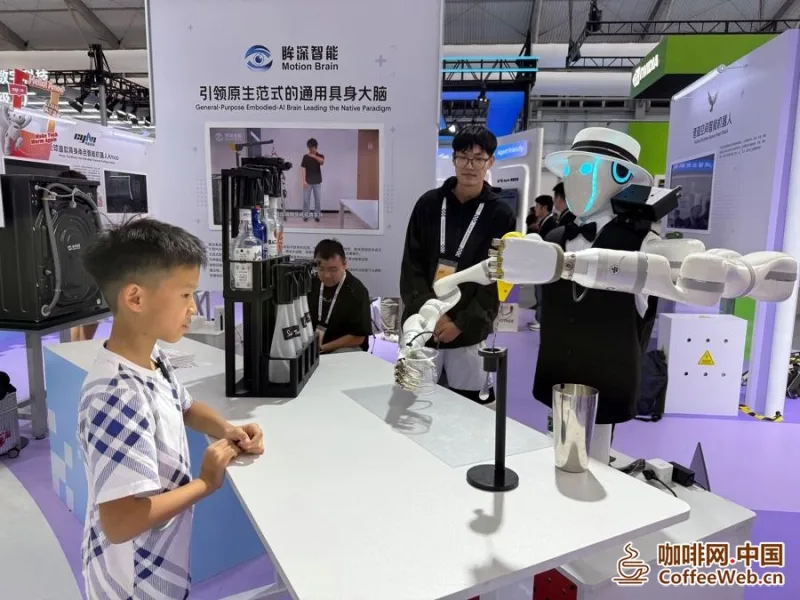
The embodied-intelligence industry is also probing a new question: the robot making coffee today — can it work in a pharmacy tomorrow? That points to the robot’s “general-purpose brain.” For a long time the industry has faced the challenge of “one machine, one task”: to complete a workshop handling task you had to write a control program, and switching scenarios meant rewriting the algorithm from scratch at huge cost. What kind of general-purpose brain does a robot actually need? In Shen Yujun, chief scientist at Ant Lingbo’s view, its basic abilities boil down to three things: extracting effective representations from raw signals, fusing and aligning different modalities such as vision and touch, and then generating actions that can truly be executed.
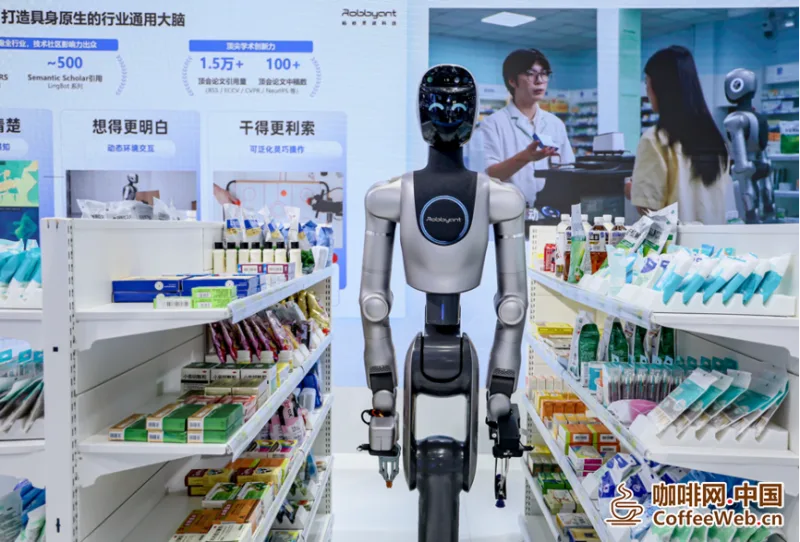
Ant Lingbo is now trying to mount the same general-purpose brain on robots of different forms, sending them respectively into pharmacy, logistics and industrial scenarios. Reportedly, its self-developed LingBot-VLA 2.0 has, in pre-training, already adapted to 17 mainstream robot brands and 20 robot configurations, covering single-arm, dual-arm, biped and wheeled robots. If the “general-purpose brain” path holds, robots could move from “one machine, one task” to “one brain, many machines,” truly walking from the booth into industry.
The AI economy: the incremental imagination of a cup of coffee
At this year’s Bund Summit, a cup of coffee stands for the AI economy.
All over the summit, “coffee shops” opened; whether the Starbucks on the plaza or the BeCoCo coffee experience zone inside the tech exhibition run by Meiyijia, you could order through an agent. The reporter tried it: say “I’m at the Bund Summit, please order me a Starbucks,” and the assistant A’bao automatically locates the nearest store; once the store is confirmed, the coffee types and prices pop up directly, the whole process without switching pages or hunting for coupons and filling in addresses. The reporter also tried a “coffee alarm”: say “every day at 10 a.m., buy me a Starbucks latte” and it starts running the task on its own, right up to the final step of waiting for you to confirm payment.
“The trend of the AI economy is unstoppable,” OPPO senior vice president and chief product officer Liu Zuohu told the reporter. OPPO’s assistant Breeno (Xiao Bu) has driven related consumption to nearly double within a few months; though the base is still small, users have begun to get used to letting an agent shop for them. “In the future the agent will move further from reactive service to proactive intelligence.”
“The ChatGPT moment for agent commerce has arrived, and it will erupt over the next 6 to 12 months,” judged Han Xinyi, CEO of Ant Group. It is changing not only the consumer-side paradigm but also opening up more possibilities on the innovation and production sides.
At the AI Coding hackathon, nine-year-old Luo An’ge, who doesn’t know how to program, used only natural language with AI to turn a summer-camp experience learning ancient ceramic craft in the mountains of Jiangxi into an online-running “Clay Lab,” winning first prize. This year the hackathon set a Guinness World Record, drawing over ten thousand participants and producing tens of thousands of AI application works.
“AI is lowering the cost of acquiring professional skills, widening the pool of market participants, and cutting the cost of innovation trial-and-error,” noted Zhao Bo, associate professor at Peking University’s National School of Development, from the perspective of growth mechanics. A key point of the AI economy is turning things that were once too expensive, too hard, or impossible to scale into things that can be done, bought and traded — shifting from “efficiency” to “increment.”
Still, Liu Yuanchun, president of the Shanghai University of Finance and Economics, also said: “The new form of the AI economy is established, but AI economics has not really begun.” In his view, AI has already begun to change the economy, but how large its effect will be, when it appears and through what path still depends on whether today’s compute, models and infrastructure can settle into real productive capacity.
That sets up next year’s Bund Summit. Perhaps next year’s cup of coffee will taste a little different.
Reprint Note & Disclaimer
- This article is reprinted from Chinese media for information and cultural exchange. The views expressed are those of the original author and do not necessarily reflect the position of coffeeyo.com.
- All trademarks, brand names and logos mentioned belong to their respective owners.
- For cooperation, reprint or correction requests, please contact coffeeyo.com.
Reprint Notice & Disclaimer
- This article has been edited and compiled by China Coffee Network. The information and images therein come from public sources and the copyright belongs to the original author. This reprint is intended solely for information sharing within the coffee industry and does not represent the views of this website; all data and opinions are subject to the original article. Our thanks to the original author for creating and sharing it.
- For matters concerning content licensing, attribution, copyright or otherwise, please contact us promptly and we will verify and cooperate in handling them as soon as possible. We also welcome coffee origins, brands and industry media to exchange ideas and contribute articles.
- Contact China Coffee Network: Tel 400-0000-641 (+86-18288016826) | Email 405854472@qq.com
Related Reading
 A ‘Travel Pack’ Reveals Another Possibility for Pu’er Baristas
 Cangyuan: Yanshuai Town Delivers ‘Tech Nourishment’ to Coffee Fields
- 9.9-Yuan Coffee but a 50,000-Yuan Bike: Jiang Nanchun Fears Not Price but Lack of Soul
- After Just 19 Months in Coffee, He Was Called to Save Heineken
 Guangzhou Haizhu Uses Coffee to Engage Delivery Riders in Party Education
- Laishan Police Safeguard the Coffee Festival with Dedicated Patrols



 Liaoning ICP Security No. 21122402000217