
Brief (coffeeyo.com): Goji-berry lattes to nourish the liver, tangerine-peel (chenpi) americanos for the spleen, kudzu (gegen) coffee said to protect the liver, and five-finger-peach (wuzhimaotao) coffee to drain dampness — new-style “medicinal-food” wellness coffees are everywhere on social media. But is the herb-and-coffee combo truly the worry-free remedy it is marketed as?

Goji-berry lattes to nourish the liver and kidneys, tangerine-peel (chenpi) americanos to bolster the spleen and stomach, kudzu (gegen) coffee said to protect the liver, and five-finger-peach (wuzhimaotao) coffee to drain dampness…
Lately, new-style wellness coffees that blend “medicinal food homology” ingredients with coffee have won a devoted following on social media. Plenty of office workers hope a healthful drink can help correct their subhealthy routines.
Herbs meet coffee
Is it really a reliable, worry-free form of food therapy?
▼▼▼
01
New-style wellness coffee sells hundreds of cups a day
The 2026 China Urban Coffee Development Report shows that “post-80s” and “post-90s” consumers form the core of the coffee market, with women in particular dominating — accounting for 65.45% of spending, far ahead of men.
A reporter from Today’s Women’s News / Feng Media searched platforms such as Xiaohongshu and Douyin and found that herbal-coffee content had racked up tens of millions of views, with recommendations and reviews multiplying by the day. Offline, a number of chain brands and small guofeng (national-style) cafés have launched herbal specialty lines; products promising to “drain dampness,” “replenish qi,” or “protect the liver” have become bestsellers, and some shops report selling over a hundred wellness coffees a day.

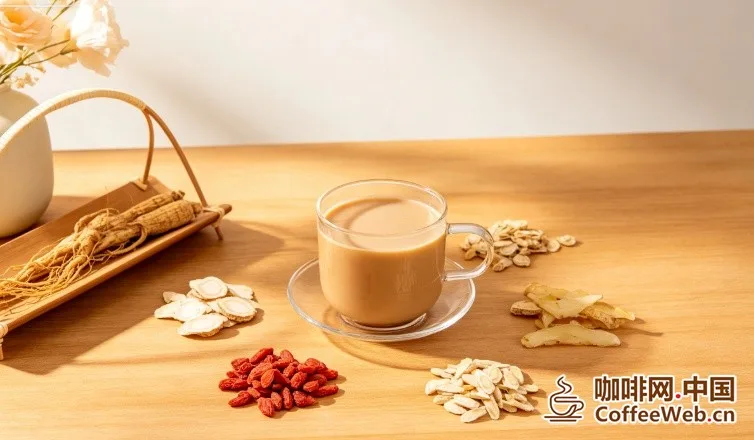
AI-generated image
Xiao Huang, 28, is a herbal-coffee enthusiast. Long hours, irregular meals and a sedentary lifestyle had left her constantly drained. Swayed by “planting grass” (recommendation) posts, she tried several herbal coffees and now drinks three or four a week. “After late nights I’ll have one with ginseng to replenish qi; when I’m under the AC I’ll have five-finger-peach to drain dampness — I get my coffee and my tune-up at the same time. Best of both worlds!”
“Pairing herbs with coffee isn’t a baseless internet fad — the two do have a genuine, complementary wellness effect,” says Xu Fan, an attending physician at the Preventive Treatment Center of the Second Affiliated Hospital of Hunan University of Chinese Medicine. Coffee is exceptionally good at moving qi (vital energy); paired with herbs it acts rather like a “guide herb” in traditional Chinese medicine, helping the ingredients exert their effects.
She explains: combined with spleen-strengthening, dampness-draining ingredients such as five-finger-peach and poria (fuling), coffee’s qi-moving power amplifies the de-dampening effect and eases bloating and internal dampness; paired with yin-nourishing, moisture-building ingredients such as Solomon’s-seal rhizome (yuzhu) and goji, coffee’s warm, drying nature offsets the coolness of those herbs, protecting the stomach and spleen.
With qi-tonifying herbs such as ginseng and astragalus (huangqi), coffee’s upward, generative force helps qi rise and quickly relieves the fatigue and foggy headedness that follow late nights; with kudzu, it unblocks qi flow and lends an auxiliary liver-protecting synergy.
02
Herbal coffee is not for everyone
Worth stressing: although herbal coffee has its wellness logic, it is by no means suitable for everyone, or for drinking at any time.
Some netizens reported dryness, mouth ulcers and insomnia after a stretch of drinking; others said it upset their stomach and even triggered irritability and hormonal imbalance.
“People with a yin-deficiency, fire-prone constitution should not drink wellness coffee. And never on an empty stomach — the best time is before 2 p.m.,” Xu Fan cautions. Yin-nourishing styles such as yuzhu coffee will worsen cold-deficiency symptoms in those with a weak spleen, loose stools or cold limbs, so they must be avoided.
“Chinese medicine is about tailoring treatment to the individual constitution, and the right style varies enormously,” Xu Fan explains. Cold-deficiency types suit warming, tonifying coffees such as goji and ginseng, and should avoid cooling styles like yuzhu and dwarf lilyturf (maidong); damp-heat types suit kudzu coffee and should skip warming ingredients like ginseng and goji to keep damp-heat from worsening; yin-deficiency types may drink a little yuzhu, but only sparingly.
AI-generated image
Moreover, people with cardiovascular disease, intractable insomnia, neurasthenia, gastroesophageal reflux or chronic gastritis are advised against any coffee at all.
“Women are the main coffee consumers, yet those who are menstruating, postpartum or in menopause are among those who should not drink wellness coffee,” Xu Fan explains. During menstruation it can increase flow, lengthen the period and cause insomnia and irritability; for postpartum women, already depleted of qi and blood with a weak spleen, coffee worsens dizziness and night sweats and may reduce milk supply; menopausal women, mostly liver-kidney yin-deficient, find coffee aggravates hot flashes, irritability and insomnia, upsetting hormonal balance.
Asked about the common young-person belief that herbal coffee can undo the damage of late nights and sitting all day, Xu Fan is blunt: this treats the symptom, not the cause.
Drinking it short-term may perk you up and ease fatigue, but relying on it long term only deepens the depletion and never heals the root. “Wellness coffee is just a flavored functional drink — never mistake it for medicine that treats chronic illness,” Xu Fan advises. Regular sleep, early nights, and taking care of the spleen, stomach, qi and blood are the real foundation of health.
Share this and remind others.
By Wu Wenqian, reporter for Today’s Women’s News / Feng Media. Images: AI-generated.
Reprint Note & Disclaimer
- This article is reprinted from Chinese media for information and cultural exchange. The views expressed are those of the original author and do not necessarily reflect the position of coffeeyo.com.
- All trademarks, brand names and logos mentioned belong to their respective owners.
- For cooperation, reprint or correction requests, please contact coffeeyo.com.
Reprint Notice & Disclaimer
- This article has been edited and compiled by China Coffee Network. The information and images therein come from public sources and the copyright belongs to the original author. This reprint is intended solely for information sharing within the coffee industry and does not represent the views of this website; all data and opinions are subject to the original article. Our thanks to the original author for creating and sharing it.
- For matters concerning content licensing, attribution, copyright or otherwise, please contact us promptly and we will verify and cooperate in handling them as soon as possible. We also welcome coffee origins, brands and industry media to exchange ideas and contribute articles.
- Contact China Coffee Network: Tel 400-0000-641 (+86-18288016826) | Email 405854472@qq.com
Related Reading
 How ‘Sea-Flavored’ Coffee Blooms Across Dongtou
- Health Guide: How to Enjoy Your Coffee the Healthy Way
 Study: Regular Coffee and Tea May Lower Dementia Risk, but More Is Not Better
 Frontline Story: A ‘Mobile City Coffee Bar’ Arrives by the Grand Canal
 Yantai’s Wind Tastes of Coffee
 In Zhenyuan, a Cup of Coffee and a Waiting Train







 Liaoning ICP Security No. 21122402000217