
Brief (coffeeyo.com): Soon you may be able to brew fresh coffee right inside your car. After Lei Jun’s Xiaomi teamed up with Peet’s Coffee on a “Free Coffee House,” rivals from Roewe to Huawei are racing to put coffee into the cabin. When carmakers start making coffee, how big an incremental market can it open?
You may soon be able to make freshly ground coffee right inside your car.
Recently, news that Xiaomi’s Pengcheng model and Peet’s Coffee are co-creating a “Free Coffee House” (Zizai Coffee House) drew wide attention.
Beyond Xiaomi, SAIC Roewe joined Luckin to make “fresh iced coffee in the car” via an ultra-fast fridge; Huawei’s Zunjie V800 debuted an integrated “private beverage bar” that extracts coffee with one tap; and NIO Café went live on delivery platforms.
When the captains of the auto industry start making coffee, how much incremental growth can it bring?
1. Carmakers Are Moving Coffee From the Store Into the Cabin
On September 7, Lei Jun posted a poster on Weibo with the caption: “Xiaomi Pengcheng and Peet’s Coffee are co-creating a Free Coffee House — under construction.”
In the poster, Xiaomi’s new “Pengcheng” model and the Peet’s coffee house echo each other under warm yellow lighting, but the exact location, format, and opening date have not yet been announced.
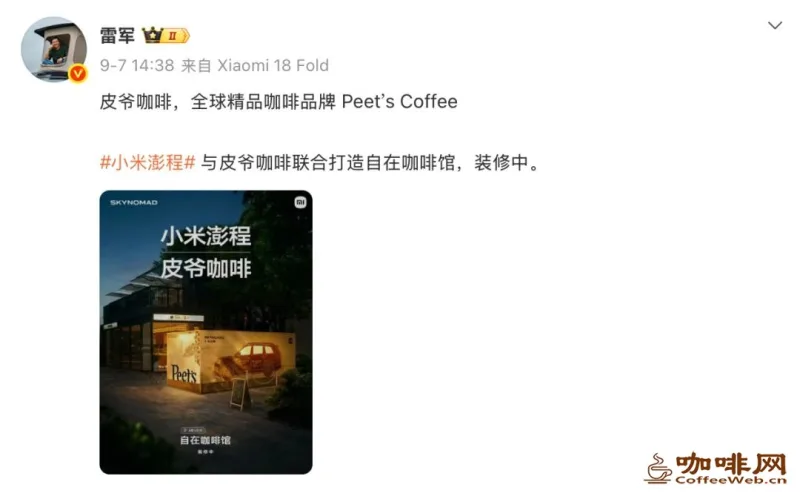
After the news broke, it sparked extensive discussion among “Mi fans.” Some urged “when can we taste it,” others asked “will all models be supported.” Many praised the collaboration as “spot on,” while some questioned whether it was “all form and no substance.”
In fact, as early as 2022, Xiaomi partnered with Peet’s to open an “Image Story Coffee House” by West Lake. This July, Lei Jun showed off a Xiaomi Science Park custom coffee printed with the “Pengcheng” logo; at the September 13 Pengcheng delivery event in Shanghai, the gift for owners was also a Peet’s custom gift box.
Xiaomi is not alone. Other automakers and coffee brands have been collaborating intensely lately, with playbooks already clearly diverging.
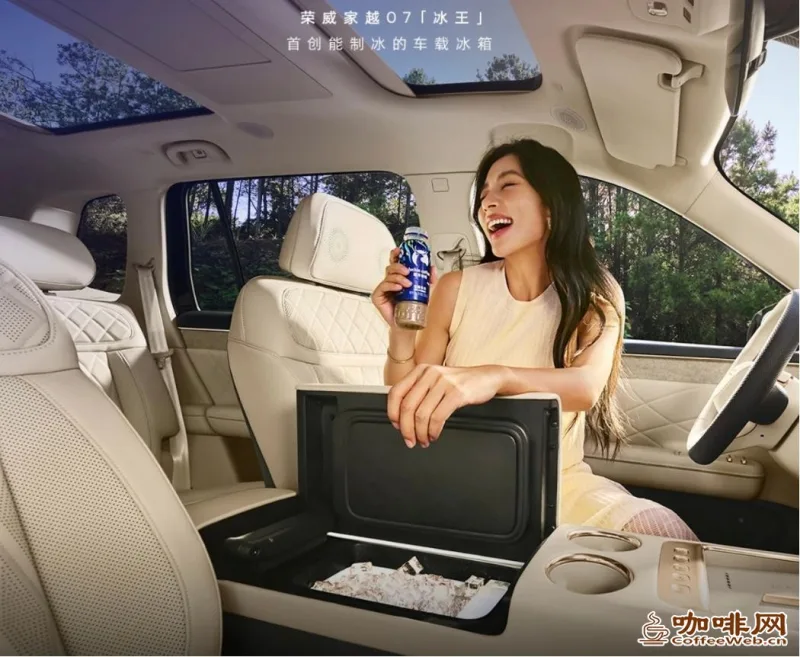
Some take the light route. SAIC Roewe’s Jiaoyue 07 model has a built-in AI ultra-fast cooling and heating fridge, paired with Luckin’s ready-to-drink bottled coffee, enabling “fresh iced coffee in the car” in 10 minutes. The fridge is the core; the coffee brand supplies the product, not the equipment.
Some go heavier. Huawei’s Harmony Intelligent Mobility Alliance Zunjie V800 builds the coffee equipment directly into the vehicle hardware. An integrated “private beverage bar” is mounted in the central island of the second row, supporting Americano and espresso extraction, with water temperature adjustable between 40°C and 95°C, and able to make up to 3 drinks consecutively.
This is not “putting coffee in the car,” but turning the car itself into a coffee-making space.
Xiaomi and Peet’s, meanwhile, pioneered a third path — “co-building space.” Peet’s embeds itself into Xiaomi’s user-operations system. The coffee brand no longer reaches consumers only through its own stores, but borrows someone else’s scenes, someone else’s users, and someone else’s traffic pool.
Stringing these cases together reveals a common trend: beverage brands are shifting from “opening their own stores” to “embedding into others’ scenarios.”
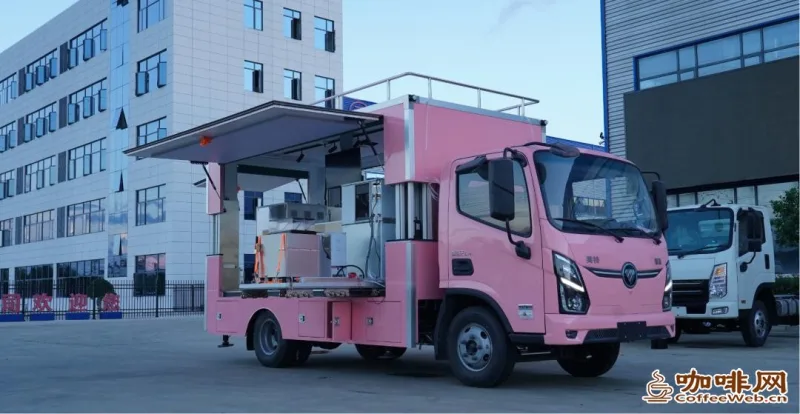
Wu Wendi, founder of Fengtu Lab and the Coffee RV, told me: “The third space is certainly the future’s wind vane. For coffee lovers, the cafe is the third space; and now the car has become many people’s third space in life, especially RVs and motorhomes. When the new third space forms, coffee lovers will surely place coffee and coffee machines within it.”
2. In-Car Coffee — A New Incremental Market?
Peet’s is the first specialty coffee brand to do “physical space co-building” with an automaker. After Peet’s, will more brands follow?
Equipment makers have already moved — the real threshold is water, power, and compliance.
In fact, making coffee in the car is something equipment makers have quietly done for years. Xifei Technology co-developed in-vehicle coffee equipment with Li Auto, reimagining the product as a thermos form factor, and won the product-innovation gold award at the Shanghai CIIE with its “mobile coffee house” concept.
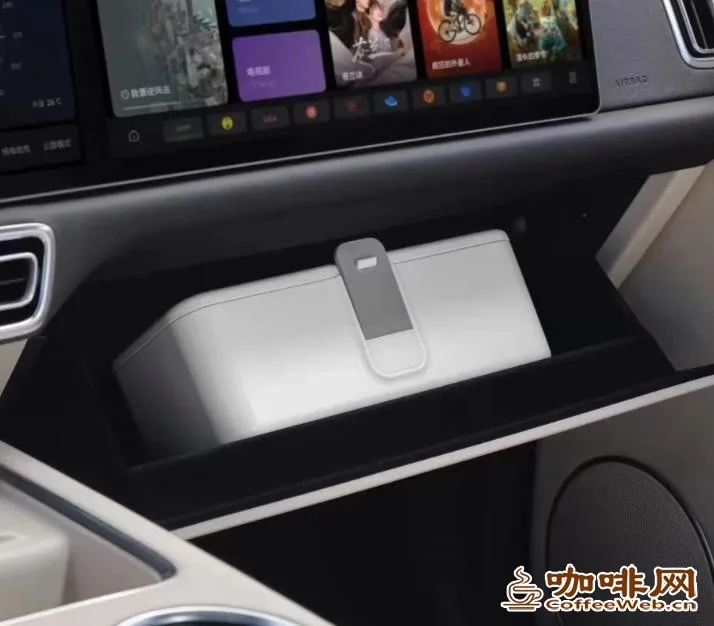
But truly putting coffee into the car is not as simple as imagined.
Wu Wendi said: “The biggest challenges for home and in-vehicle coffee are water and electricity — not hard to solve, and mature solutions already exist on the market. But for commercial use, it further brings a series of issues: power rating, battery capacity, ice-making volume, wastewater, and qualification compliance.”
Automakers’ procurement logic differs — a new B2B channel is opening.
Under Peet’s collaboration post on Xiaohongshu, the most-liked comment came from a mobile-coffee-house entrepreneur: “I want to convert an N70 into a mobile little coffee house; I’m working on the plan.”
For upstream tea-and-coffee equipment suppliers, the entry of more leading automakers means a new B2B channel is opening.
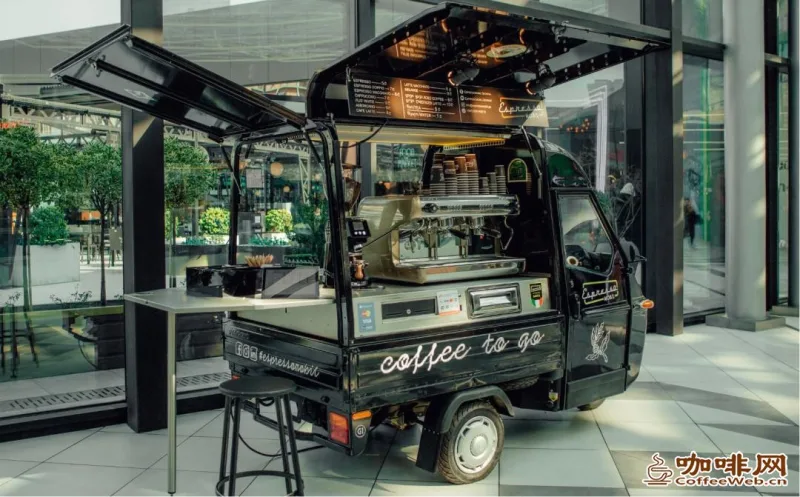
Automakers’ procurement logic is completely different from that of beverage stores: a single beverage store buys small volumes and values cost-performance and ease of operation; automakers buy in bulk, value automotive-grade certification and safety, and once in the supply chain, orders are stable and large.
“Coffee was born of passion and developed through commerce. Whether seasoned coffee operators or chain brands, all are rapidly embracing the in-vehicle coffee trend. Faced with change, coffee people’s attitude has always been positive,” Wu Wendi said.
After coffee, what will be the next thing loaded into the car?
Wu Wendi’s judgment is baking and light meals: “The car is just a venue. The products easiest to combine with traditional coffee stores — bagels, sandwiches, pizza, ciabatta, and ice cream — will naturally blend into in-vehicle coffee as well. Consumption habits run in one continuous line.”
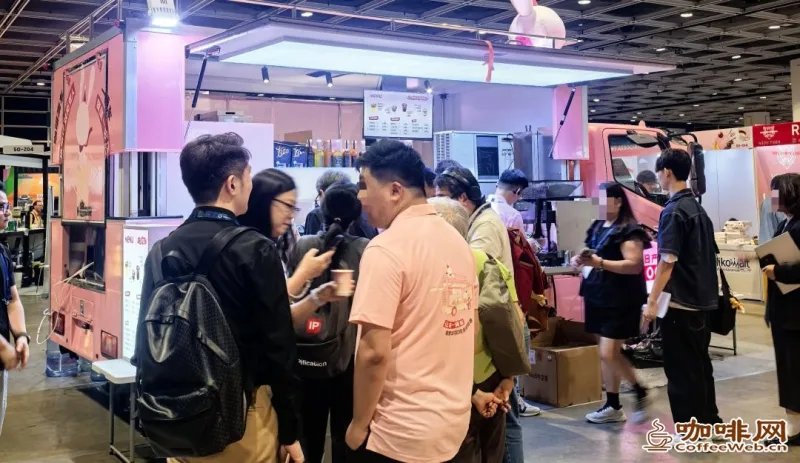
From store to cabin, the consumption scenario of coffee is being redefined.
For the coffee industry, this is not just one more place to sell coffee, but one more possibility for letting consumers “drink coffee anytime, anywhere.”
3. From “Opening Stores” to “Embedding”: Coffee’s Next Growth Path
Pull back the lens and you’ll see that coffee brands “embedding into others’ scenarios” has long been proven across multiple channels.
1. Convenience stores: the store-within-a-store model is validated.
Nowwa Coffee has partnered with over 100 convenience-store brands, covering more than 300 cities nationwide. Its collaboration with Meiyijia alone broke 100 million yuan in revenue, with overall partnered-store revenue growth holding between 20% and 50%.
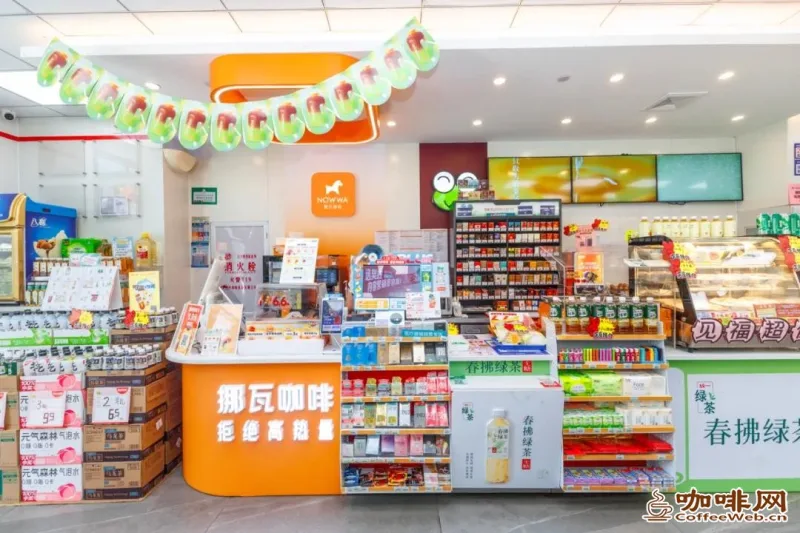
Cotti Coffee, meanwhile, launched three store formats — “coffee shop + convenience store + store-within-a-store” — embedding the convenience format into affiliated chain businesses to further intercept consumers.
2. Subway stations: the commute scenario becomes a new battlefield.
Recently Luckin signed with Xiamen Metro to enter 14 stations, following earlier deals with Tianjin Rail Transit and Suzhou Metro. Mixue has opened stores in bus stops, high-speed rail, and airports, holding first place among affordable tea-and-coffee brands in transport-hub store count. Manner, Tims, and others are also accelerating subway-site deployment.
3. Mobile coffee vehicles: chainization is accelerating.
Starbucks China’s “a thousand stores, a thousand faces” strategy explicitly includes the mobile coffee-vehicle form — from coffee carts at concerts to modular office-building convenience stores — fitting commute, cultural-tourism, and community scenarios.
Liu Wenjuan, CEO of Starbucks China, said future store expansion will thoroughly break the limits of the traditional “big store” model, showing a diversified and flexible layout.
Chen Hao, retail general manager of Peet’s Coffee, explicitly stated at the FBIF 2026 forum that the brand is exploring “stores with more scenario attributes.”
From convenience stores to subway stations to mobile coffee vehicles, coffee brands are shifting from “waiting for people to come” to “going to find people.”
The in-cabin scenario explored by Xiaomi and Peet’s is essentially a further extension of this path — letting coffee appear wherever consumers already linger.
This article comes from the WeChat public account “Kamen” (ID: KamenClub), author: Qianya, published by 36Kr with authorization.
Reprint Note & Disclaimer
- This article is compiled and edited by coffeeyo.com. The materials and images herein are sourced from public channels and the copyright belongs to the original authors. This site reprints them solely for information sharing within the coffee industry and does not represent our stance; all data and views are subject to the original source. We thank the original authors for their work and sharing.
- For matters concerning content authorization, attribution, copyright, or any other issues, please contact us promptly. We will verify and cooperate in handling them without delay. We also welcome coffee-growing regions, brands, and industry media to exchange and contribute articles with us.
- Contact coffeeyo.com — Tel: 400-0000-641 (+86-18288016826) | Email: 405854472@qq.com | Address: Jinghong City, Xishuangbanna, Yunnan / Tieling City, Liaoning
Reprint Notice & Disclaimer
- This article has been edited and compiled by China Coffee Network. The information and images therein come from public sources and the copyright belongs to the original author. This reprint is intended solely for information sharing within the coffee industry and does not represent the views of this website; all data and opinions are subject to the original article. Our thanks to the original author for creating and sharing it.
- For matters concerning content licensing, attribution, copyright or otherwise, please contact us promptly and we will verify and cooperate in handling them as soon as possible. We also welcome coffee origins, brands and industry media to exchange ideas and contribute articles.
- Contact China Coffee Network: Tel 400-0000-641 (+86-18288016826) | Email 405854472@qq.com | Address: Jinghong, Xishuangbanna, Yunnan Province / Tieling, Liaoning Province
Related Reading
 How ‘Sea-Flavored’ Coffee Blooms Across Dongtou
- Health Guide: How to Enjoy Your Coffee the Healthy Way
 Study: Regular Coffee and Tea May Lower Dementia Risk, but More Is Not Better
 Frontline Story: A ‘Mobile City Coffee Bar’ Arrives by the Grand Canal
 Yantai’s Wind Tastes of Coffee
 In Zhenyuan, a Cup of Coffee and a Waiting Train






 Liaoning ICP Security No. 21122402000217