
At a Glance (China Coffee Network): Source: Gelonghui APP Article author | Yuanhe Data support | Gougu Big Data (www.gogudata.com) The Luckin that nearly died is back. Recently, Mubadala Investment Company, the Abu …
Source: Gelonghui APP
Article author | Yuanhe
Data support | Gougu Big Data (www.gogudata.com)
The Luckin that nearly died is back.
Recently, Mubadala Investment Company, the Abu Dhabi sovereign wealth fund, announced that, together with Centurium Capital, Luckin’s controlling shareholder, it has completed a strategic minority investment of about $1 billion in Luckin Coffee.
Mubadala, which manages about $385 billion in assets, had previously invested in SHEIN in China and bought the core business of UCB Pharmaceuticals; now it has placed its chips on coffee.
It is still that same “fraudster” Luckin—once shorted by Muddy Waters, self-exposing 2.2 billion yuan in financial fabrication, and ingloriously delisted from Nasdaq.
Six years ago, Luckin was still being condemned by the entire capital market.
Today, it commands 36,000 stores, monthly transacting customers have surpassed 113 million, annual revenue nears 50 billion yuan, and even Middle Eastern sovereign funds have come running to hand over money.
Its share price climbed from a pink-sheet-market low of $1.54 all the way back above $30, a gain of more than 20-fold.
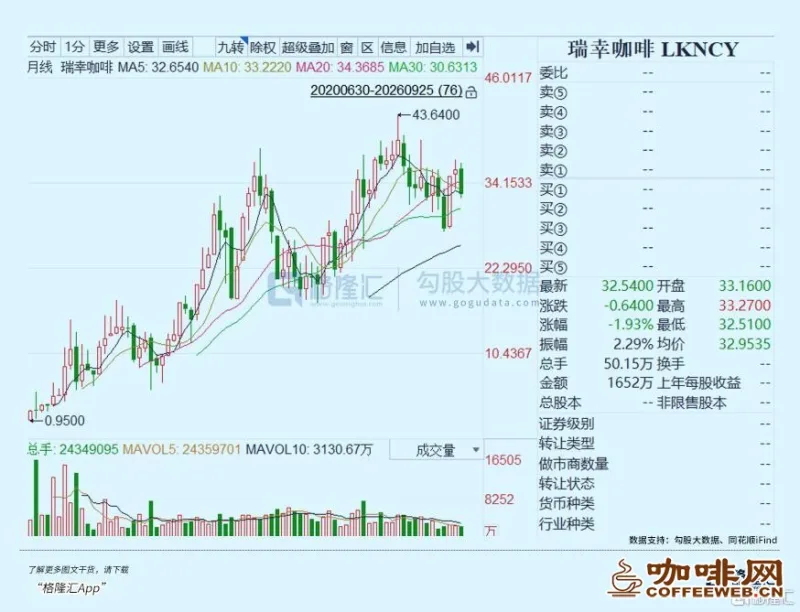
From a rat everyone wanted to cross the street to avoid, to a capital-market darling—what exactly did Luckin go through?
01
Reborn from the Ashes
First, wind the clock back to 2020.
That year, Luckin self-exposed about 2.2 billion yuan in inflated 2019 revenue; its share price plummeted 80% overnight, then it delisted from Nasdaq and moved to the pink sheets.
Founding team members such as Qian Zhiya and Lu Zhengyao were purged; Guo Jinyi took office in a crisis, succeeding as chairman and CEO.
At that time, almost no one believed Luckin could turn around.
Fines, lawsuits, debt restructuring—mountain after mountain weighed down this three-year-old company until it could barely breathe.
But Luckin somehow survived.
In 2021, a Coconut Latte burst onto the scene, selling over 70 million cups in a year, single-handedly pulling Luckin back from the cliff’s edge.
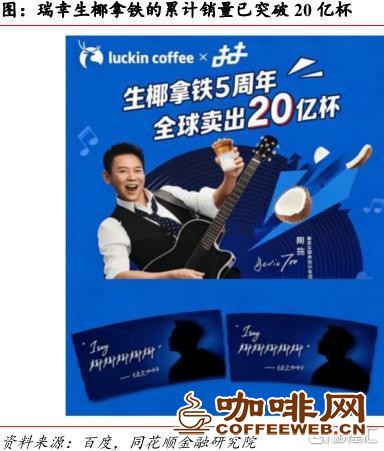
Then came the Coconut Cloud Latte, the Sauce-Aroma (Moutai) Latte, wave after wave; with an almost frenzied product-iteration speed, Luckin won back consumers’ wallets.
In February 2022, Luckin reached a $180 million settlement with the U.S. SEC, and simultaneously completed bankruptcy restructuring.
In October 2023, it repaid all debts ahead of schedule.
In 2024, it became one of the first Chinese-concept stocks to pass PCAOB on-site audits.
By 2025, Luckin delivered a stunning report card.
Full-year total net revenue of 49.288 billion yuan, up 43% year-on-year; net profit of 3.6 billion yuan, up 21.8% year-on-year.
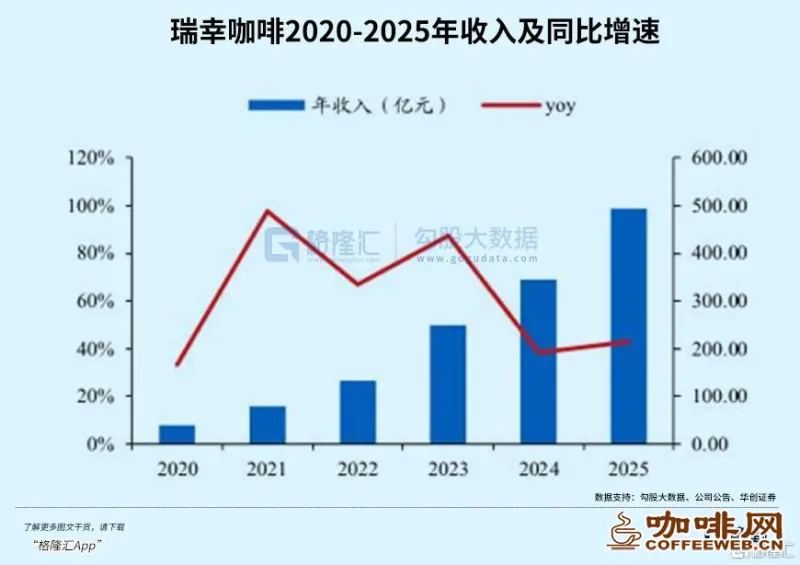
Full-year freshly made beverage sales of 4.1 billion cups—meaning that year, nearly every Chinese person drank almost 3 cups of Luckin.
Luckin’s GAAP operating profit reached 5.073 billion yuan, with an operating margin of 10.3%.
As of June 30, 2026, Luckin’s total global store count reached 36,310, a net increase of over 5,000 in the first half.
Compare with old rival Starbucks, which painstakingly operated in China for over twenty years yet has no more than 8,000 stores.
In less than a decade, Luckin reached more than four times Starbucks’ count.
Moreover, Starbucks’ global store total is about 41,000; if Luckin maintains its current store-opening pace, it may soon catch up with or even surpass this global coffee giant with over half a century of history.
But the story never has only its glamorous side.
The side effects of runaway scale expansion have already emerged.
In the second quarter of 2026, Luckin’s same-store sales at company-operated stores fell 5.3% year-on-year, and the previous quarter saw a slight 0.1% drop as well.
In other words, new stores are diluting the foot traffic of old stores; each additional store opened means the neighboring old store sells a little less.
The profit side is also under pressure.
In the fourth quarter of 2025, Luckin’s net profit fell 39% year-on-year to 518 million yuan, the core reason being a sharp 94.5% surge in delivery expenses.
At that time, the delivery war was raging; consumers grew accustomed to waiting for coffee at home, but the fulfillment cost of every delivered cup was eating into profits.
Across the full year 2025, Luckin’s delivery expenses reached 6.879 billion yuan, a year-on-year surge of 143.8%.
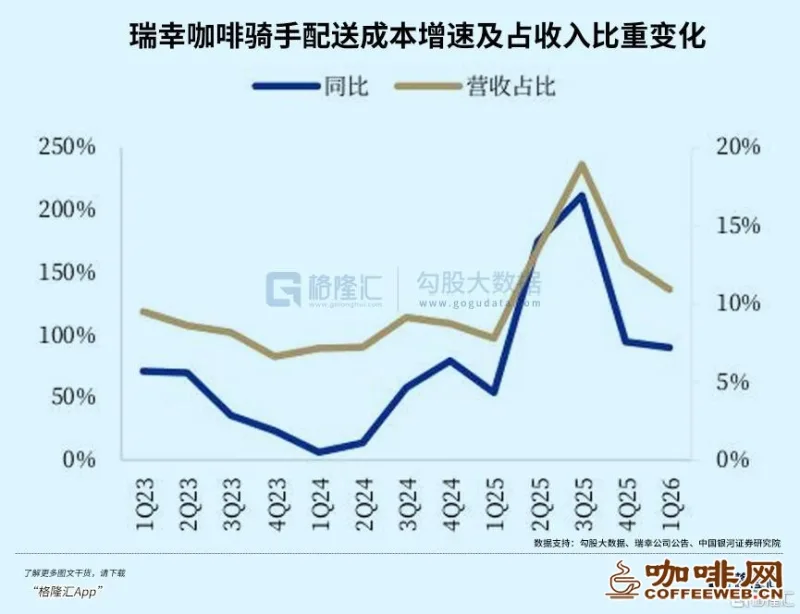
Luckin CEO Guo Jinyi has been clear on this: delivery fulfillment costs take too high a share, and unit economics are suboptimal.
However, as the delivery war gradually subsides, Luckin’s Q2 2026 delivery expenses fell 3.1% year-on-year to 1.618 billion yuan—the first year-on-year decline since the delivery war began—and the expense ratio is gradually retreating.
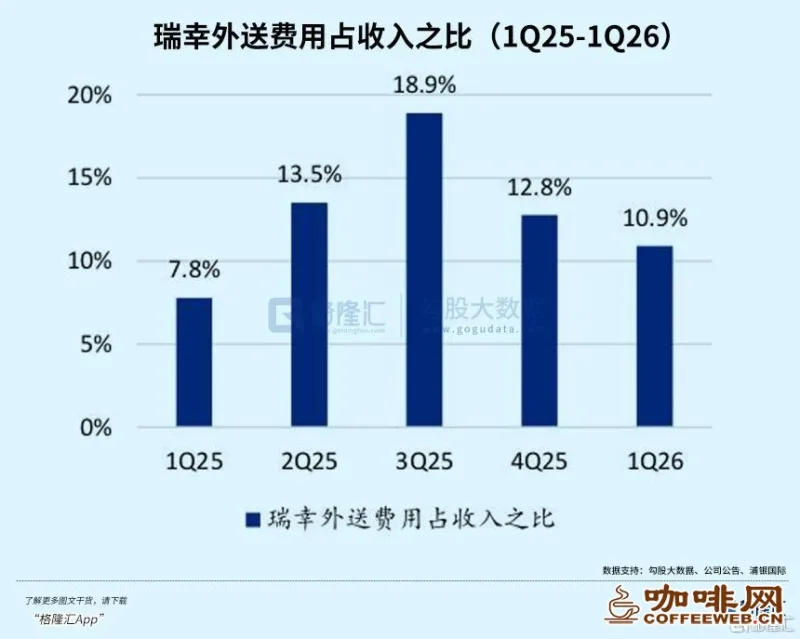
But the improvement in delivery expenses masks a more fundamental problem—the even more brutal free-for-all Luckin is now facing.
02
The Coffee-Tea Brawl
Luckin’s story becomes even more thought-provoking when viewed against the broader backdrop of the entire coffee-and-tea-drink industry.
In the first half of 2026, six domestic listed tea-drink enterprises had combined revenue of about 36.78 billion yuan, up only 9% year-on-year, and net profit attributable to parent fell about 2% year-on-year.
Compared with the 20%-plus growth of previous years, the entire industry has clearly slowed.
In 2025, China’s new-style tea-drink market grew 5.7% year-on-year and the coffee-drink market 9.6%, both ending the previous years of double-digit growth.
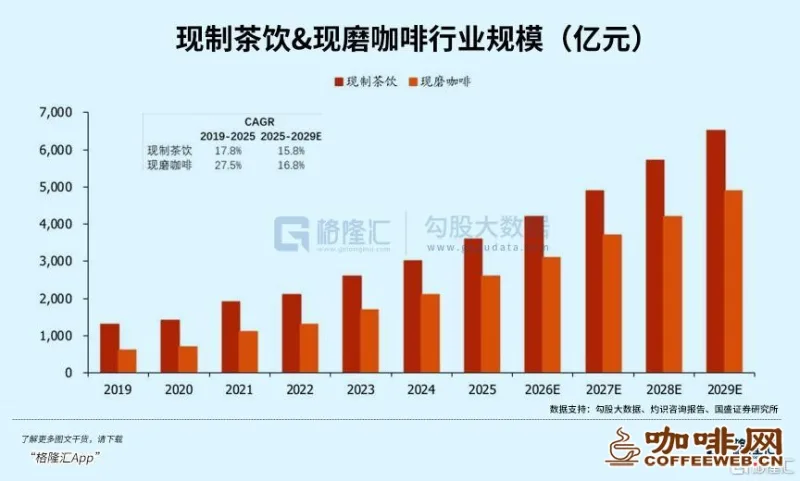
As the “ten-thousand-store” targets loudly proclaimed in past years are successively reached, more and more emerging brands gradually erode the market, and the major tea-drink brands have unanimously slowed their pace.
But what to do after slowing down?
The major brands made the same choice: crossover.
Nowadays, the line between milk tea and coffee is increasingly blurred.
Tea-drink brands charge into the coffee track, coffee brands in turn sell tea drinks; two industries once clearly separated are now thoroughly mixed together.
Guming is the most aggressive representative among them.
This tea-drink company with a market cap over 45 billion yuan announced a 400 million yuan investment to push into the coffee category, planning to raise coffee’s revenue share from 10%–15% to 20%–25%, nearly doubling it.
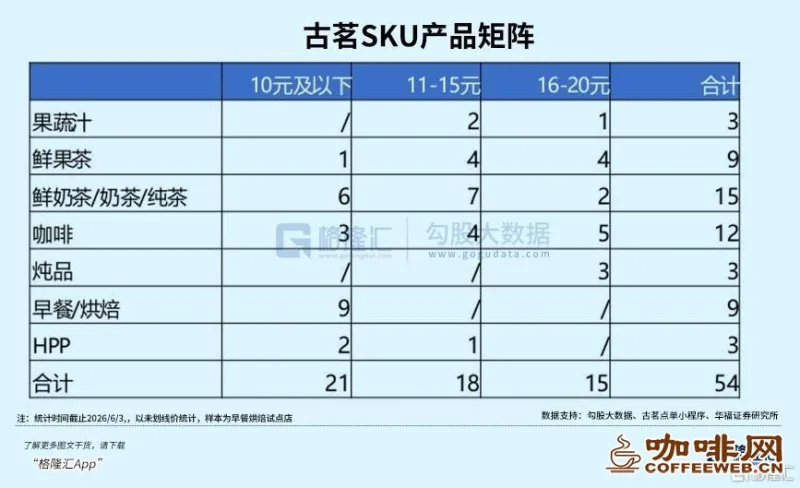
As of June 2026, about 13,500 of Guming’s stores were equipped with coffee machines, a coverage rate above 90%.
And it is precisely the morning-time revenue brought by coffee that let Guming sustain its first-half growth.
Chabaidao, Auntie Shu (Shanghai Auntie), and Mixue Bingcheng also followed suit.
About 6,000 Mixue Bingcheng stores have installed fresh-grind coffee machines, while Auntie Shu has completed coffee-machine upgrades at over 9,000 stores.
Lucky Cup, under Mixue Bingcheng, has already surpassed 10,000 stores, still using Mixue’s lower-tier playbook—low price, high density, supply-chain driven.
On the coffee side, Luckin’s biggest rival Cotti has not been idle either.
Currently, Cotti’s store count has reached about 16,000, covering 358 cities—the widest city coverage among coffee brands.
But in the first half of 2026, Cotti at one point closed over 600 stores within 90 days, with many franchisees posting transfer notices on social media.
Even more telling is the shift in the direction of the price war.
At the start of 2026, Cotti announced the end of its across-the-board 9.9-yuan-unlimited promotion, keeping only 3–7 products at low prices and restoring regular prices for the rest, with some core items rising 30%–60%.
This “9.9-yuan war” fought from 2023 to 2026 has finally begun to ebb.
But after the ebb, what remains is even more brutal stock competition.
Luckin’s rivals have not only not decreased, but become more numerous.
How should Luckin endure this bitter battle?
03
Expensive or Cheap?
Returning to the capital-market perspective, Luckin’s valuation has always been a contentious topic.
Currently, Luckin’s P/E ratio is about 19x, far below Starbucks’ 58x but above Mixue Group’s 11x.
If benchmarked against Starbucks with its international brand influence, 19x is too cheap; but if valued merely as a restaurant company, 19x is not low either.
This number itself shows a problem: the market is uncertain whether Luckin has the potential to become an international brand.
Over the past year, Luckin’s share price has roughly stood still; behind this may be that the market’s interest in its growth story is rapidly fading.
This also, to some extent, explains why, after many years, Mubadala invested this $1 billion in Luckin.
There is an easily overlooked detail: this transaction was not a typical share-issuance fundraising, but a transfer of old shares.
The investors in two of Centurium Capital’s old funds achieved exit; Mubadala entered as the new investor, and the funds did not flow into Luckin’s corporate account.
Currently, Luckin’s cash and short-term deposits on the books have reached 10.9 billion yuan, with a Q2 net cash inflow of 2.63 billion yuan—it is not short of money.
So what is this money actually going to be used for?
Some current market speculation points to mergers and acquisitions.
Earlier this year Centurium Capital acquired the specialty-coffee brand Blue Bottle Coffee from Nestlé for $400 million, and Luckin and Centurium had previously teamed up to bid for COSTA.
If Luckin wants to tell a new growth story—say, by acquiring high-end brands to open the specialty-coffee market, or by acquiring overseas targets to accelerate internationalization—this $1 billion can give Luckin ample ammunition.
Currently Luckin has only 223 overseas stores, 0.6% of total stores—vast room for internationalization.
Another possible use is to push for a return to a U.S. main-board listing.
In November 2025, Guo Jinyi publicly stated that Luckin is actively promoting a relisting on a U.S. main board; although officials later responded that there is no set timetable, the signal itself is clear enough.
Mubadala’s strategic stake happens to provide Luckin with international-capital-level endorsement.
Once it returns to the main board, liquidity and valuation typically rise in tandem.
The pink-sheet market’s average daily turnover is only a few million dollars; most U.S. equity funds and ETFs cannot participate in trading, and it also lacks options markets and margin-trading mechanisms.
And institutions broadly expect that after Luckin returns to the main board, its reasonable P/E could rise to 18–22x.
04
Conclusion
From its first store at Beijing’s Galaxy SOHO to a coffee empire spanning 36,000 stores worldwide, Luckin’s decade-long story is more dramatic than many novels.
But the coffee industry has never lacked drama.
Starbucks took 50 years to teach Chinese people to drink coffee; Luckin took less than 10 years to turn coffee into a 9.9-yuan everyday consumer product.
And in the next decade, perhaps tea drinks and coffee will completely merge, the crowds drinking milk tea and those drinking coffee are gradually overlapping—can Luckin still hold its current position?
For Luckin, what matters now is no longer the past, nor even the present, but whether in the next decade it can continue to rewrite the industry’s rules.
As for Luckin’s final ending, only time can give the answer. (End of article)
Reprint Notice and Disclaimer
- This article is compiled and edited by China Coffee Network (coffeeyo.com). The materials and images herein are sourced from public channels, and copyright belongs to the original authors. This site reprints it solely for coffee-industry information sharing and does not represent this site’s position; all data and viewpoints are subject to the original. We thank the original authors for their creation and sharing.
- If content authorization, attribution, copyright, or other matters are involved, please contact this site promptly; we will verify and cooperate in handling them as soon as possible. We also welcome coffee-producing regions, brands, and industry media to exchange and contribute articles with us.
- China Coffee Network contact: Tel 400-0000-641 (+86-18288016826) | Email 405854472@qq.com | Address: Jinghong City, Xishuangbanna, Yunnan Province / Tieling City, Liaoning Province
Reprint Notice & Disclaimer
- This article has been edited and compiled by China Coffee Network. The information and images therein come from public sources and the copyright belongs to the original author. This reprint is intended solely for information sharing within the coffee industry and does not represent the views of this website; all data and opinions are subject to the original article. Our thanks to the original author for creating and sharing it.
- For matters concerning content licensing, attribution, copyright or otherwise, please contact us promptly and we will verify and cooperate in handling them as soon as possible. We also welcome coffee origins, brands and industry media to exchange ideas and contribute articles.
- Contact China Coffee Network: Tel 400-0000-641 (+86-18288016826) | Email 405854472@qq.com | Address: Jinghong, Xishuangbanna, Yunnan Province / Tieling, Liaoning Province
Related Reading
 ‘All-Ice’ Coffee Goes Viral! Will the Next Hit Be Your Personal Favorite?
- Hong Kong’s Dyee Coffee Lands in Qianhai, Building a Specialty Pour-Over Outpost
 Ken Yue Coffee Opens Egg-Tart Pop-Up in Hangzhou: Sweet Craft, Reinvented Classics
 World Cup Enters the Breakfast Slot: Can Coffee-Tea Brands Turn Traffic into Orders?
- ICE Agricultural Futures Mostly Rise at Close; Coffee Futures Up 3.28%
- ‘Sleep Cafés’ Become a New Favorite Among Seoul Office Workers



 Liaoning ICP Security No. 21122402000217