
At a Glance (China Coffee Network): Coffee is the modern worker’s life-saver—boosting alertness while also fighting inflammation and influencing metabolism. But beyond “how much is safe,” a growing body of research suggests the timing of your coffee may matter as much as the amount.
For years, discussion centered on “will too much coffee hurt you?” and “how many cups a day is safe?” Yet more and more studies indicate that when you drink may be just as important as how much. Some people switch on with a morning cup; others rely on coffee to get through the entire day.

A large study tracking nearly 40,000 U.S. adults for almost 10 years found that some of coffee’s hard-core health benefits may be “morning-only.” Researchers sorted participants into three groups by their usual coffee timing: the morning group (coffee only in the morning), the all-day group (coffee around the clock), and the minimal/decaf group (rarely drinking coffee).
The results: compared with non-drinkers, morning coffee drinkers had a 16% lower risk of all-cause death and a 31% lower risk of death from heart disease; those who drank coffee throughout the day saw no such benefit, no different from non-drinkers.

Why didn’t the all-day group benefit? Researchers suspect two factors. First, afternoon or evening caffeine disrupts the body’s circadian rhythm and suppresses nighttime melatonin, driving changes in cardiovascular risk factors such as inflammation and blood pressure. Second, coffee’s main benefit comes from its anti-inflammatory action. The body’s inflammatory markers keep their own schedule—usually peaking in the morning and bottoming out around 5 p.m. So, with the same total intake, concentrating coffee in the morning fights inflammation more effectively than spreading it across the day.
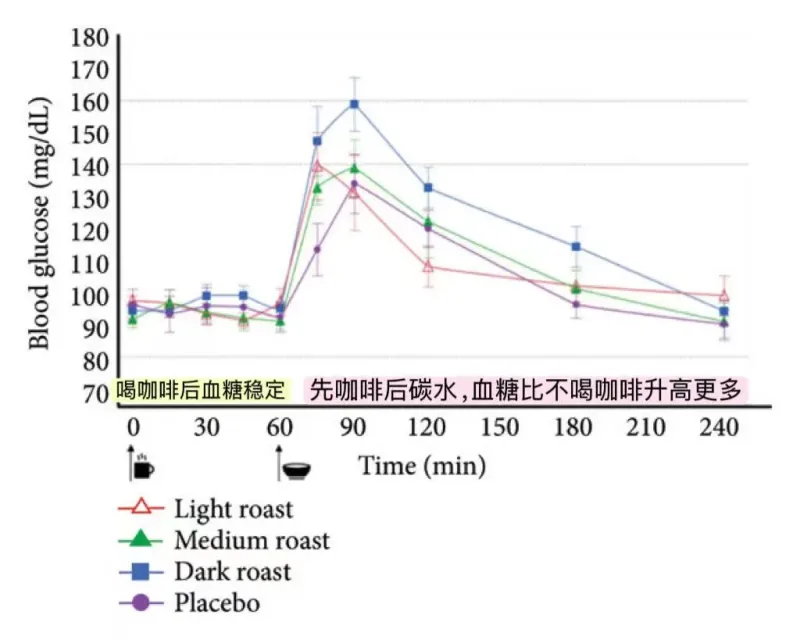
Before vs. after breakfast—very different blood sugar. After a poor night’s sleep, many reach for an extra-strong black coffee. It does force you awake, but if you get the order wrong it can impair glucose tolerance.

In a University of Bath study, researchers deliberately disrupted subjects’ sleep, then tracked post-breakfast glucose [2]. A bad night alone did not worsen glucose/insulin response—but a strong black coffee before breakfast raised the post-meal glucose response by about 50%. A 2025 study in the Journal of Nutrition and Metabolism found similar patterns with more detail: (1) Black coffee alone barely affects blood sugar but amplifies the glycemic response of carbohydrates—glucose spikes higher when coffee precedes carbs, especially with dark roast, likely because coffee boosts adrenaline and temporarily lowers insulin sensitivity. (2) Coffee with the meal keeps glucose steadier (versus before the meal), with medium roast performing best, as polyphenols and chlorogenic acid may slow sugar absorption or aid glucose use. (3) Coffee after the meal has little effect on blood sugar.
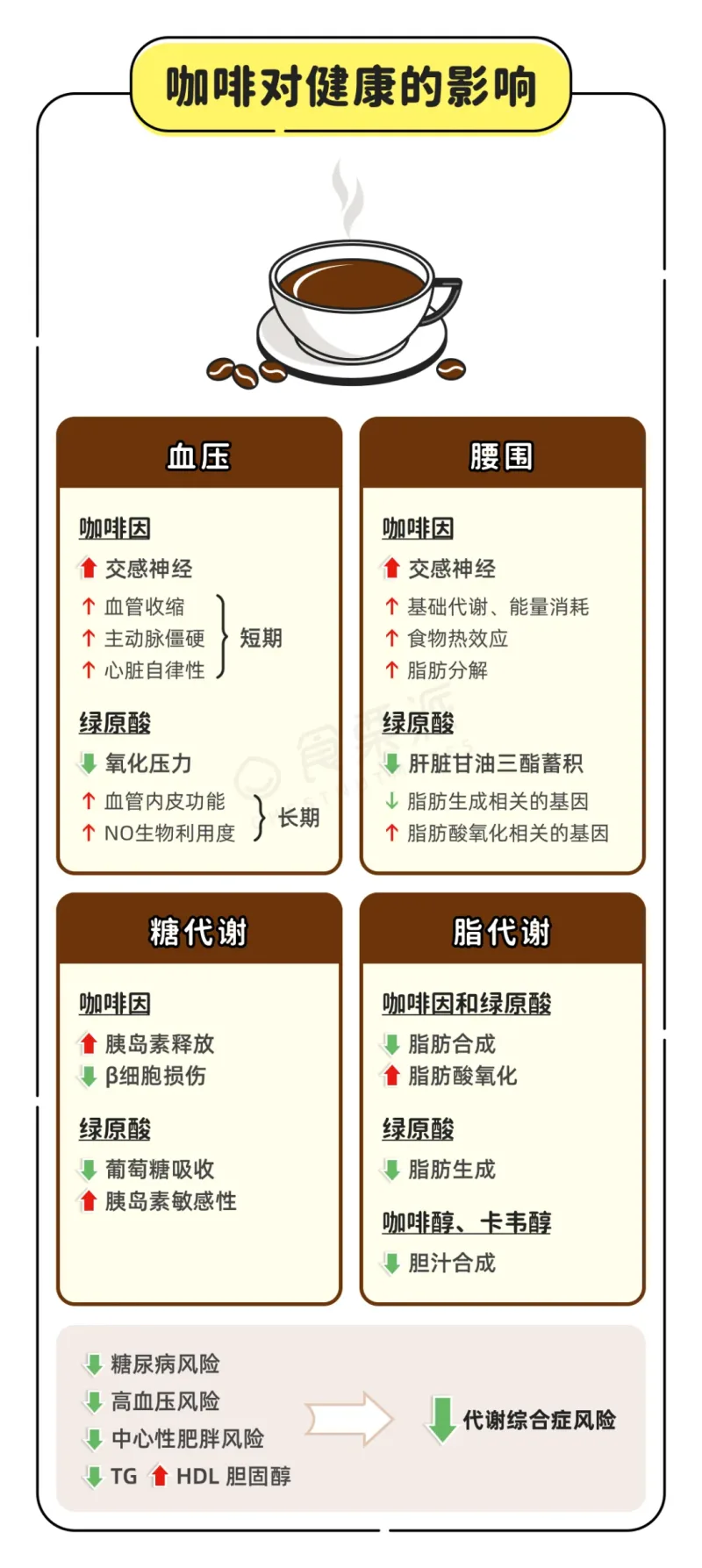
Note that “raised” here means more pronounced post-meal glucose swings—not that one cup “damages metabolism” or “causes diabetes.” In fact, long-term epidemiological studies consistently show that regular coffee drinkers tend to have a lower risk of type 2 diabetes [6,7].
This article is compiled and edited by China Coffee Network (coffeeyo.com). Materials and images are drawn from public channels; copyright belongs to the original authors. This reprint is for the sharing of coffee industry information only and does not represent the position of this site; all data and views are subject to the original.
Reprint Notice & Disclaimer
- This article is compiled and edited by China Coffee Network (coffeeyo.com) from public-domain materials. The copyright of the original article belongs to the original authors. This reprint is for the sharing of coffee industry information only and does not represent the position of this site; all data and views are subject to the original. We thank the original authors for their work and sharing.
- For matters regarding authorization, attribution, copyright, or any other issues, please contact us promptly and we will verify and cooperate in handling them. We also welcome coffee businesses and industry media to exchange and contribute content.
- Contact China Coffee Network (coffeeyo.com): Tel 400-0000-641 (+86-18288016826) | Email 405854472@qq.com | Address: Jinghong City, Xishuangbanna, Yunnan Province / Tieling City, Liaoning Province
Related Reading
 How ‘Sea-Flavored’ Coffee Blooms Across Dongtou
- Health Guide: How to Enjoy Your Coffee the Healthy Way
 Study: Regular Coffee and Tea May Lower Dementia Risk, but More Is Not Better
 Frontline Story: A ‘Mobile City Coffee Bar’ Arrives by the Grand Canal
 Yantai’s Wind Tastes of Coffee
 In Zhenyuan, a Cup of Coffee and a Waiting Train







 Liaoning ICP Security No. 21122402000217