
At a Glance (China Coffee Network): China’s first national standard for Baoshan small-grain coffee has been approved, establishing a unified sensory and physical-chemical grading system that lets Yunnan’s premium beans finally command a premium price—Yunnan’s second national standard in the coffee category.
Recently, the State Administration for Market Regulation and the Standardization Administration approved and released the recommended national standard “Geographical Indication Product Quality Requirements — Baoshan Small-Grain Coffee” (hereinafter “the Standard”). This is the first national standard in the coffee sector for Baoshan City.
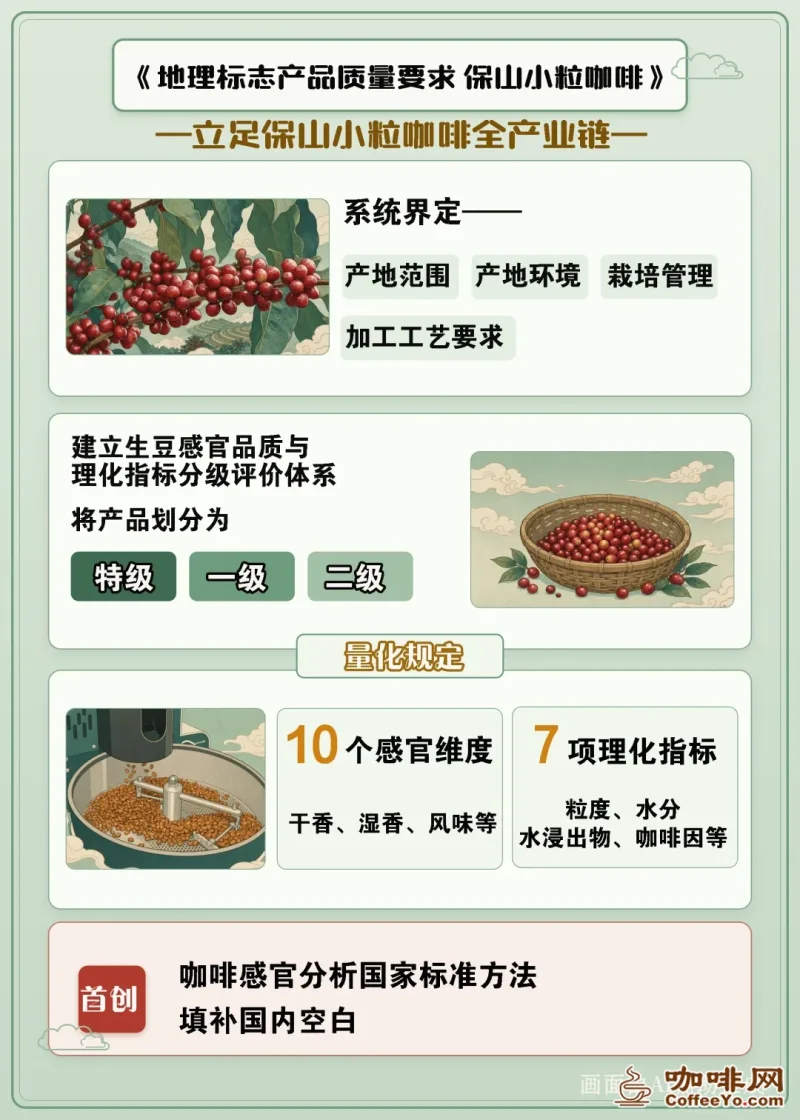
Yunnan is a major coffee-producing province in China, with both planting area and output exceeding 98% of the national total. Yet for a long time Yunnan coffee suffered from inconsistent quality-evaluation criteria and the industry pain point that high quality could not reliably command a premium. As Yunnan’s coffee industry approaches the trillion-yuan tier, how should the quality of Baoshan small-grain beans be evaluated, and how can the added value of Yunnan coffee be further raised? The release of this “Standard” offers answers on three levels.
What does this “Standard” mean?
When people speak of geographical indications, it often seems to mean only origin protection. But this “Standard” is grounded in Baoshan small-grain coffee’s full industry chain—it systematically defines the origin scope, growing environment, cultivation management and processing requirements, and establishes a grading and evaluation system for green-bean sensory quality and physical-chemical indicators. From then on, “Baoshan small-grain coffee” is no longer just a name, but a reproducible, verifiable quality promise.
Yunnan coffee has long faced a real dilemma: when negotiating prices it could only reference international futures prices, with no stable transmission chain between “growing well” and “selling well.” The “Standard” divides products into three grades—Special, Grade I and Grade II—and quantifies requirements across 10 sensory dimensions (dry aroma, wet aroma, flavor, and so on) and 7 physical-chemical indicators (particle size, moisture, water-soluble extract, caffeine, and others), unifying the basis for evaluating and testing Baoshan small-grain coffee quality. With this common yardstick, premium quality finally has a path to a premium price.
This “Standard” pioneers a national-standard method for coffee sensory analysis, with clear provisions on laboratory conditions, evaluation steps and scoring norms, filling a domestic gap. For the first time at the national-standard level, a complete chain for sensory-evaluation methodology has taken shape. This means Yunnan coffee is not only selling beans, but also participating in defining “how to evaluate a cup of coffee.”
Why Baoshan?
The “Standard” landing in Baoshan is no accident.
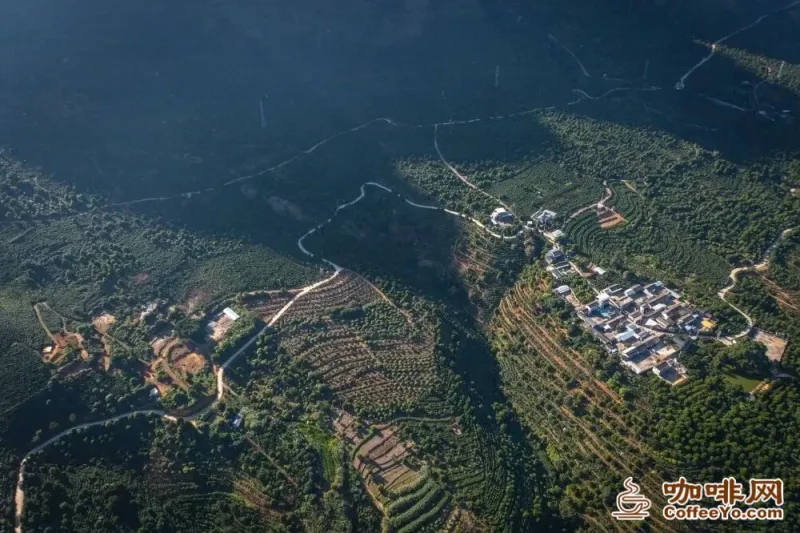
Baoshan’s Longyang District, Lujiangba, is the core producing area and birthplace of Baoshan small-grain coffee; Xinzhaicun in Luzhang Town is honored as “China’s No. 1 Coffee Village.” Situated on the eastern flank of the Gaoligong Mountains along the dry-hot Nujiang river valley and frost-free year-round, the small-grain coffee develops a distinctive “strong but not bitter, aromatic but not harsh, slightly fruity in acidity” flavor.
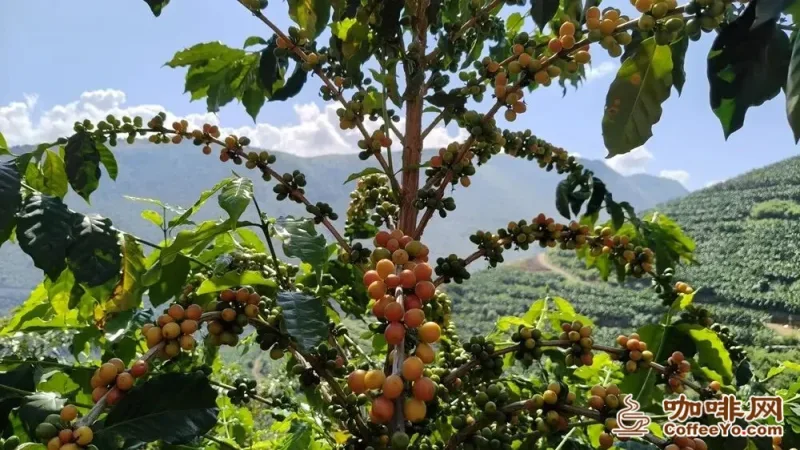
Blessed with natural endowments, success still requires method. In recent years Baoshan’s municipal party committee and government have driven development from the top, converting resource endowments into industrial advantage:
establishing a leading group for the high-quality development of Baoshan small-grain coffee and forming a dedicated coffee-industry task force;
rolling out multiple measures including the “Ten Coffee Policies” (ten support policies for the Baoshan coffee industry) to push industrial transformation, upgrading, quality improvement and efficiency gains;
promoting a “village party branch + enterprise + cooperative + base + farmer” model, building sound interest linkages between coffee enterprises and growers;
building the province’s largest deep-processing industrial park for coffee, with standard workshops, warehousing and logistics zones;
establishing the nation’s first “coffee production and processing” specialty program, building a talent support system;
formulating local standards covering “from seed to cup,” largely completing a Baoshan small-grain coffee standard system with its own characteristics…
In Baoshan’s coffee development, several “firsts” have appeared: its specialty-coffee rate ranks first in the province, deep-processing rate first, number of provincial leading enterprises—over 60% of the province’s total—first, specialty coffee estate construction first, renowned-product cultivation first, and sci-tech innovation first. In 2022, the “Baoshan Small-Grain Coffee National Geographical Indication Product Protection Demonstration Zone” was approved for preparation—this plaque laid the foundation for today’s national standard.
How does the Standard let “Yunnan coffee” spread its aroma worldwide?
For Yunnan coffee to truly represent China, it cannot stop at output and origin, but must strive to become a vivid representative of Chinese quality, Chinese standards, Chinese culture and the Chinese image.
In terms of standards, Yunnan is building a multi-level, three-dimensional standard system led by national standards, supported by industry standards, centered on local standards, and refined by supplementary standards. Standard norms now run through the entire chain—planting, deep processing, quality testing, market circulation, skilled talent, cultural-tourism integration, and by-product comprehensive utilization—reversing the past development dilemma of no unified criteria and uneven coffee quality.
The release of “Geographical Indication Product Quality Requirements — Baoshan Small-Grain Coffee” elevates Baoshan small-grain coffee from a local to a national standard. Together with the previously released “Geographical Indication Product Quality Requirements — Pu’er Coffee,” Yunnan has now contributed two national standards in the coffee category.
Additionally, this July, five series of local standards for “Coffee Vocational Skill Requirements” were released, covering five job types—coffee garden management, primary processing, brewers, roasters and tasters—taking the lead nationwide in building a systematic coffee vocational-ability evaluation system, supplying the industry with “certified” professional craftsmen and making up the talent shortfall that long constrained service quality. Yunnan has also deeply participated in drafting industry standards such as “Green Food — Coffee,” “Roasted Coffee” and “Green Coffee,” unifying national general technical criteria for green-coffee planting, roasting processing and green-bean testing, and setting a quality baseline for the domestic coffee industry.
At the same time, Yunnan’s provincial local standards form closed-loop management; 23 provincial standards such as “Small-Grain Coffee” build a full-process technical framework for small-grain coffee, covering variety breeding, seedling care, field planting, primary processing, defective-bean inspection, green-bean grading, cup evaluation, premium raw materials and warehousing logistics; it also formulates detailed norms for coffee pest monitoring, green control of coffee rust, coffee husk-tea processing, product quality traceability and industry-competition management.
In production, the rollout of standardization has unified Yunnan coffee’s fresh-cherry picking, grading and processing flows; the province’s specialty-coffee rate keeps climbing, with the share of specialty coffee in Baoshan’s core producing areas risen to 70%.
On quality control, Yunnan has refined standards for green-bean grading, cup evaluation and sensory analysis, building a scientific, quantified evaluation system; premium coffee beans show clear market premiums, and per-mu farmer income has seen real growth. The “Coffee Quality Safety Traceability Management Specification” promotes full-process traceability, paired with defect inspection and green-food standards, so every “Yunnan bean” is queryable and trustworthy from field to cup, with inspection pass rates staying high.
Furthermore, Yunnan’s nationally pioneering provincial local standards “Coffee Husk” and “Coffee Husk Tea Processing Technical Specification” standardize for the first time the processing and utilization of coffee by-products, turning yesterday’s “waste” into trendy new beverages.
From “seed” to “cup”
From product to talent
From local practice to national standard
Yunnan coffee’s quality
is getting better and better
Reprint Notice & Disclaimer
- This article is compiled and edited by China Coffee Network (coffeeyo.com) and reprinted from Yunnan Net: “《这份国家标准,让云南咖啡更香了》”. The copyright of the original article belongs to Yunnan Net and the original author. This site reprints it solely for coffee-industry information sharing and does not represent our position; all data and views are subject to the original. We thank the original author for their creation and sharing.
- Original article: Yunnan Net: 《这份国家标准,让云南咖啡更香了》
- If there are any issues regarding content authorization, attribution, copyright or other matters, please contact this site promptly; we will verify and cooperate in handling them at the first opportunity. We also welcome coffee enterprises and industry media to exchange and contribute articles.
- Contact China Coffee Network (coffeeyo.com): Tel 400-0000-641 (+86-18288016826) | Email 405854472@qq.com | Address: Jinghong City, Xishuangbanna, Yunnan Province, China
Related Reading
 Three Decades of Shanghai-Yunnan Collaboration: A Coffee Bean ‘Ferments’ at the Import Expo
 Why Yongde’s Coffee Beans Won Gold in Shanghai – A Taste of ‘Life in Yunnan: 365 Days’
- Yunling Commentary: Yunnan Coffee Turnaround Hinges on Autonomous Pricing
 A ‘Travel Pack’ Reveals Another Possibility for Pu’er Baristas
- Bean in Short Supply: A Taiwan Youth on Yunnan Coffee as a Shared Cross-Strait Stage
- Five Years, Eight Championships: Lincang Coffee Joins the World Stage



 Liaoning ICP Security No. 21122402000217