


Introduction(Coffeeyo.com, a coffee website):The recommended national standard GB/T 48261-2026 "Baoshan Small Grain Coffee" will be implemented on April 1, 2027, forming a "dual national standard" for Yunnan coffee along with the already implemented national standard GB/T 45690-2025 for Pu'er coffee. Expert Qi Ming interpretation: Baoshan emphasizes the refinement of high-altitude water washing and the integration of SCA quantitative scoring, while Pu'er focuses on large-scale and multi treatment methods; The two standards support the industry from dimensions such as price discovery and batch stability.
Recently, the recommended national standard GB/T 48261-2026 "Quality Requirements for Geographical Indication Products – Baoshan Small Grain Coffee" was released and will be implemented on April 1, 2027. Previously, the recommended national standard GB/T 45690-2025 "Quality Requirements for Geographical Indication Products – Pu erh Coffee" was implemented on September 1, 2025. At this point, both Baoshan and Pu'er, the two major coffee producing areas in Yunnan, have their own national standards. What are the similarities and differences between the two standards? What does it mean for the industry? Coffee industry expert Qi Ming recently provided an interpretation in his personal video. Based on the video content, I have authorized it.
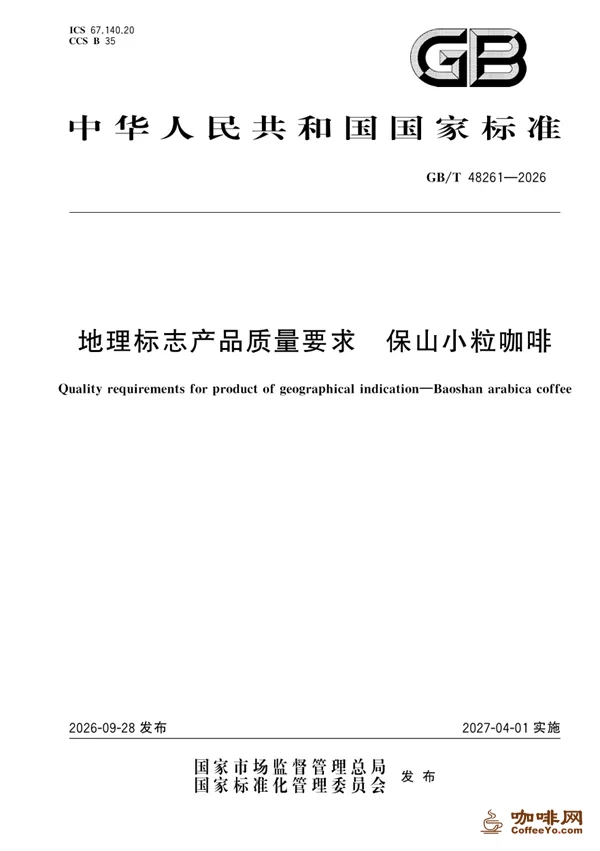
Two standards with different orientations
Both standards form a closed loop for the protection of geographical indication products, consisting of "origin range+variety+process+quality indicators+special marks", but each has its own emphasis on design orientation.
One is that the positioning and route are different. Baoshan emphasizes high altitude, water washing (wet method) and refinement, with water washing as the main processing method; Pu'er emphasizes scale and diversification, allowing for various methods such as wet, dry, and semi wet methods. The former is conducive to establishing a unified impression of high-quality water washing, while the latter covers more processing methods. In Qi Ming's view, the so-called "fourth wave of coffee" in the industry refers to the diversification of production areas, bean varieties, and processing methods. A single national standard is difficult to cover the entire path of the industry's future development; The parts beyond the national standard that are higher than the national standard can also be presented in the form of industry standards, local standards, group standards, enterprise standards, etc.
The second difference is the sensory evaluation system. Baoshan has established a relatively advanced quantitative scoring system in this national standard, which provides a lot of reference and connection to international sensory evaluation systems such as SCA, which is helpful for market promotion and embracing the consumer end, and also leaves space for subsequent reviewer management, training and certification.
The third difference is the method of defining the scope of origin. Baoshan is divided into counties, mainly defined by altitude and climate thresholds; Pu'er is based on a list of towns and villages, with additional constraints on altitude limits and slope. Both methods of definition have their own characteristics, and Baoshan focuses on leaving space for exploring high-quality batches in microclimate environments.
Fourthly, the degree of quantification varies. Baoshan standard quantifies more finely in seedling cultivation, water and fertilizer, drying, sensory evaluation and other aspects, and sets a rule of veto for non abnormal cups, which is more suitable for fine coffee micro batches; Pu'er adopts a sensory approach of "description+one vote veto", with finer harvest grading and particle size labeling, making it more suitable for large-scale coffee trade. In addition, there are subtle differences between the two in terms of quality indicator orientation.
Value to the industry
Qi Ming believes that the value of the two national standards for the coffee industry is mainly reflected in five aspects:
Firstly, transform geographical indications from mere names into verifiable language of quality. The core is to establish a corresponding relationship between origin, variety, process, and quality, which not only enables the implementation of measurable indicators, but also leaves enough space for industrial innovation outside the national standard.
Secondly, establish a price discovery mechanism. Grade, sensory score, and physical and chemical indicators constitute the unified language of green bean trading. Taking Baoshan's digital rating as an example, it can distinguish the price difference between special grade and first and second grade, reduce disputes between buyers and sellers, and provide reference for diversified trading methods such as micro batch trading and auctions.
Thirdly, reduce batch fluctuations and support scaling. The cultivation appendix of Baoshan and the processing flow of Pu'er standardize farmers' operations, which helps reduce quality differences between batches.
Fourthly, it helps to combat counterfeiting and maintain brand rights. The standard specifies what can be called "Pu'er coffee" and what can be called "Baoshan small grain coffee", providing a basis for brand protection.
Fifth, it is conducive to aligning with international standards. The two standards extensively reference ISO standards, and Baoshan standards also connect cup measuring instruments, providing Yunnan coffee with a common technical language in export and international trade communication.
This article is based on the video published by Mr. Qi Ming and has been authorized to be forwarded by me. The views expressed in the article are the author's personal opinions and do not represent the position of this website.
Author Introduction: Qi Ming, founder of Bolan Coffee and dean of Bolan Coffee Academy, founder of the digital platform "Little Coffee Hero" in the coffee industry, and director of Yunnan Fine Coffee Society; Long term participation in Yunnan coffee competition evaluation and industry standard work, authored monographs such as "Coffee Baking Master", "Coffee Tasting Master", "Coffee", "Handmade Coffee Practice", etc.
Yunnan Net reporter Gu Zhen intern Wei Xiangran
Reproduction instructions and disclaimer
- This article is written byCoffeeyo.com, a coffee websiteEdited and reprinted from Tencent News Yunnan Network's "Yunnan Coffee Enters the Era of 'Dual National Standards' – Industry Expert Qi Ming Interprets the National Standards for Baoshan and Pu'er Coffee". The original copyright belongs to Tencent News Yunnan Network and the original author. The reposting on this website is only for information sharing in the coffee industry and does not represent the position of this website. The data and opinions in the article are subject to the original text. Thank you to the original author for their creation and sharing.
- Original reading:Tencent News · Yunnan Net "Yunnan Coffee Enters the Era of 'Dual National Standards' – Industry Expert Qi Ming Interprets the National Standards for Baoshan and Pu'er Coffee"
- If there are any issues related to content authorization, attribution, copyright or other matters, please contact our website in a timely manner, and we will verify and cooperate in handling them as soon as possible; We also welcome coffee companies and industry media to communicate and contribute to us.
- Coffeeyo.com Contact Information: Phone 400-0000-641 (+86-18941000313) Email 478203668@qq.com Address: Jinghong City, Xishuangbanna, Yunnan Province
Related Reading
 Tim Hortons China Q3: System Sales Up 6.3% Quarter on Quarter
- CRH Plans OATLY Exit, Nayuki Leaves Wenzhou | Tea & Coffee Weekly
 The 2026 Asian Coffee Association Annual Meeting will be held in Dehong, Yunnan, and the Asia ABODY Coffee System Standard will be officially released
 The President of Brazil's Victoria Coffee Business Center (CCCV) led a delegation of four people to Pu'er, Yunnan to conduct a special inspection of the coffee industry
 Behind the 1836 yuan "King of Brands": The Full Industry Chain and Offline Layout of Xinlu Coffee
 From a raw bean to a fragrant cup, Xiamen International Coffee Exhibition unlocks a new picture of the entire industry chain


 Liaoning ICP Security No. 21122402000217