


Introduction(Coffeeyo.com, a coffee website):A study by the University of Oulu in Finland tracking 2264 46 year olds showed that coffee drinkers had less total and visceral fat, more muscle mass, and little difference in BMI. Research suggests that coffee drinkers have lower visceral fat, lower BCAA levels, and higher SHBG, which may help reduce the risk of metabolic related fatty liver disease.
In outpatient clinics, people often ask me with a "normal weight" scale: How was fatty liver detected? ——Because BMI can deceive people. A study in Finland that tracked over 2000 people and spanned half of their lives has given the answer: people who drink more coffee have less total fat and visceral fat, more muscle mass, but their BMI is similar to those who do not drink. In other words, coffee may be quietly helping you "change meat" – replacing bad oil with good meat, and the liver will also breathe a sigh of relief. Today, from the perspective of hepatobiliary surgery, Lao Meng will explain this' hidden benefit 'thoroughly.
1、 What exactly does this study say
The researchers are from the University of Oulu in Finland, focusing on the famous "Northern Finland 1966 Birth Cohort" – a group of people born in 1966 who have been tracked for their entire lives. This time, 2264 middle-aged people aged 46 were selected to examine their coffee drinking habits and the relationship between their body composition, blood metabolic indicators, and sex hormones (Verroest et al., 2026, published in the European Journal of Nutrition).
What about people who drink a lot of coffee
Total fat/visceral fat
Less (under the premise of the same BMI)
Branched chain amino acids (BCAAs) in the blood
Lower (lower for both men and women)
Better blood glucose insulin profile and higher total testosterone+sex hormone binding globulin (SHBG)
Higher SHBG and lower free androgen
In one sentence: For the same volume, coffee drinkers have cleaner "content" – less oil, more meat, and smoother metabolic indicators. Finnish people are already the world's strongest drinkers of coffee (with an average of about 11.8 kilograms per person per year), and this sample perfectly illustrates their 'long-term habits'.
2、 Lao Meng's Key Points: Coffee and Liver, Three Dark Lines
① Reduced visceral fat → reduces liver burden
Visceral fat is the "bad meat" that accumulates around the mesentery and liver. It not only occupies space, but also releases inflammatory factors and interferes with insulin, directly feeding the liver out of MASLD (metabolism related fatty liver disease, formerly known as non-alcoholic fatty liver disease). People who drink a lot of coffee have less visceral fat, which is equivalent to reducing the burden on the liver from the source – this is exactly the underlying logic of the body's "coffee protects the liver" mentioned by Lao Meng in # 176 "Coffee=Liver Protecting Drink": coffee does not directly wash the liver, but it first loosens the soil of metabolic disorders.

Image: Visceral fat surrounds the liver, which is the "bad meat" that should be reduced the most.
② More muscles → Prepare "reserve food" for the liver
Muscles are the largest buffer pool of amino acids in the body and also the "stove" for burning blood sugar. The scene that Lao Meng saw the most in the ward: liver cirrhosis patients quietly lose muscle (sarcopenia), and once muscle loss occurs, the prognosis for the liver becomes even worse. Coffee drinkers have higher muscle mass, which is equivalent to storing more "strategic reserves" for the liver – this is a chain reaction with # 218 "How much protein to eat, the liver knows best" and # 204 "Exercise right to protect the liver": sufficient protein+resistance training, a win-win situation for fatty liver and muscle.
③ BCAA low, SHBG high → metabolism of "oil-water" is smoother
BCAA (branched chain amino acid) is on the high side for a long time, and is linked to insulin resistance and type 2 diabetes in literature; Coffee drinkers have lower levels of BCAA in their blood, indicating a cleaner metabolic pathway. High SHBG and low free androgen are good signals of insulin sensitivity and low risk of MASLD – conversely, low SHBG is precisely one of the risk signs of non-alcoholic fatty liver disease. A cup of coffee, I casually turned several metabolic switches that the liver cares most about in the positive direction.
3、 A cup of coffee, three wires connected to the liver (control)
Significance for liver/metabolism
MASLD、 Reduced risk of metabolic comorbidities (sugar/fat/fat)
Anti muscular dystrophy, better prognosis for liver cirrhosis
More sensitive insulin, lower risk of diabetes
Metabolic health signals lower risk of fatty liver
Lao Meng reminds us that the above are phenomena that occur simultaneously in coffee drinkers, and the study itself is observational – association does not equal causality. It cannot be said that 'drinking coffee can make you thin or protect your liver', it can only be said that among people of the same weight, coffee habits are tied to better body composition and metabolic profiles. The mechanism is still being studied in animal experiments (polyphenols and caffeine affecting fat oxidation and insulin sensitivity are popular hypotheses).
4、 Reminder on Lao Meng's drinking method
Don't ruin it on the additives. The benefits of black coffee can be offset by a spoonful of sugar, a lump of cream, and a packet of vegetable fat powder, and may even lead to weight gain – echoing the saying in # 215 "Sugar Replacement Heartbreaks the Liver" and # 208 "Potassium Supplementation is Liver Protection" that "sweet drinks and good metabolism are mortal enemies".
The quantity should be appropriate. Drinking too much is the norm for Finns in research (several cups a day). For ordinary Chinese people, 2-3 cups of black coffee per day is a relatively stable range; Going further, palpitations, insomnia, and acid reflux should be stopped. The stronger the coffee, the better.
Who should drink it? For people with gastric ulcers/reflux, arrhythmia, severe osteoporosis, pregnancy and lactation, anxiety and insomnia, whether or not to drink and how much to drink should be determined by the corresponding specialist. Don't force yourself.
5、 Old Meng's Three Sentences Hard Line
Reminder written next to the surgical knife
Coffee is the 'invisible bodyguard' of the liver, but it's just icing on the cake. Antiviral therapy, quitting alcohol, weight loss, and lipid-lowering are the correct ways to protect the liver; Don't use coffee as medicine.
The same BMI results in vastly different body composition. Thick waist, stuffy liver area, and lack of energy, don't just look at the scale – check your body, liver, and visceral fat.
Black coffee is superior to fancy coffee, with a daily limit of 2-3 cups. Adding sugar and creamer is equivalent to drinking for nothing and adding chaos.
The red line of the liver belongs to the Department of Hepatobiliary Surgery/Gastroenterology: jaundice, ascites, repeated high transaminase levels, liver area bloating, vomiting blood and black stool – these should be referred to Lao Meng and the Department of Gastroenterology. How to drink coffee depends on the attending physician.
Coffee's risk reduction of liver cancer is epidemiological and cannot replace screening: hepatitis B vaccination, hepatitis C treatment, alcohol control, and ultrasound+AFP regular screening are the hard lines of defense (see References 2 and 5 for details).
Do not go beyond the boundaries: gastric ulcer/reflux should be referred to the gastroenterology department, arrhythmia should be referred to the cardiology department, osteoporosis should be referred to the endocrinology department/orthopedics department, pregnancy and lactation/insomnia anxiety should be referred to the obstetrics department/corresponding specialty; This article only discusses the principles and red lines, and does not prescribe a plan or medication for you. For those who have already suffered from liver disease, please follow the advice of the surgeon/attending physician regarding coffee intake.
Verroest L, Jokelainen J, Choudhary S, et al.Associations of habitual coffee intake with testosterone and cardiometabolic markers: the Northern Finland birth cohort 1966 study.European Journal of Nutrition. 2026; 65 (5). DOI: 10.1007/s00394-026-04038-z (Main reference of this study: 2264 46 year old subjects, the association between coffee and visceral fat ↓, muscle ↑, BCAA ↓, sex hormone spectrum)
Kennedy OJ, Roderick P, Buchanan R, et al. Coffee, including caffeinated and decaffeinated coffee, and the risk of hepatocellular carcinoma: a systematic review and dose response meta-analysis. BMJ Open. 2017; 7 (5): e013739. DOI: 10.1136/bmjopen-2016-013739 (more than 2.27 million people, 18 queues: adding 2 cups of coffee per day can reduce the risk of liver cancer by about 35%; Decaffeinated coffee also has a protective effect)
Mure K, Maeda S, Mukoubayashi C, et al. Habitual coffee consumption is inversely associated with metabolic syndrome related biomarkers that are involved in metabolic responsibility. Nutrition. 2013; 29 (7): 982-987. DOI: 10.1016/j.nut.2013.01.011 (364 Japanese males: Drinking coffee is significantly negatively correlated with visceral fat area and visceral/subcutaneous fat ratio, P<0.0001)
Wong THT, Luo S, Au Yeung SL, et al.Association between coffee consumption and metabolic syndrome: A cross-sectional and Mendelian randomization study.Journal of Diabetes. 2024. DOI: 10.1111/1753-0407.70004( More than 350000 people in the UK Biobank: ≤ 2 cups of coffee per day is negatively correlated with metabolic syndrome; Mendelian randomization does not support causality, high intake is associated with central obesity – can serve as honest boundary evidence)
Bravi F, Bosetti C, Tavani A, et al. Coffee reduces risk for hepatocellular carcinoma: An updated meta-analysis. Clinical Gastroenterology and Hepatology, 2013; 11 (11): 1413-1421. e1. DOI: 10.1016/j.cgh. 2013.04.039 (Updated meta-analysis: Regular coffee consumption can reduce the risk of liver cancer by about 40%, and about 3 cups per day can reduce the risk by more than 50%)
Reproduction instructions and disclaimer
- This article is edited and compiled bycoffee website Coffeeyo.com, and is reproduced from Tencent News' "Why drinking coffee may make people thinner with the same weight". The original copyright belongs to Tencent News and the original author. The reposting on this website is only for information sharing in the coffee industry and does not represent the position of this website. The data and opinions in the article are subject to the original text. Thank you to the original author for their creation and sharing.
- Original reading:Tencent News "Why is it said that people with the same weight who drink coffee may be slimmer?"
- If there are any issues related to content authorization, attribution, copyright, or other matters, please contact our website in a timely manner, and we will verify and cooperate in handling them as soon as possible; We also welcome coffee companies and industry media to communicate and contribute to us.
- Coffeeyo.com Contact Information: Phone 400-0000-641 (+86-18941000313) Email 478203668@qq.com Address: Jinghong City, Xishuangbanna, Yunnan Province
Related Reading
 Research shows that drinking coffee regularly can reduce the risk of gout
- Does drinking coffee lead to calcium deficiency, uric acid elevation, and heartburn? The merits and demerits of coffee
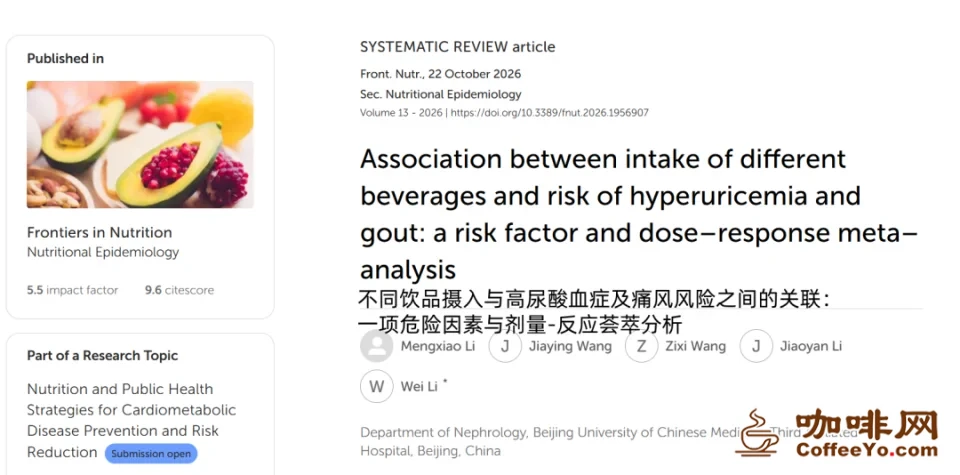 ‘Uric-Acid-Friendly Drink’ Identified: Study Links Regular Coffee Consumption to a 46% Lower Risk of Gout
 Coffee and Health: The 400 mg Daily Caffeine Limit
- Does Coffee Promote Cancer? Harvard Study: One Extra Cup of This Coffee Raises Bladder Cancer Risk
- Study Finds: Drinking Coffee Does Affect People’s Mood


 Liaoning ICP Security No. 21122402000217