


At a Glance (China Coffee Network): A large meta-analysis covering more than 260,000 participants found that coffee was the only beverage among alcohol, sugar-sweetened drinks and tea to show a protective signal against gout; regular coffee drinkers had roughly a 46% lower risk.
‘Uric-Acid-Friendly Drink’ Identified: Study Links Regular Coffee Consumption to a 46% Lower Risk of Gout
Many people with high uric acid or gout know that beer and fruit juice can raise uric acid levels. But is there a drink that is actually “friendly” to uric acid — one that might even lower gout risk?
Yes — and researchers have found it. A recent study systematically analysed the relationship between different beverages and gout risk, and identified one “uric-acid-friendly drink”: coffee. The finding: people who drink coffee regularly do have a lower risk of gout.
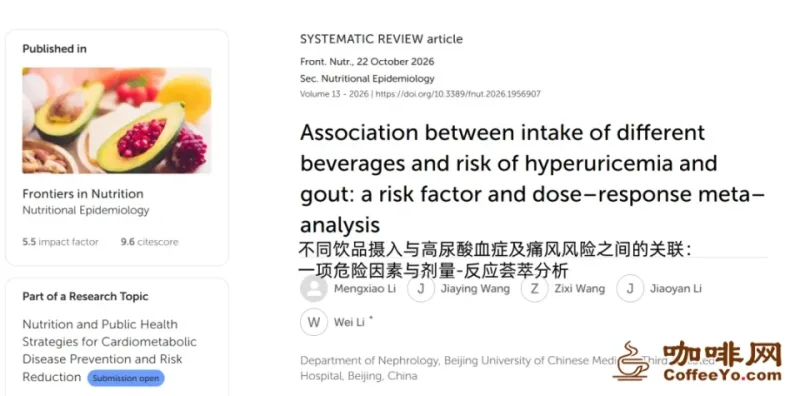
In October 2026, the international journal Frontiers in Nutrition published a large meta-analysis covering more than 260,000 participants across Asia, North America, South America, Europe and Oceania. It systematically compared four beverage categories — coffee, alcohol, sugar-sweetened drinks and tea — against hyperuricemia and gout. The result: coffee was the only one of the four to show a “protective” association with gout.
In detail:
✅ Coffee: associated with a lower gout risk. Compared with non-coffee drinkers, coffee drinkers had about a 46% lower risk of gout.
✅ Tea: overall, tea showed no significant association with either gout or hyperuricemia risk.
❌ Alcohol: associated with higher risks of gout and hyperuricemia. People who drank alcohol had roughly an 81% higher gout risk and a 52% higher risk of hyperuricemia.
❌ Sugar-sweetened drinks: likewise associated with higher risk. Compared with people who consumed very little or almost none, higher intake of sugar-sweetened drinks was associated with about a 37% higher gout risk and a 48% higher risk of hyperuricemia. ①
⚠️ One important caveat: although coffee shows a protective signal for gout risk, that does not mean a drink alone can prevent gout. Prevention still comes down, fundamentally, to a healthy lifestyle and a balanced diet.
Why might coffee lower gout risk?
Physician: four pathways working together
In a 2026 article for The Paper, Wang Ruiyan, chief physician of nephrology at Shanghai Fourth People’s Hospital affiliated to Tongji University, explained that coffee’s uric-acid-lowering effect is not down to caffeine alone, but to several pathways acting together. ②
Pathway one: suppressing uric acid production
Caffeine in coffee is a methylxanthine compound that competitively inhibits xanthine oxidase, reducing uric acid formation by interfering with the conversion of xanthine into urate. Chlorogenic acids and other polyphenols can mildly inhibit uric acid production — a weaker, natural version of allopurinol, a classic uric-acid-lowering prescription drug (and in no way a substitute for medication).
Pathway two: dilating renal blood vessels
Coffee can dilate the blood vessels in the kidneys and increase renal blood flow, raising the clearance rate of uric acid. Put simply, it makes the “exit route” for uric acid smoother.
Pathway three: improving insulin resistance
Wang Ruiyan notes that insulin resistance is a major reason uric acid excretion falls. A 2024 study in the European Journal of Epidemiology reported that polyphenols in coffee, such as chlorogenic acid, can improve insulin sensitivity ③ and thereby indirectly influence uric acid metabolism. ②
Pathway four: reducing inflammation
A gout attack is essentially an acute inflammatory response triggered by urate crystals. Polyphenols in coffee help dampen inflammation, which is beneficial in the chronic inflammatory state of gout — turning down the “fire” of a flare. ②

Beyond the study, we have compiled advice from clinical guidelines and expert consensus, so it is clear at a glance what you can drink regularly and what to limit:
👉 Green-list drinks: fine to drink, friendly to uric acid
1. Plain water
The Dietary Guidelines for Adult Hyperuricemia and Gout (2024 Edition) note that drinking water regularly and at set times promotes uric acid excretion. People with hyperuricemia or gout, provided heart and kidney function are normal, should drink plenty of water — 2,000–3,000 ml a day is recommended, aiming to keep daily urine output above 2,000 ml, with plain water the first choice. ④
2. Lemon water
A study published in the International Journal of Rheumatic Diseases in December 2025 found that drinking freshly squeezed lemon water daily significantly helped lower uric acid levels, with a more pronounced effect in people with gout or hyperuricemia. Use warm water below 40°C to protect the vitamin C in the lemon, and add as little sugar as possible. ⑤
3. Milk
In a 2025 article on the hospital’s WeChat account, Zhang Hanwen, a dietitian in the nutrition department of No. 924 Hospital of the PLA Joint Logistics Support Force, pointed out that milk is a low-purine food and that its casein and whey proteins promote uric acid excretion. Dairy products may also help the kidneys excrete xanthine, a uric acid precursor, which could lower uric acid levels. ⑥
4. Coffee
Although the Frontiers in Nutrition study found an inverse association between coffee intake and gout risk, with no clear “ceiling” where the benefit stopped within the range analysed, it needs to be said that this is a trend from observational research and cannot be applied mechanically to daily life.
In a 2025 post on his WeChat account, registered dietitian Gu Zhongyi explained that the safe daily caffeine dose for a healthy adult is 400 mg; but to cut the risk of anxiety, depression and stress while still enjoying coffee’s “lift”, staying under 300 mg — and preferably around 200 mg — is better (about 1–1.5 iced Americanos). ⑦
👉 Black-list drinks: drink as little as possible, they add to the uric acid problem
1. Alcohol
Beer, baijiu, wine, yellow rice wine — any drink containing alcohol hinders uric acid excretion and encourages crystal deposition, sharply raising the risk of a gout flare.
2. Sugar-sweetened drinks
In a 2024 article for China Science Communication, registered dietitian Wang Lu explained that fructose metabolism not only directly promotes purine production but also inhibits uric acid excretion, raising uric acid levels in the body and triggering gout. Even products with no added fructose — those sweetened only with white sugar, rock sugar or honey — are metabolised into fructose in the body. What is more, high-sugar foods and sweetened drinks raise the risk of obesity and high blood lipids, both of which are risk factors for high uric acid. ⑧

3. Freshly squeezed fruit juice
The Dietary Guidelines for Adult Hyperuricemia and Gout (2024 Edition) also list freshly squeezed juice among the high-fructose foods to be limited. A distinction matters here: whole fruit and fruit juice are not the same thing. Nutrients in whole fruit — vitamin C, flavonoids, polyphenols, potassium and dietary fibre — change how fructose affects uric acid, so fruit intake shows no significant association with gout. Once juiced, however, especially when the pulp is strained out, it is not recommended as an everyday drink. ④
4. Meat broth
In a 2026 episode of the CCTV-4 programme Healthy China, Liu Yanying, chief physician of rheumatology at Beijing Friendship Hospital affiliated to Capital Medical University, explained that purines themselves dissolve in water — and dissolve readily in hot water. The purines in meat, including seafood, therefore leach into the broth in large amounts; the soup can contain more purines than the meat itself. ⑨
Sources compiled for this article:
① Li M, Wang J, Wang Z, Li J and Li W (2026) Association between intake of different beverages and risk of hyperuricemia and gout: a risk factor and dose–response meta–analysis. Front. Nutr. 13:1956907. doi: 10.3389/fnut.2026.1956907
② The Paper, 6 June 2026, “Explainer: If You Have Gout, Can You Drink Coffee (or Tea)?”
③ Alperet, D.J., Wang, X., Zhu, L. et al. Influence of consuming coffee and other beverages in adolescence on risk of type 2 diabetes in adulthood. Eur J Epidemiol 39, 1183–1197 (2024). https://doi.org/10.1007/s10654-024-01165-x
④ National Health Commission, 8 February 2024, Dietary Guidelines for Adult Hyperuricemia and Gout (2024 Edition).
⑤ Lemon Water Reduces Serum Urate Levels in Gout Patients and Individuals With Hyperuricemia—A Pilot Study. International Journal of Rheumatic Diseases 28: e70488. https://doi.org/10.1111/ijrd.170488
⑥ WeChat account of No. 924 Hospital of the PLA Joint Logistics Support Force, 26 December 2025, “Weekly Medical Nutrition: A Guide to the Nutritional Value of Milk and How to Drink It”.
⑦ Dietitian Gu Zhongyi, 2 December 2025, “To Avoid Raising Anxiety and Depression Risk, Keep Your Coffee Intake Within This Range”.
⑧ China Science Communication, 15 June 2024, “The Hidden Culprits Behind Rising Uric Acid: Not Just Purines — These Foods Too”.
⑨ CCTV-4 Healthy China, 21 August 2026, “Not Just Beer and Seafood: The Other Items in a Gout Combo”.
Reprint Notice & Disclaimer
- This article has been edited and compiled by China Coffee Network and reprinted from Tencent News, “"尿酸友好型饮料"找到了!研究:经常喝的人,痛风风险降低46%.” The copyright of the original text belongs to Tencent News and the original author. This reprint is intended solely for information sharing within the coffee industry and does not represent the views of this website; all data and opinions are subject to the original article. Our thanks to the original author for creating and sharing it.
- Read the original: Tencent News, “"尿酸友好型饮料"找到了!研究:经常喝的人,痛风风险降低46%”
- For matters concerning content licensing, attribution, copyright or otherwise, please contact us promptly and we will verify and cooperate in handling them as soon as possible. We also welcome coffee origins, brands and industry media to exchange ideas and contribute articles.
- Contact China Coffee Network: Tel 400-0000-641 (+86-18288016826) | Email 405854472@qq.com
Related Reading
 Coffee and Health: The 400 mg Daily Caffeine Limit
- Does Coffee Promote Cancer? Harvard Study: One Extra Cup of This Coffee Raises Bladder Cancer Risk
- Study Finds: Drinking Coffee Does Affect People’s Mood
 Coffee and Heart Health: To Drink or Not, and How to Do It Safely
 How Many Cups of Coffee a Day Is Healthiest? Scientific Consensus and Common Myths





 Liaoning ICP Security No. 21122402000217