
At a Glance (China Coffee Network): From November 5 to 10, the ninth China International Import Expo (CIIE) was held in Shanghai. Photo: Internat…
From November 5 to 10, the ninth China International Import Expo (CIIE) was held in Shanghai.
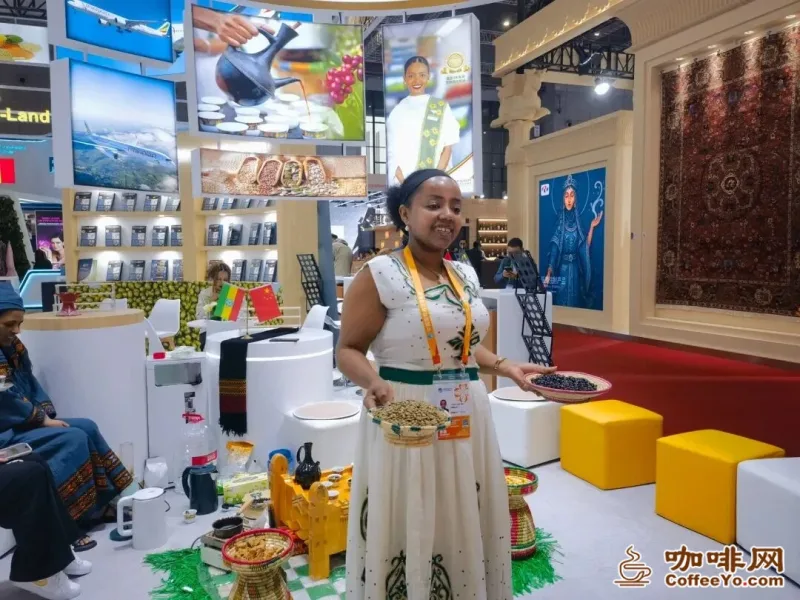
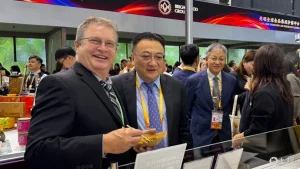
At the national pavilions, our reporter saw an Ethiopian coffee merchant repeatedly handing out coffee bean samples to onlookers. It was his second trip to China, yet his first time at the CIIE. He hoped to meet people who truly love Ethiopian coffee here and build lasting connections.
In the agri-food products zone, Indonesian bird’s-nest brand Xia Yuyan shared its new coffee with passing visitors, while the Joël Robuchon food workshop showcased a limited butterfly-shaped puff pastry adapted to Chinese tastes… Exhibitors from different countries and categories, each with a story behind their products, looked forward to meeting new friends at the CIIE. For them, exhibiting is not just about displaying goods and closing deals, but an opportunity to take root in the Chinese market and find long-term partners.
The “Long Journey” of a Coffee Bean
“I came here to open up the coffee-bean market and find consumers who love our beans,” Mesfin Kebede, marketing and quality director of FENAOL, told the International Finance News reporter.
This is an Ethiopian coffee trading company. Mesfin Kebede, on his second visit to China, attended the CIIE for the first time, an experience that left a deep impression.
He observed that China has a large population, its coffee consumer base is still expanding, and the market’s growth potential is considerable. During the CIIE he already connected with quite a few prospective clients and plans to follow up. Next, he hopes to export more coffee beans to China and is even considering setting up an office here.
Booth staff displaying coffee beans. Photo by Xia Yuechao.
Dr. Aziza Geleta Dessalegn, chargé d’affaires of the Embassy of Ethiopia in China, told our reporter that at this CIIE more than 70 Ethiopian suppliers exhibited, with exhibits ranging from coffee beans, corn and sesame to beef and avocados. She said the CIIE brings merchants and consumers together, and more importantly helps enterprises build networks and gives exporters more direct access to the Chinese market.
A coffee bean sets out from the African plateau, crosses oceans to reach Shanghai; behind it lies not just trade, but a deep China-Africa friendship.
Starting May 1 this year, China has fully implemented zero-tariff measures for 53 African countries with diplomatic ties, creating more convenient conditions for African specialties to enter the Chinese market. Ethiopian and other African exporters are leveraging this policy dividend to expand exports to China, with coffee and other agricultural products especially prominent.
“The CIIE has opened a huge product sales market for Ethiopia, and combined with the zero-tariff policy introduced by the Chinese government for African countries, Ethiopian exporters are truly tapping into this enormous potential,” said Dr. Aziza Geleta Dessalegn.
“Compared with previous editions, we feel the CIIE’s support for Africa and least-developed countries keeps growing, and the agri-products in the Asia-Africa Zone are richer,” said Sun Yanlei, chairman of Hainan Zhongyu, on his second exhibition, deeply impressed. Last year, Hainan Zhongyu followed the Orient International Group and brought exclusively sourced Burundi coffee beans to the CIIE. There, buyers, roasters and media tasted this Burundi-origin coffee in Shanghai for the first time, and the team also connected with a group of clients who stayed in touch. Beyond coffee, they also plan to import cocoa and other agricultural products from Africa.
Seeking Innovation in China
For many importers, the significance of attending the CIIE also lies in using this platform to explore more innovative directions for their brands in the Chinese market.
“The CIIE gave us a chance to be ‘seen’,” Qi Xiayu, founder of the Xia Yuyan brand, told our reporter. This is the brand’s fifth time at the CIIE. “When we first came, the idea was simple: let more people know who Xia Yuyan is and where our bird’s nest comes from. But after a few years, the CIIE has long ceased to be just a ‘display window’ for us.”
Qi Xiayu explained that Xia Yuyan has been deep in the bird’s-nest industry for nearly twenty years; coffee is a brand-new track that requires considerable cost and time to build from scratch, and the CIIE happened to become their platform for testing new categories. From first experimenting with wild civet coffee, to introducing the century-old Butterfly brand for its China debut last year, to launching the Ijen volcanic single-origin bean this year, she is keenly aware of the CIIE’s “spillover effect”: “Exhibits really can become commodities, and exhibitors really can become investors.”
Also exploring innovation through the CIIE is first-time exhibitor the Joël Robuchon food workshop, which not only brought its classic butterfly puff pastry but also launched a limited edition tailored to Chinese tastes: retaining the French craft core, moderately reducing sweetness, and combining it with Chinese solar terms to create limited gift boxes.
When this France-origin brand first entered Shanghai, many diners came for the Michelin halo and the puff pastry. Wang Gaoliangmei, brand promotion lead of the Joël Robuchon food workshop, told our reporter that over time Chinese diners no longer only value labels, but are more willing to savor the layers of flavor; they embrace both authentic French flavors and fusion innovation, and consumption scenarios are increasingly diverse. “The respect Chinese diners show for fine food is what makes us decide to take root here,” she said.
“The CIIE is a window for industry exchange and brand showcasing,” said Wang Gaoliangmei. She felt at the CIIE that China’s high-end dining industry is maturing, diners care more about the long-term development of food culture, and brands look forward to connecting with more business partners through it.
Relationships More Lasting Than Orders
The changes the CIIE brings go beyond exhibits being seen and orders being closed. For many exhibitors, more importantly, through this platform they find partners, build long-term ties, and turn a single event into the starting point of ongoing cooperation. After the encounters at the booth, it is the processing at origin, the connection of supply chains, and the long-term operation of the brand in the Chinese market that determine whether this link extends further.
Hainan Zhongyu is planning to build a coffee processing plant in Tanzania, moving sorting and quality control upstream to origin. While reducing logistics and loss costs, the company also hopes to keep the added value and jobs from primary processing local. “As a state-owned enterprise, we have always upheld ESG principles and social responsibility,” Sun Yanlei said.
“What African growers want is actually simple: a stable, long-term communication channel with China — someone to centrally purchase the initially processed beans, inspect them to standard, and then centrally distribute them to China,” Sun Yanlei said. “That reassures them far more than a one-off big order, and we are working hard in that direction.”
Xia Yuyan, for its part, has set its China operating base in Qingpu, Shanghai, hoping to grow from a bird’s-nest brand into a “bridge bringing Indonesia’s quality goods into Chinese homes.” “Qingpu, Shanghai, is ‘the first stop for Yangtze River Delta enterprises entering Shanghai and going global.’ In recent years, from policy consultation to resource matching, every department has been proactive. That we dare to place our operating center here is inseparable from this feeling of ‘being served’,” Qi Xiayu said.
For Xia Yuyan, the CIIE has also become a fixed appointment to stay connected with Chinese consumers. “We will keep participating in the CIIE,” Qi Xiayu said.
Dr. Aziza Geleta Dessalegn said Ethiopian exhibitors look forward to building deeper networks through the CIIE and bringing more products into the Chinese market.
Wang Gaoliangmei said China is a key market for the Joël Robuchon food workshop’s long-term focus, and going forward it will continue to develop localized limited products, bringing French flavors to more Chinese diners.
Reprint Notice & Disclaimer
- This article has been edited and compiled by China Coffee Network and reprinted from International Finance News, “【国际金融报】从展台到长期合作,这是他们的跨国生意经.” The copyright of the original text belongs to International Finance News and the original author. This reprint is intended solely for information sharing within the coffee industry and does not represent the views of this website; all data and opinions are subject to the original article. Our thanks to the original author for creating and sharing it.
- Read the original: International Finance News, “【国际金融报】从展台到长期合作,这是他们的跨国生意经”
- For matters concerning content licensing, attribution, copyright or otherwise, please contact us promptly and we will verify and cooperate in handling them as soon as possible. We also welcome coffee origins, brands and industry media to exchange ideas and contribute articles.
- Contact China Coffee Network: Tel 400-0000-641 (+86-18288016826) | Email 405854472@qq.com
Related Reading
- 2026 4th Yi Nian Yi Su Cup Yunnan Coffee Roasting Competition – Xi’an Station Winners Announced
 Coffee Aroma Fills Yunnan Ag, Youth Embrace the Event! 2nd University Coffee Culture Festival & 2026 “You Must Coffee” Baoshan Arabica Coffee Culture on Campus
- A Coffee Bean ‘Ferments’ at the CIIE: Three Decades of Shanghai-Yunnan Collaboration
 CIIE Spotlight: Global Gastronomy Delights Draw Crowds to Taste and Explore
 Video | Returning with New Debuts and New Identities: Overseas Exhibitors Embrace Open Opportunities at the CIIE
 Brewick Coffee Debuts at CIIE: Global Fine Beans Gathered in Kunshan


 Liaoning ICP Security No. 21122402000217