


At a Glance (China Coffee Network): In its 27 years in China, Starbucks China has for the first time set a spending threshold for seats at stores nationwide, and the third space is moving toward scenario segmentation.
Having entered the Chinese market 27 years ago, Starbucks China has for the first time imposed a spending threshold on seats at all its stores nationwide.
Recently Starbucks China announced that ‘pay-to-sit’ has been in effect at stores nationwide since 22 October, with table signs reading ‘Starbucks business space, please be seated with a purchase’, and also issued the ‘Third Space Initiative’, putting forward three proposals on the use of seats and public areas, conversation volume and outside food. Starbucks China said partners would follow friendly and kind communication principles and give priority assistance to customers such as pregnant women and people with limited mobility.
According to Starbucks’ fiscal 2026 second-quarter results, in the three months ending 29 March net revenue in the Chinese market was US$799.8 million, up 8% year on year, with same-store sales up 0.5%, transactions up 2.1% and average ticket down 1.6%. From now on, seats at more than 8,000 stores must first pass a spending threshold.
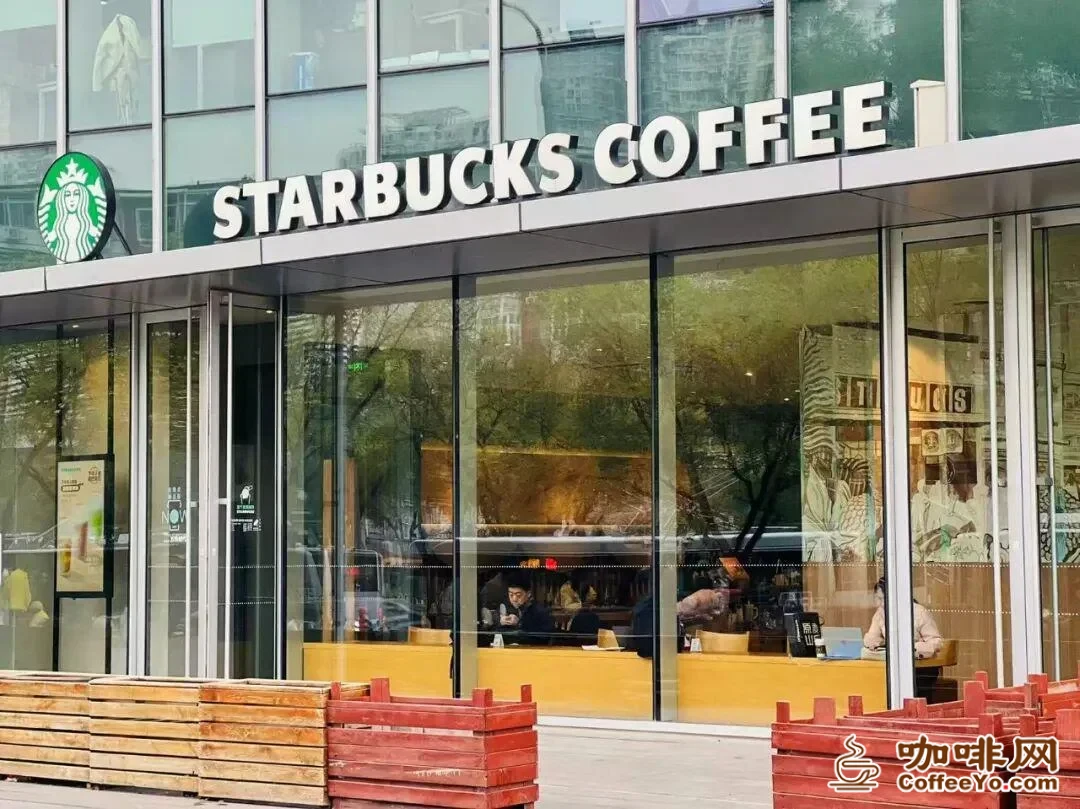
Stores Set Limits Before the Nationwide Rule
In July this year, a Starbucks store in Tianjin put out its own ‘pay-to-sit’ table sign, and the image spread on social media; in September, a store in Nanchong, Sichuan chained up its outdoor seats with a sign reading ‘for paying customers only’, and after the controversy grew the chains were removed but the sign stayed. As early as May 2024, stores in Xi’an and elsewhere had implemented pay-to-sit, without asking people to leave when customer flow was light.
China City News found after review that individual stores acted three months ahead of the nationwide rule. However, standards varied between stores – whether to ask people to leave when business was slow was left to staff judgement; the nationwide rule draws a boundary, yet specific scenarios still leave room.
‘Customer flow has picked up somewhat, but what each customer is willing to pay is falling,’ said Gao Chengfei, deputy director of the Brand and IP Committee of the Influence Research Institute, in an interview with China City News. In the past, free seats were hidden inside the coffee premium; the 9.9-yuan price band thinned that pricing power, and space became an operating cost that needed managing.
According to Starbucks’ results, in the first quarter of fiscal 2026 Starbucks China’s same-store sales grew 7%, with transactions and average ticket up 5% and 2% respectively; in the second quarter same-store sales rose only 0.5%, transactions rose 2.1% and average ticket turned to a 1.6% decline. Two years earlier, in fiscal 2024 average ticket fell 8% year on year, and in fiscal 2025 same-store transactions grew 4% while average ticket fell a further 5%.
Zhu Danpeng, vice chairman of the Guangdong Food Safety Assurance Promotion Association, analysed in an interview with China City News that pay-to-sit is a common international practice. In his view, one should not enter a store and occupy a seat without making a purchase, and the rule itself is fair, just and open; stores differ in nature from the public spaces of CBDs, large shopping malls and complexes, and assessments of sales per square metre and per employee both require stores to screen who enters.
‘Stores have operating costs; when there are few people, getting a cup of hot water and resting a while is fine, but occupying a seat for a long time when customer flow is heavy hurts business,’ Ms. Lu, a Beijing white-collar worker, told China City News. Other coffee shops she often visits have likewise long practised pay-to-sit, with signs marking consumption areas on the tables, and the new rule does not affect how often she goes.
Relevant data show that as of the end of September 2026 Starbucks China had 8,342 stores in total, with net additions of 331 in fiscal 2026, 415 in fiscal 2025, 790 in fiscal 2024 and 885 in fiscal 2023 – fewer new stores each year.
Some practitioners have also revealed that, unlike the past when stores were opened regardless of cost, single-store profit has become a key assessment indicator for stores.
Cost Ownership Shifts With Equity
In November 2025, Starbucks announced a joint venture with Boyu Investment, with Boyu holding up to 60% equity and Starbucks retaining 40% while continuing to hold the brand and intellectual property. The deal closed on 2 April 2026, with roughly 8,000 company-operated stores gradually converted to franchises; the two parties set a long-term goal of growing Chinese stores to 20,000.
In the third quarter of fiscal 2026, the China store business exited full consolidation; Starbucks instead recognised product sales to the joint venture, royalty fees and investment income by equity share, receiving US$52.5 million in related income from the joint venture that quarter, and same-store sales data for the Chinese market were no longer listed separately.
Gao Chengfei analysed that in the company-operated era space costs were borne on headquarters’ balance sheet, with assessments focused more on same-store sales and brand momentum; after the shift to franchising, store rent, labour and maintenance expenses fall directly onto single-store profit and loss, and new shareholder Boyu focuses more on profit margins and single-store sales. The cost of free seats accordingly falls on franchisees.
In the same period, Starbucks China announced that in fiscal 2027 it would add more than 300 million yuan of investment to increase peak-hour and Starbucks Reserve bar service staffing, upgrade digital-intelligent systems and core equipment, and advance facility renewal at about 1,000 stores.
By the reporter’s estimate based on store count, if the full 300 million yuan were used for store renewal, spread across about 1,000 stores it would be roughly 300,000 yuan per store. By Starbucks’ stated scope, the 300 million yuan also covers peak-hour staffing and digital-intelligent systems, and no separate amount for renewal was disclosed. Renewed stores account for less than one-eighth of all stores nationwide.
Gao Chengfei believes that adding peak-hour staffing and renewing stores uses service density and space quality to offset the possible experience loss from tightened entry, so that pay-to-sit is not only subtraction in the single-store model.
The Third Space Is Segmenting
Manner’s stores are mostly around a dozen square metres, with customers taking a coffee at the counter; M Stand turns stores into destinations, where the design itself is a reason to visit; Starbucks takes another path, selling a seat you can take at any time.
Gao Chengfei groups market practices into three categories; the core dimension of segmentation is consumers’ willingness to pay for ‘sitting’ and the rigidity of the scenario, with the three corresponding to efficiency, experience and the certainty of a seat.
Manner has more than 2,000 company-operated stores nationwide, mostly in office-building lobbies and shopping-mall corners, with no seats and transactions completed at the counter. An Orient Securities research report shows Manner’s rent costs are only 10% to 20% of those of traditional coffee shops, with average daily single-store revenue of 7,000 to 8,000 yuan and a gross margin of 62.5%.
Monitoring by Yilan Business shows M Stand had 601 stores in December 2025, rising to 642 by May 2026; at the same time, the number of closed stores declined month by month, all closures being in first-tier and new first-tier cities, with 30% in office buildings, inside industrial parks or community commercial areas outside core business districts, including the Shanghai Jiadi Business Center store and the Shenzhen Chuangzhi Yuncheng store.
Gao Chengfei says plainly that the third space in office-building scenarios fails first, as white-collar workers’ coffee demand has already been intercepted at their desks by 9.9-yuan quick-pickup stores.
At the other end, those sticking with large stores: Peet’s Coffee is still expanding, with 300 to 400 stores in China in 2026, sites concentrated in core business districts and high-end office buildings, and average ticket long stable above 40 yuan.
Starbucks China’s ‘a thousand stores, a thousand faces’ strategy splits stores into several specifications, with 10-square-metre quick-pickup stores, movable coffee carts, small office-building stores, Reserve flagship stores and intangible-cultural-heritage themed stores coexisting.
‘The conditions for large-scale replication are not mature; the premise for pay-to-sit is that the brand itself has sufficient space premium and a base of paying customers. Most chain coffee brands still trade free space for customer flow, and tightening entry would directly hit transaction volume,’ Gao Chengfei predicts. If customer loss occurs in execution, Starbucks’ most likely adjustment is tiered implementation – strict enforcement at busy business-district stores, flexible relaxation at community and low-traffic stores – replacing hard removal with membership benefits or spending thresholds.
Zhu Danpeng believes many domestic consumers have not yet formed the habit of paying to sit. Starbucks China’s stores already cover more than 1,100 county-level markets, where customer density and payment habits differ greatly from first-tier cities, making it hard to apply one uniform rule everywhere to the letter.
Wang Zhendong, chairman of Shanghai Feiyue Investment Management Co., Ltd., noted in an earlier media interview that Starbucks needs stronger training and should not apply a uniform rigid standard; office-building and business-district stores could designate some areas allowing seating without purchase, and the consumption attribute of outdoor seating is likewise unclear, so flexibility could be left there too.
Gao Chengfei believes what sustains Starbucks’ space premium is network density – consumers are willing to pay more for ‘there is always a store with seats nearby’. But he cautions that the moat must keep proving what the price gap between 30 yuan and 9.9 yuan buys; once the space premium is only brand inertia, it will grow shallow from within. Over the next two or three years, he judges the third space will keep segmenting: efficiency stores will keep compressing space and pursuing sales per square metre, paid-experience stores will turn space into a priceable product, and the free large-space model in between will keep shrinking. Starbucks’ choice is to bind the seat to a cup of coffee, letting the third space exist in a different way.
Original title: Starbucks ‘Pay-to-Sit’ Goes Nationwide, the Third Space Moves Toward Scenario Segmentation
Source: China City News reporter Zhang Yaxin
Content editor: Liu Lei
Reprint Notice and Disclaimer
- Compiled and edited by Coffee Network coffeeyo.com — compiled from China City News, “Starbucks ‘Pay-to-Sit’ Goes Nationwide, the Third Space Moves Toward Scenario Segmentation”; the original copyright belongs to China City News and the original authors. This reprint is solely for sharing coffee-industry information and does not represent this site’s position; all data and views follow the original. Our thanks to the original authors for creating and sharing this work.
- Read the original: China City News: “Starbucks ‘Pay-to-Sit’ Goes Nationwide, the Third Space Moves Toward Scenario Segmentation”
- For matters concerning content authorization, attribution, copyright or other issues, please contact us promptly and we will verify and assist at the earliest opportunity; coffee companies and industry media are also welcome to contact us to exchange contributions.
- Coffee Network coffeeyo.com contact: Tel 400-0000-641 (+86-18288016826), Email 478203668@qq.com, Address: Jinghong, Xishuangbanna, Yunnan
Related Reading
 Tim Hortons China Q3: System Sales Up 6.3% Quarter on Quarter
- CRH Plans OATLY Exit, Nayuki Leaves Wenzhou | Tea & Coffee Weekly
 The 2026 Asian Coffee Association Annual Meeting will be held in Dehong, Yunnan, and the Asia ABODY Coffee System Standard will be officially released
 The President of Brazil's Victoria Coffee Business Center (CCCV) led a delegation of four people to Pu'er, Yunnan to conduct a special inspection of the coffee industry
 Behind the 1836 yuan "King of Brands": The Full Industry Chain and Offline Layout of Xinlu Coffee
 From a raw bean to a fragrant cup, Xiamen International Coffee Exhibition unlocks a new picture of the entire industry chain


 Liaoning ICP Security No. 21122402000217