


At a Glance (China Coffee Network):Hubei Daily all-media reporters Gong Xue, Peng Yibo; correspondents He Li, Yang Linghuan.
Hubei Daily all-media reporters Gong Xue, Peng Yibo; correspondents He Li, Yang Linghuan
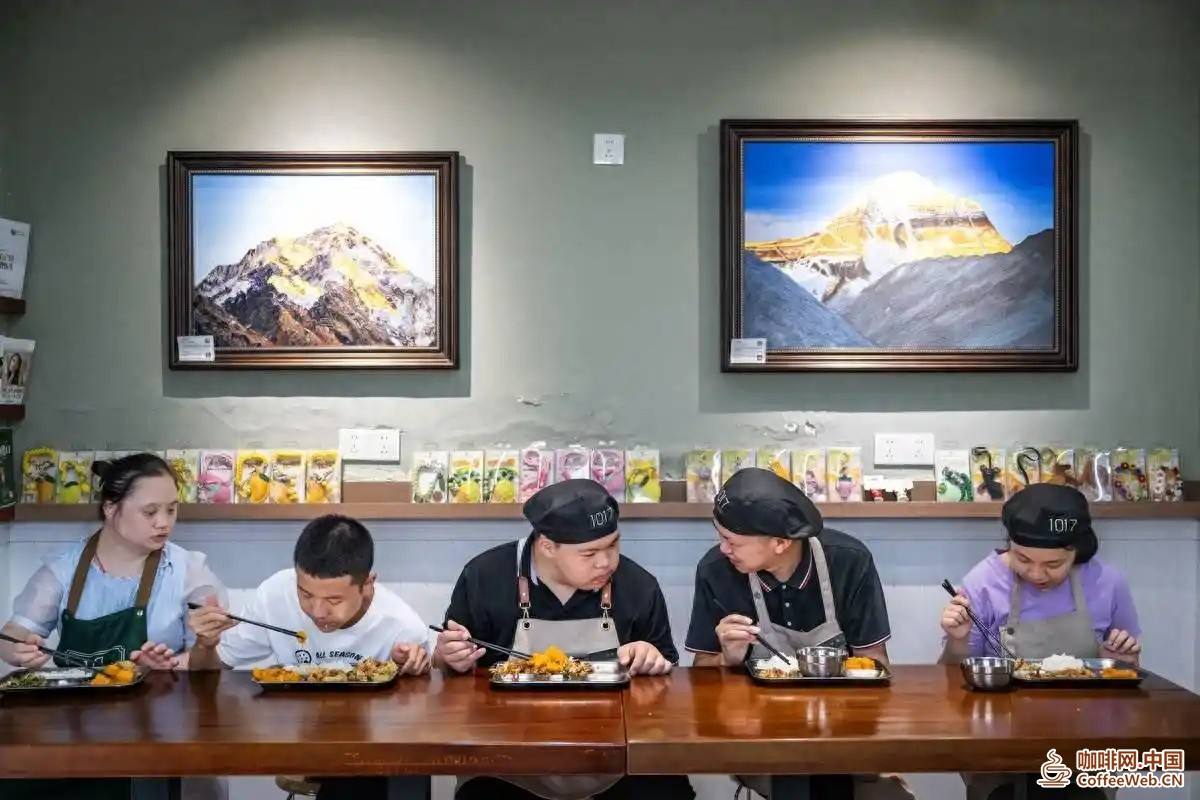
On 22 July, at the 1017 Cafe at No. 8 Gaoxiong Road, Jiang’an District, Wuhan, employees with intellectual disabilities (from left: Wang Zhihan, Yin Haojie, Wang Zirui, Hua Wei, Zhu Xiuli) eat lunch. (Photo by Ren Yong, Hubei Daily all-media reporter.)
After two and a half years of dedicated operation, the 1017 Cafe began to turn a profit this June.
This cafe at No. 8 Gaoxiong Road, Jiang’an District, Wuhan looks unremarkable from the outside. Step inside and you notice the difference at a glance: 12 ‘heart youth’ employees each have their own duties, their busy, orderly figures becoming a distinctive sight in the shop.
‘Heart youth’ is a general term for young people with intellectual disabilities, covering autism, intellectual disability, Down syndrome, cerebral palsy and other types. Once, they were withdrawn into themselves and found it hard to step out of that small world.
At the 1017 Cafe, Hu Hong, founder of the Wuhan Aite Special Children’s Education and Training Centre (hereafter Wuhan Aite), is like a magician, letting these ‘heart youths’ shine in the most suitable posts and redefine their lives as they actively integrate into society and realise their own value.
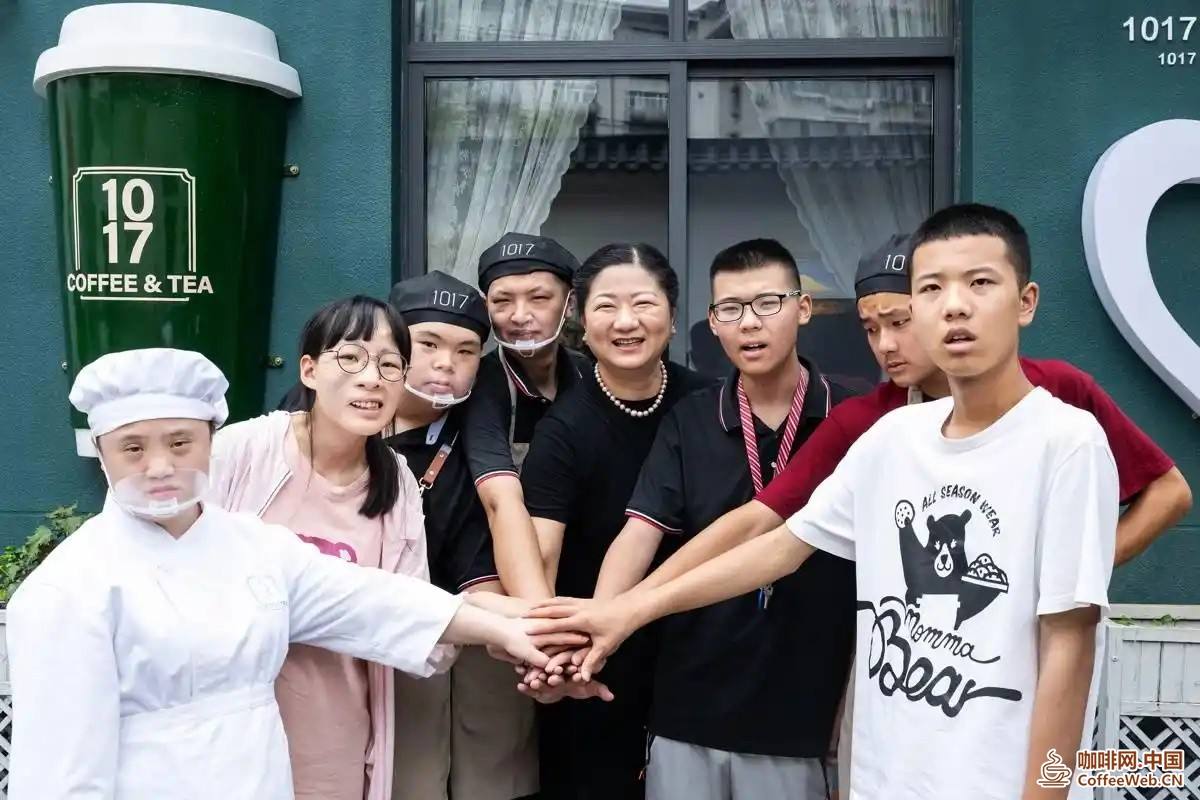
On 22 July, at the 1017 Cafe at No. 8 Gaoxiong Road, Jiang’an District, Wuhan, Hu Hong (fifth from left) with employees with intellectual disabilities. (Photo by Ren Yong, Hubei Daily all-media reporter.)
A single ‘welcome’ took the teachers several months to teach
The 200-plus-square-metre cafe takes pale green as its base tone; from the wall backdrop to the tablecloths and the cups in hand, everything is steeped in a harmonious warm palette, and the overall environment is relaxed and pleasant. Slogans on the wall, such as ‘I’ll be slower, please be lazier’ and ‘Dreams begin with coffee’, are both inspiring and distinctive.
At around 10 a.m. on 18 July, Hubei Daily all-media reporters came to the 1017 Cafe. There weren’t many customers, and the employees weren’t idling; each was busy at their post.
Seeing a customer come in, Chen Zhi’ao bent down, stretched out his right hand and called out loudly: ‘Hello, welcome, come in please.’
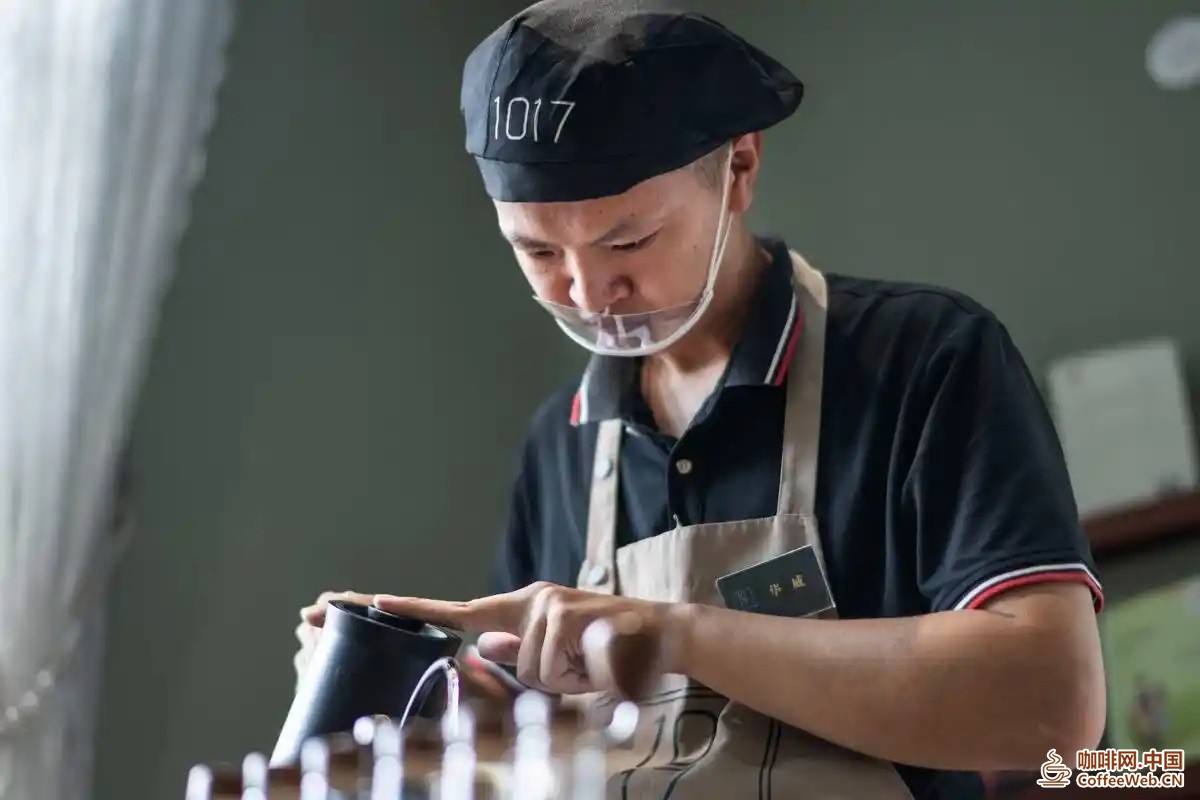
On 22 July, at the 1017 Cafe, barista Hua Wei is making pour-over coffee. Hua Wei has a mild intellectual disability and is the 1017 Cafe’s most ‘senior’ employee. (Photo by Ren Yong, Hubei Daily all-media reporter.)
The customer sits down and orders by scanning a code. Hua Wei deftly makes the coffee: grinding, extracting, portioning, his movements skilled and without a wasted motion.
Wang Zirui is responsible for delivering food to customers. As he sets down the plate he murmurs ‘Enjoy your meal’ and ‘Have a pleasant meal’. Though his enunciation isn’t very clear, a smile never leaves the corners of his mouth.
Every time she sees a scene like this, Hu Hong is especially gratified. Brewing coffee, sealing bags, cleaning up: tasks that look simple to ordinary people take a hundred times the effort for people with intellectual disabilities to do well. Even a single ‘welcome’ took the teachers several months to teach them.
This small cafe carries the dreams of the ‘heart youths’ to break out of isolation, realise their value and embrace society. Chen Zhi’ao, with outstanding language skills, is assigned to greet customers at the door; Wang Zhihan, who likes quiet handicrafts, focuses on sealing cookies in the bakery; the tidy Wang Zirui works as a server; Yin Haojie, with musical talent, is the cafe’s pianist…
Hu Hong explained that of the 12 ‘heart youth’ employees, one is in full-time employment at a monthly salary of about 1,200 yuan; 11 are in supported employment, working 15 hours a week at a monthly wage of about 600 yuan. Six people in Wuhan Aite’s youth vocational class are still in the employment-assessment stage, with teachers assisting in product development and operations for the cafe.
Once prone to outbursts and tears, now he has passed piano grade nine
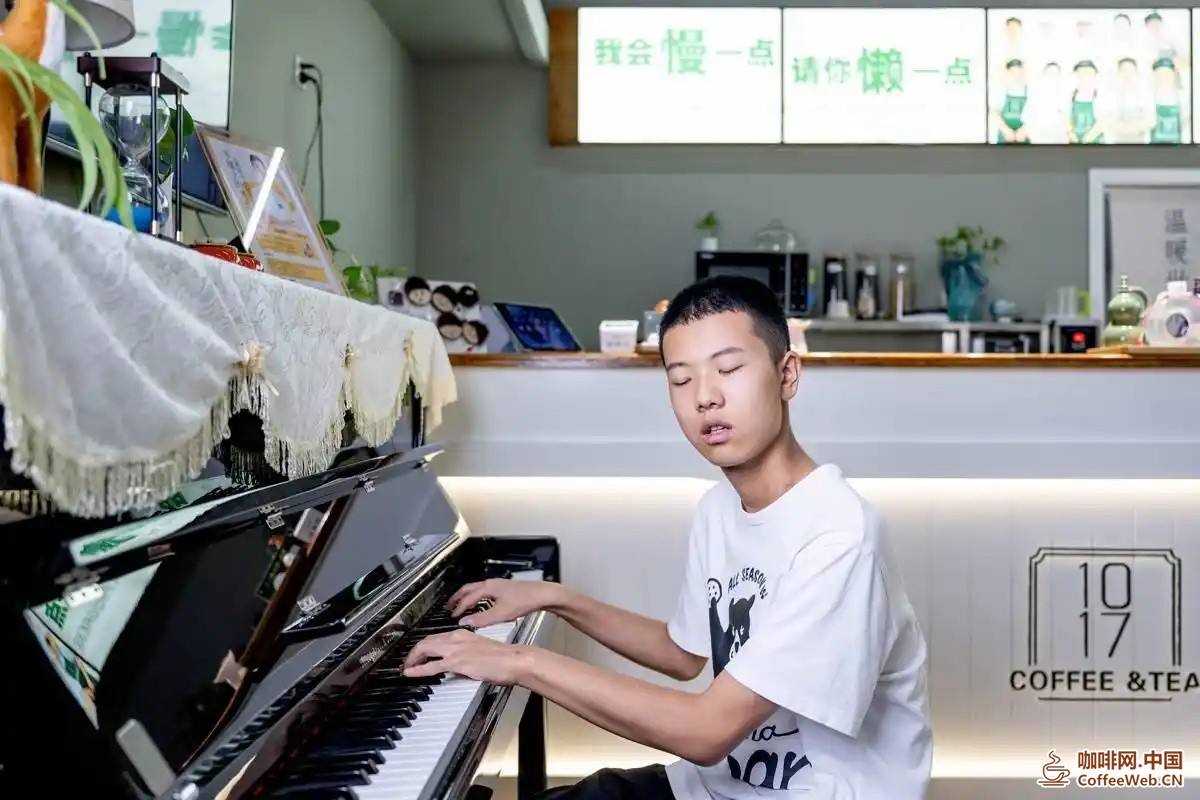
In the cafe’s main hall, 17-year-old Yin Haojie sits upright at the piano bench, fingers flying over the keys; the melody of ‘A Comme Amour’ is now gentle and lingering, now urgent, utterly enchanting.
On 22 July, at the 1017 Cafe at No. 8 Gaoxiong Road, Jiang’an District, Wuhan, 17-year-old autistic boy Yin Haojie plays the piano. (Photo by Ren Yong, Hubei Daily all-media reporter.)
‘When he was born we didn’t notice anything wrong. After age two, we found he wouldn’t make eye contact or speak. Later he was diagnosed with autism, and our mood plummeted from the mountaintop to the valley floor.’ Yin Haojie’s mother couldn’t hold back tears as she recalled her child’s growing up.
Later, as he grew, Yin Haojie became irritable and often cried and hit people at home. Out of helplessness, the family sent him to Wuhan Aite for rehabilitation, where teachers guided him to learn music. At first he learned drums, then began piano at 11. ‘The teachers found he had musical talent; in four months he finished what ordinary children take two years to learn. He practises piano every day and has now passed grade nine,’ his mother said with a happy smile.
‘We only hoped he’d stabilise his emotions and live his life happily; we never imagined he could integrate into society and hold a job.’ Yin Haojie’s mother knows well that for her child to become self-reliant there is still a long road ahead; the 1017 Cafe has lit a flame of hope for them.
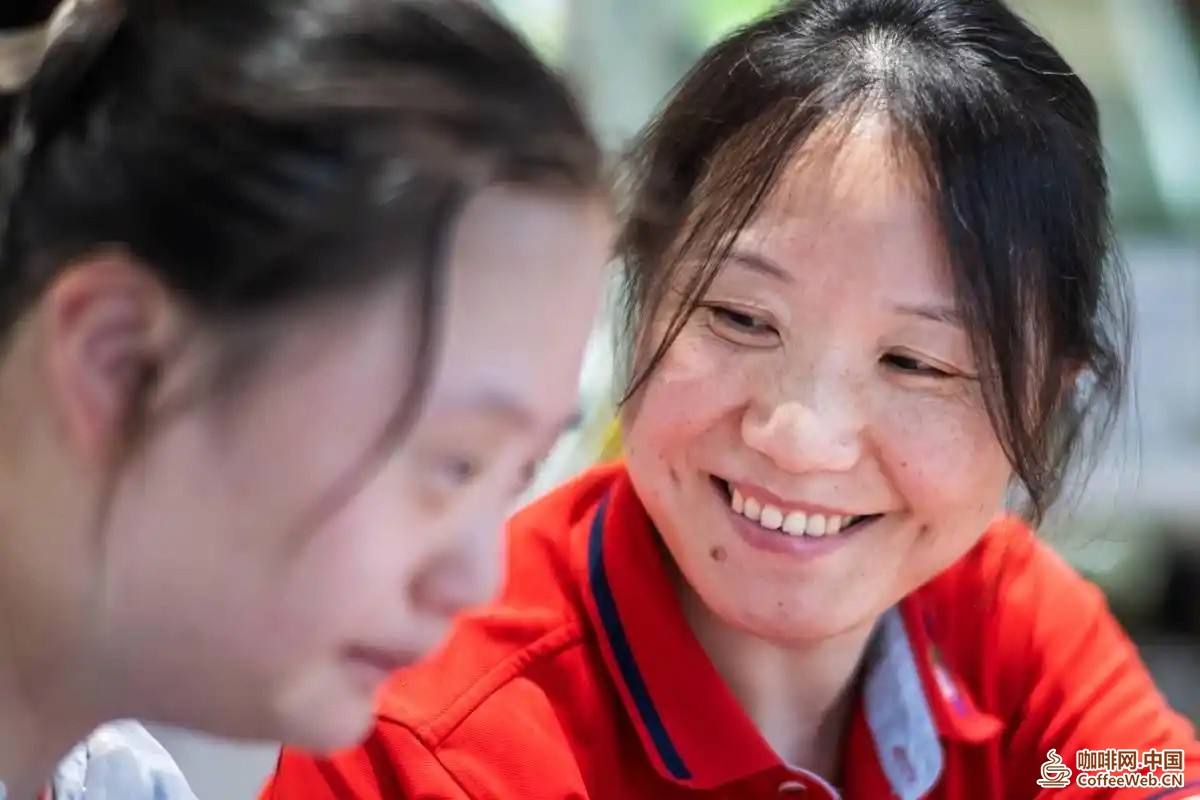
On 22 July, at the 1017 Cafe at No. 8 Gaoxiong Road, Jiang’an District, Wuhan, Zheng Xiaohong (right) looks at her daughter Wang Zhihan (left) with eyes full of love. (Photo by Ren Yong, Hubei Daily all-media reporter.)
Watching her daughter Wang Zhihan concentrate on sealing cookies, mother Zheng Xiaohong is deeply comforted. Wang Zhihan is 24 this year; just eight days after birth she was diagnosed with Down syndrome and congenital megacolon, and doctors judged her survival rate at under 1%. At the time Zheng Xiaohong felt ‘the sky had fallen’, but never gave up on her child. Once she was physically ready for the megacolon surgery, Zheng brought five-year-old Wang Zhihan to Wuhan Aite to begin rehabilitation and learning.
‘She’s worked at the cafe for a year and a half; her language expression and cognitive comprehension have improved a lot, and her personality has grown more cheerful,’ Zheng Xiaohong said with feeling. ‘This job is a breakthrough for her; it opened the door to hope. The child is getting better, and it feels like the whole family has been reborn.’
Graduation equals unemployment? Opening a window into society
Hu Hong was once a teacher at a Wuhan welfare institution and witnessed many heart-wrenching scenes of children with intellectual disabilities being abandoned. Working on the front line of special education, she could read the hardship behind those parents all the more: intellectual disability is mostly congenital and incurable, lacking social support and professional guidance; unable to face a child’s whole life, they had no choice but to give up their own child.
In 2005, Hu Hong resigned her public post and founded Wuhan Aite, letting special children receive rehabilitation and special education close to home. ‘At the time Wuhan already had schools for the blind, schools for the deaf, schools for the intellectually disabled and other special-education schools, but private educational institutions for the intellectually disabled group were still a blank,’ Hu Hong said. ‘I wanted to found a professional institution in the community, right at people’s doorsteps, to accompany parents and children in hacking a path through the thorns!’
Over 21 years, Wuhan Aite has taken in more than 8,000 children with intellectual disabilities for rehabilitation; besides Hubei, parents from nearby provinces such as Anhui, Hunan and Henan have also come seeking it out. At present Wuhan Aite’s three campuses in Jiang’an, Hanyang and Huangpi have over 400 enrolled students.
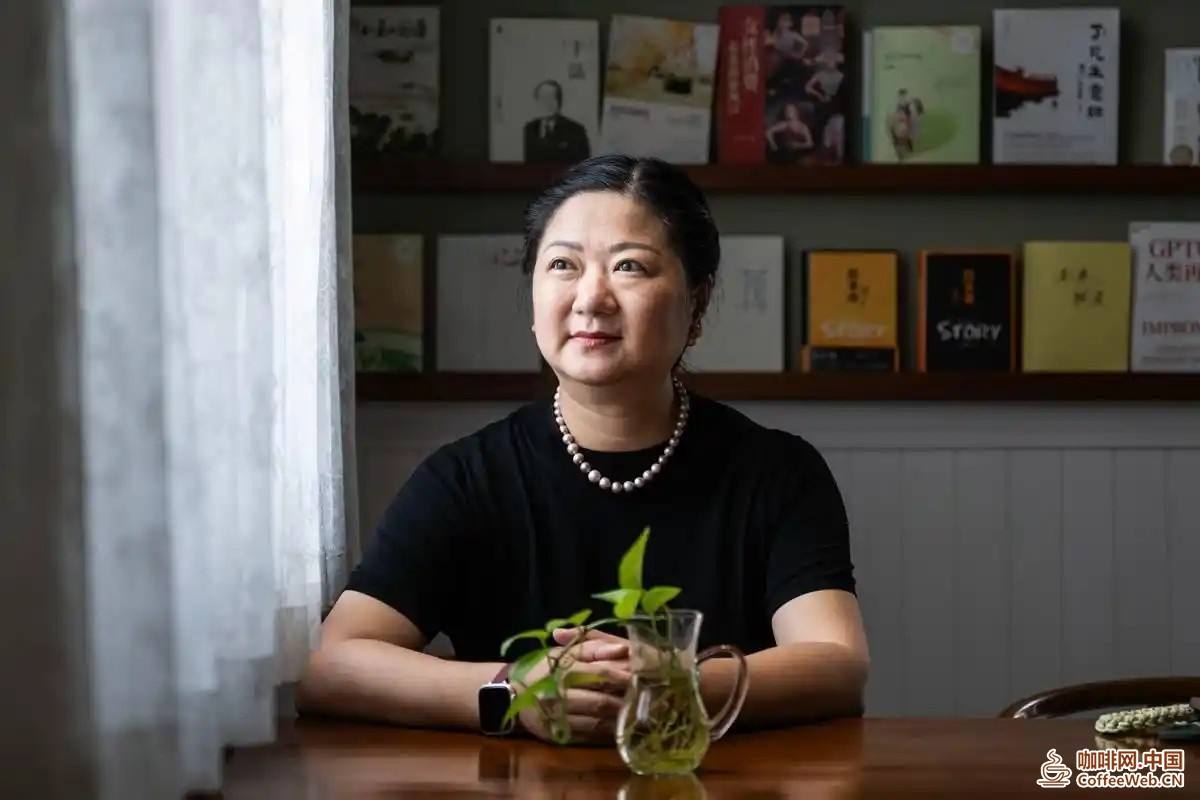
‘Many children, after a period of training and rehabilitation, can look after themselves and join ordinary schools. But after they graduate, new difficulties come one after another,’ Hu Hong said. ‘Many older youths with intellectual disabilities, lacking employment channels, find graduation equals unemployment; group living turns into solitary living, so rehabilitation results are greatly discounted, and some even see years of training results come to nothing.’
Watching more and more special children gradually grow up, how to let them enter society became a question Hu Hong kept pondering. Earlier, some parents had found their children jobs at companies, but the results weren’t ideal. After starting work, the children repeatedly ran into walls due to social barriers, insufficient employment support and outside prejudice, and were eventually sent back to the family.
Hu Hong wasn’t resigned to this. After scouting around, she decided to found a cafe as a supported-employment workplace for the ‘heart youths’, letting them ‘rehabilitate through work and work through rehabilitation’. In October 2023 the 1017 Cafe officially opened, offering customers coffee, baking, fruit tea, fruit juice, customised holiday gifts and other services. ‘1017 is a homophone for invite you together (yao nin yi qi),’ Hu Hong said. ‘This is both a classroom for the vocational rehabilitation practice of youths with intellectual disabilities and a window for them to integrate into society.’
Mutual healing; no striver will be let down
This June, the 1017 Cafe began to turn a profit. ‘This breakthrough is not only a business breakthrough, but the best proof of social inclusion,’ Hu Hong said.
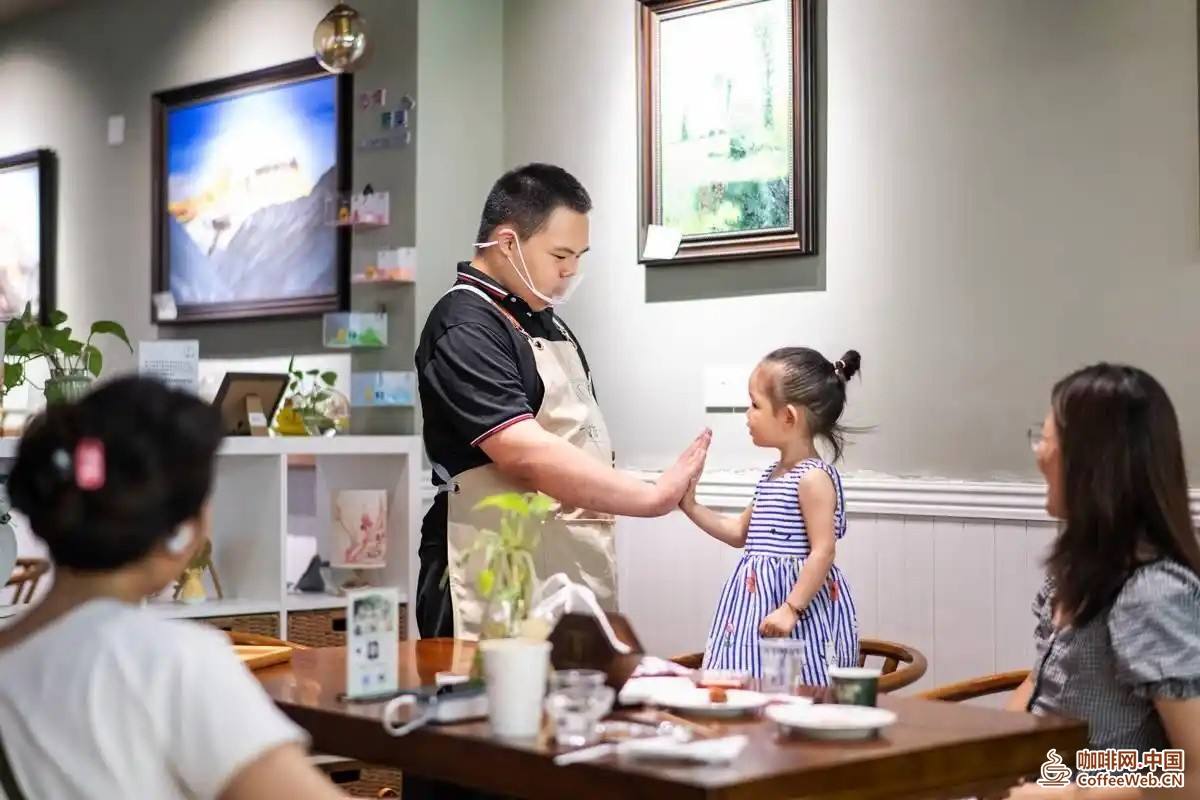
Since summer began, the cafe’s online and offline daily orders have exceeded 100. Customers have interacted more with the ‘heart youth employees’, cheering them on, showing tolerance when their movements are slow, and some would bring friends along to visit the cafe.
Many citizens make a special trip to check in at the cafe, conveying kindness through their spending, and also come here to heal anxiety. Ms. Xie, a customer escaping the heat at the cafe that day, had once been on the verge of collapse from a tense parent-child relationship. She brought her child to Wuhan Aite’s public-welfare activities, and through time spent with the ‘heart youths’ gradually dissolved the conflict between mother and son. Now that her child has got into university, she specially returned to the little shop to feel this warm strength.
‘People with intellectual disabilities are like a mirror, reflecting how precious health is, and letting us see the diverse richness of life,’ Hu Hong said. Social inclusion has never been about making special groups erase their differences and become ordinary, but about letting every difference be respected and finding an outlet for value for every trait.
Data show that nationwide there are nearly 20 million people with intellectual disabilities, with an employment rate under 5%. Starting from one cafe, Hu Hong keeps to her original intention without stopping, planning to keep broadening employment channels and build a tiered inclusive-employment system: outstanding trainees can intern at social enterprises such as Wuhan’s cultural-tourism cafes, bakeries and food companies, gradually leaving sheltered settings and adapting to real workplaces; through a handicraft and creative-products platform, trainees can earn labour income by making handmade goods, realising self-worth through multiple channels.
‘I’m not fighting alone; now more care is being showered on them,’ Hu Hong said. The state has woven a denser safety net for people with intellectual disabilities, with subsistence allowances and rehabilitation subsidies, family living allowances, corporate charity funds, and special education flourishing in many forms.
In this small cafe, the ‘heart youths’ break free of the gloom and shine in ordinary posts, letting more people see that no striver will ever be let down.
Reprint Notice & Disclaimer
- This article has been edited and compiled by China Coffee Network. The information and images therein come from public sources and the copyright belongs to the original author. This reprint is intended solely for information sharing within the coffee industry and does not represent the views of this website; all data and opinions are subject to the original article. Our thanks to the original author for creating and sharing it.
- For matters concerning content licensing, attribution, copyright or otherwise, please contact us promptly and we will verify and cooperate in handling them as soon as possible. We also welcome coffee origins, brands and industry media to exchange ideas and contribute articles.
- Contact China Coffee Network: Tel 400-0000-641 (+86-18288016826) | Email 478203668@qq.com
Related Reading
 Jiangxi Wuyuan: Rural Coffee Unlocks New Cultural Tourism Formats
 Jiangxi Wuyuan: Rural Cafes Unlock New Cultural Tourism Formats
 Global quality goods gather at Hongqiao Import Commodity Exhibition Center, setting "Chinese standards" for coffee
- Global premium products gather to set China's coffee standards as Hongqiao Import Commodity Exhibition Center keeps the CIIE spirit alive
- Global quality goods gather as Hongqiao Import Commodity Exhibition Center and CIIE forge lasting partnership to set China's coffee standards.
 Zhejiang "Science Cafe" Promotes Embodied Intelligence in Real-World Scenarios


 Liaoning ICP Security No. 21122402000217