


At a Glance (China Coffee Network): Source: Half Month Talk – A portable coffee cup has become the “standard item” for city dwellers heading out in the morning, and “bring-your-own-cup discounts” are evolving from a merchant promotion into a public consensus on low-carbon living. From a money-saving trick to a new environmental awareness, from an individual choice to an urban fashion, bringing your own cup is no longer a niche behavior but a vivid carrier reflecting social civilization, new consumption ideas, and attitudes toward life. From “saving money”
Source: Half Month Talk
A portable coffee cup has become the “standard item” for city dwellers heading out in the morning, and “bring-your-own-cup discounts” are evolving from a merchant promotion into a public consensus on low-carbon living. From a money-saving trick to new environmental awareness, from an individual choice to an urban fashion, bringing your own cup is no longer a niche behavior but a vivid reflection of social civilization, new consumption concepts, and attitudes toward life.
From “Saving Money” to “A Lifestyle Trend”
Shanghai’s mornings are always awakened by the aroma of coffee. “Heading out for coffee first thing in the morning feels more ritualistic than ordering delivery,” Xiao Shen, who recently started working in Shanghai, told a Ban Yue Tan reporter. Xiao Zhang, a white-collar worker in Shanghai’s Jing’an District, has also picked up the habit: “Each cup is 5 yuan cheaper, which adds up to a free coffee over a week.”
“Saving money” is the most direct motivation for consumers to bring their own cups. At present, many coffee brands offer discounts of 2 to 8 yuan to customers who bring their own cups. Beyond the savings, there is a deeper ecological meaning to this calculation. According to research data from China’s product life-cycle greenhouse gas emission coefficient database and the Institute of Public and Environmental Affairs, a single use of a personal cup reduces carbon emissions by about 40 grams. Used every day, the annual carbon savings are equivalent to planting a tree.
Ban Yue Tan reporters found during visits that the group of consumers bringing their own cups is steadily growing. At a coffee shop in an area dense with office buildings, a staff member gave a rather impressive figure: “Our store sells about 100 cups of coffee to customers bringing their own cups every day.”
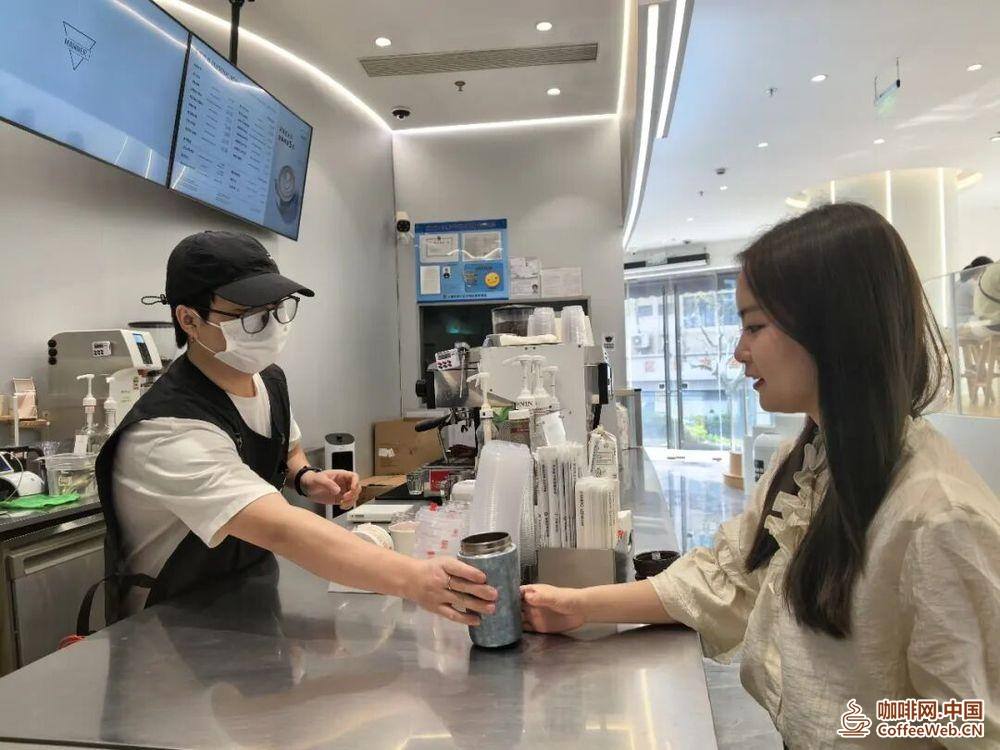
Buying coffee with a personal cup. Photo by Zhou Xinyi
Simplicity, environmental friendliness, and reusability are exactly the life aesthetic today’s young people pursue. On social platforms, netizens compete to show off their cups, their eco check-ins, and their carbon-saving tallies. This “bring-your-own-cup movement” has also shifted from merchant-led to consumer co-creation: the personal cups people post come in all shapes, stemmed glasses, ceramic bowls, thermoses… “Being green” is turning from stern preaching into a fun life experiment.
From “A Cup of Coffee” to “A Green Lifestyle Chain”
Beyond a single cup of coffee, the concept of green consumption is also entering fast food, baking, and other fields, moving from niche scenes into mainstream life.
Many consumers who consistently bring their own cups also tend to carry their own tableware, use eco-friendly bags, and refuse over-packaged goods. They actively tick “no tableware needed” when ordering delivery, prefer simply packaged products when shopping, and favor walking, cycling, or public transport when traveling. These small eco-friendly acts link together to form a complete green lifestyle chain.
Driven by the personal-cup coffee craze, the logic of “reusable” is extending to more containers such as meal boxes and dessert bowls. Some bakeries proactively offer small discounts to customers who bring their own cups or packaging boxes; some fast-food restaurants have launched discounts for bringing your own meal box…
Many coffee brands have followed the trend in good time. Beyond supporting personal cups, quite a few stores are weaving environmental protection into service details by adding dine-in ceramic cups, improving recycling systems, and reducing packaging consumables.
Digital platforms have become the “connector” of green living. Major life-service apps such as Meituan and Dianping have launched a “bring your own cup” search feature.
From “Individual Action” to “Social Consensus”
In the past, disposable cups became the mainstream of consumption because they were convenient and cheap, with huge numbers of paper and plastic cups used and discarded in rapid succession. “The world uses about 500 billion disposable cups each year; laid end to end they could make 85 round trips to the moon, and a large share eventually enter the environment and break down into microplastics, posing long-term threats to water, soil, and even human health,” said Chen Aijia, project manager at the environmental organization “Break Free From Plastic.”
That is exactly why the value of personal cups draws attention: every reuse is an act of cherishing resources.
The green consumption wave sparked by personal cups in Shanghai is spreading rapidly nationwide. According to Meituan platform data, more than 17,000 stores across the country have added a “bring your own cup” tag, of which over 2,200 are in Shanghai, ranking first nationwide.
Besides personal cups, reusable cups also offer a new option for beverage consumption today. At coffee and tea festivals in many places, reusable-cup rental services have appeared: customers borrow standardized reusable cups at designated stations and, after use, simply return them to partner stations with no need to wash them. This effectively lowers the barrier to participation, letting consumers who have no time to carry or wash a cup easily join the low-carbon ranks.
Ban Yue Tan reporters: Zhou Xinyi, Chen Xiaoyu
Original title: “Bring Your Own Cup: A New Fashion Item for the Dual-Carbon Goals”
*This article is from Issue 7, 2026 of the internal edition of Ban Yue Tan
Source: Half Month Talk
From ‘A Cup of Coffee’ to ‘Green Life Chain’
From ‘Individual Action’ to ‘Social Consensus’
Reprint Notice & Disclaimer
- This article has been edited and compiled by China Coffee Network. The information and images therein come from public sources and the copyright belongs to the original author. This reprint is intended solely for information sharing within the coffee industry and does not represent the views of this website; all data and opinions are subject to the original article. Our thanks to the original author for creating and sharing it.
- For matters concerning content licensing, attribution, copyright or otherwise, please contact us promptly and we will verify and cooperate in handling them as soon as possible. We also welcome coffee origins, brands and industry media to exchange ideas and contribute articles.
- Contact China Coffee Network: Tel 400-0000-641 (+86-18288016826) | Email 478203668@qq.com
Related Reading
 Jiangxi Wuyuan: Rural Coffee Unlocks New Cultural Tourism Formats
 Jiangxi Wuyuan: Rural Cafes Unlock New Cultural Tourism Formats
 Global quality goods gather at Hongqiao Import Commodity Exhibition Center, setting "Chinese standards" for coffee
- Global premium products gather to set China's coffee standards as Hongqiao Import Commodity Exhibition Center keeps the CIIE spirit alive
- Global quality goods gather as Hongqiao Import Commodity Exhibition Center and CIIE forge lasting partnership to set China's coffee standards.
 Zhejiang "Science Cafe" Promotes Embodied Intelligence in Real-World Scenarios


 Liaoning ICP Security No. 21122402000217