


At a Glance (China Coffee Network):In 1836, the first whiff of coffee aroma drifted out from Jingyuan Street in the Thirteen Hongs, sowing the cultural seed of Chinese-Western fusion in Guangzhou, this millennium-o.
In 1836, the first whiff of coffee aroma drifted out from Jingyuan Street in the Thirteen Hongs, sowing the cultural seed of Chinese-Western fusion in Guangzhou, this millennium-old commercial metropolis. A hundred and ninety years later, Guangzhou baristas have stepped onto the highest podium of world coffee competitions, dazzling the globe with the prowess of local coffee. From “imported novelty” to “neighborhood daily ritual,” this beverage has completed a profound process of localization in the millennia-old trading city. The 2026 Guangzhou Coffee Culture Season further ignited a citywide consumption boom. According to the latest Meituan data, within just two months Guangzhou added 376 new coffee outlets, as vibrant consumer enthusiasm translated into tangible expansion of its market footprint.
Today’s Guangzhou is already the city with the second-highest number of coffee outlets nationwide, with the total number of stores across the city surpassing 8,000. A complete coffee industry chain with an annual output value of 67 billion yuan is operating quietly, directly driving employment for over 150,000 people, with a daily consumption of freshly brewed coffee reaching 2 million cups. Behind these numbers lies Guangzhou’s unique coffee development path: it lies not only in the growth of industry scale, but also in the two-pronged effort of “fusion innovation” and “professional breakthroughs.”
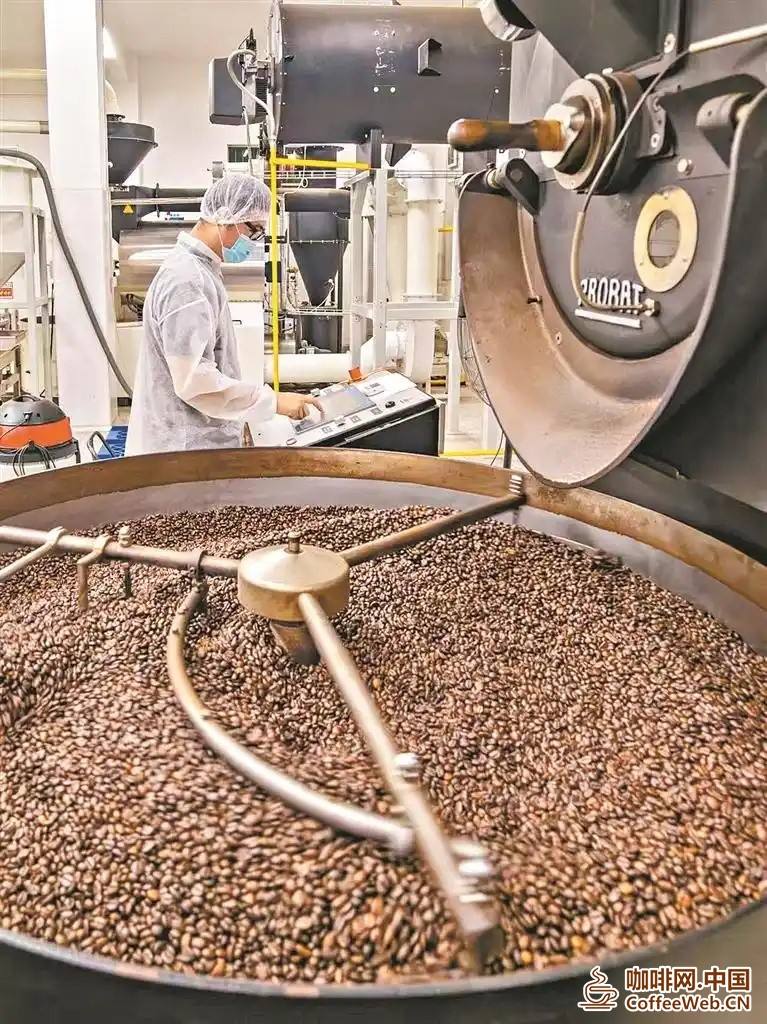
A modern coffee roasting factory located in Baiyun District.
On the Competitive Stage: Chasing Glory, Claiming the Crown
Not long ago, the global final of the World Coffee and Spirits Championship in Brussels, Belgium concluded, where Guangzhou barista Liu Zhanhong clinched the title in one stroke, securing the first-ever global overall championship for a Chinese contestant in this event, setting the competition’s highest historical score with a flawless undefeated record, showcasing to the world the professional strength and innovative ingenuity of Cantonese-style coffee.
Liu Zhanhong’s cross-over dream-chasing journey is also a true reflection of how Guangzhou’s coffee artisans diligently cultivate their craft and press forward toward the light.
Before crossing over into the field, Liu Zhanhong had long been deeply engaged in the financial sector, with no connection to the coffee industry. Driven by passion, he resolutely stepped out of his comfort zone, rooted himself in Guangzhou and started from scratch, beginning at grassroots positions in street-side cafes, quietly honing his brewing skills and accumulating industry experience. Through day-after-day practice, he built a solid professional foundation. When competing on the international stage, Liu broke the established paradigms of Western coffee, ingeniously blending in local dried lychee white wine, fusing Lingnan local flavors with professional technique to create a competition piece with unique Oriental charm, letting the allure of Cantonese-style coffee dazzle the world.
The atmosphere of mutual support and mutual achievement within Guangzhou’s coffee circle is the solid foundation for artisans’ growth. During Liu Zhanhong’s competition preparations, Qiu Jianming, a previous Chinese champion of the event, personally coached and empowered him, while Chinese champion baristas such as Ma Zhenxing and Wang Jianning voluntarily roasted competition beans and provided assistance throughout. This open, sharing, and mutually progressive industry ethos has given rise to the much-watched “Guangzhou coffee champion phenomenon.”
In recent years, a host of local coffee artisans such as Li Menghu, Sun Yanji, and Song Chundan have successively won top awards at domestic and international competitions, building Guangzhou’s formidable local coffee talent matrix. The highlights on the competitive stage testify to professional heights, while the rich aromas in the streets and alleys carry the warmth of everyday life. Guangzhou’s coffee artisans empower the industry with professionalism and fuse culture with craftsmanship, letting coffee deeply integrate into the daily life of the City of Flowers.
Dual Tracks in Symbiosis, Everyday Vibrancy Reinvented
On the international podium, Guangzhou baristas let the outside world see the hardcore professionalism of Cantonese-style coffee. Yet what truly upholds the city’s coffee-filled, down-to-earth vibrancy is the local coffee force that has blossomed everywhere across the city, each displaying its own strengths. Guangzhou’s local coffee has forged a highly distinctive development path: local chain brands advance steadily and expand outward, deepening their supply chains and expanding their market footprint; independent specialty shops take root in the streets and alleys and cultivate locality, refining signature flavors and precipitating the city’s character. The two business formats grow in symbiosis and complement each other, interpreting the Cantonese people’s urban character of pragmatic diligence and agile innovation.
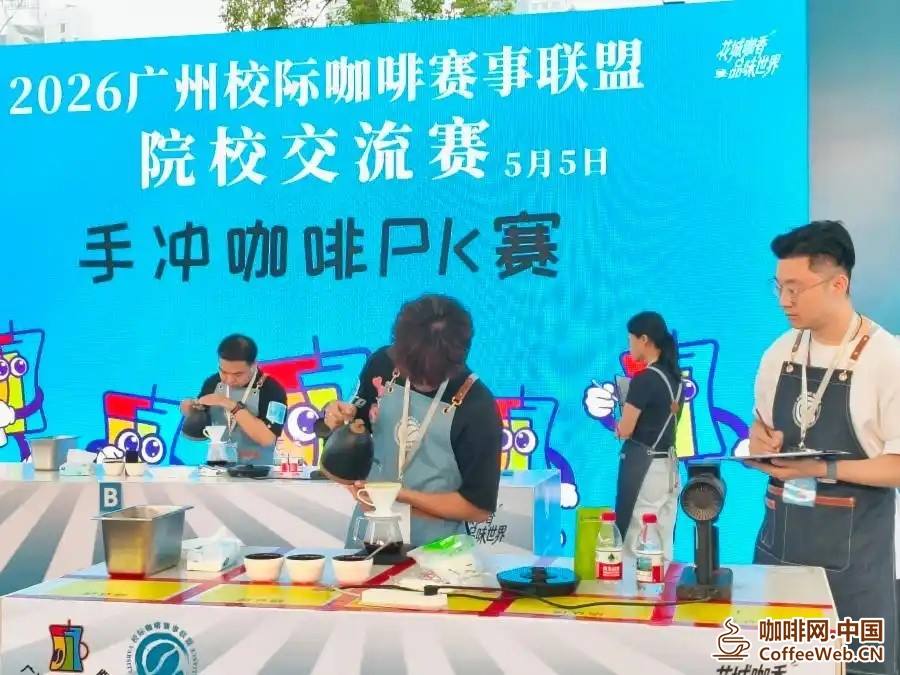
The 2026 Guangzhou Inter-School Coffee Competition Alliance college exchange tournament — pour-over coffee PK competition.
Chains Expand Boundaries, Plan Long-Term and Cultivate Deeply
Rooting in locality, cultivating deeply over the long term, and advancing with scale are the most distinctive hallmarks of Guangzhou’s coffee chain brands. Guangzhou’s local chain brands have always carried the steadfast character of Cantonese industrialists—eschewing short-term gimmicks and building long-term reputation. The growth story of Tili Coffee is the best illustration.
Born in Guangzhou in 2020, Tili Coffee started from local streets and alleys, and now boasts over 200 stores nationwide, with a presence across major cities—reaching as far north as Harbin and as far west as Aksu in Xinjiang—achieving a nationwide footprint.
Brand founder Liu Qiao frankly stated that Guangzhou is the best "proving ground" for local brands: "Guangzhou consumers have exacting demands for food, have seen specialty products, and understand value for money; flashy marketing is meaningless—only solid quality and affordable pricing can retain a lasting market." After crossing over into the coffee track, the team did not rush to capture traffic, but instead rooted itself in Baiyun District to build its own modern roasting factory, firmly controlling the core links of the entire chain—coffee bean roasting, quality control, and pricing.
With a daily production capacity of 5 to 7 tons and an annual capacity ceiling of about 2,000 tons, the fully self-roasted model both stabilizes product quality and consolidates price advantages, enabling it to gain a firm foothold in the mass market of "tasty yet affordable," using real industrial strength to validate the value of long-termism.
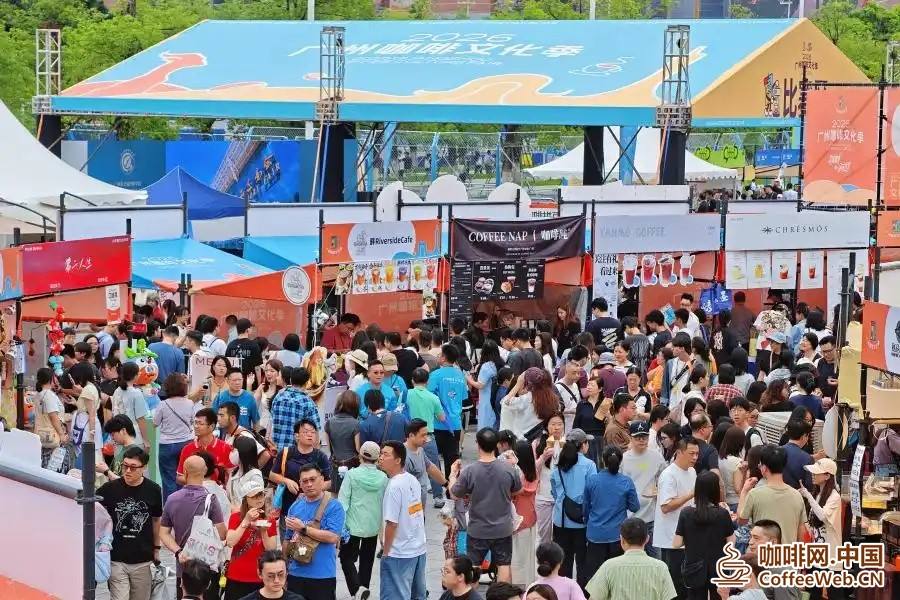
May 4, 2026: the main venue of the Guangzhou Coffee Culture Season was bustling with visitors.
Compared with Tili’s business route of deepening its supply chain and expanding at scale, PAIXCOFFEE has taken a chain development path of “building brand differentiation barriers through local innovation,” demonstrating the precise business insight of an emerging brand. Born in Haizhu District in 2020, PAIX has deeply cultivated a direct-operated layout across the Guangdong-Hong Kong-Macao Greater Bay Area, with over 40 chain stores to date. Relying on keen market judgment, the brand team captured the commercial value of local innovation from the early startup phase: specialty coffees that fit Cantonese food culture and incorporate Lingnan local flavors have received continuously positive market feedback and extremely high consumer recognition. Based on this core business judgment, PAIX firmly takes Cantonese culture as its core brand DNA, abandons the homogeneous track of copying Western coffee, and continuously deepens localized creative R&D.
Over the years, PAIX has continuously iterated its local creative products, successively launching differentiated items such as mulberry-chrysanthemum coffee and Pearl River Beer coffee, constantly strengthening its local brand label. During the 2026 Guangzhou Coffee Culture Season, PAIX partnered with Fengxing Milk to launch the Wuzhimaotao (five-finger hair root) clay-pot latte, which precisely captured Cantonese dietary preferences and urban cultural characteristics, innovatively using a sand-clay pot container to create a regional memory point, successfully setting the market ablaze. Sales of this limited specialty drink increased by 30% compared with earlier seasonal limited editions, achieving not only a sales breakthrough but also going viral at home and abroad thanks to its distinctive Lingnan identity, thereby solidifying a differentiated advantage for the brand’s chain development. Local innovation is the core key for Guangzhou’s emerging brands to break through and grow.
Huilai Coffee deeply cultivates the specialty coffee niche, leveraging the industry perspective of its founder Deng Ziyang in bulk commodity trade; the brand has been positioned on a full industry-chain layout from the start, rigorously selecting premium green beans overseas, building its own professional roasting system, and constructing a complete system from source supply chain to terminal stores. Adhering to refined “one store, one scene” operations, it creates exclusive spatial aesthetics tailored to local conditions. With stable quality and a unique character, it now operates 12 chain stores in Guangzhou and Foshan.
Street Alley Vibrancy, Cantonese Flavors Reborn
Unlike the scaled expansion of chain brands, independent specialty shops scattered throughout the city’s old streets and alleys adhere to a refined, distinctive development route, guarding Guangzhou’s exclusive coffee memories with a unique local texture. In Yongqing Fang of Xiguan, the century-old western-style houses of Dongshan, and the tree-shaded streets of Shamian, one distinctive cafe after another is deeply integrated with the old city’s fabric, radiating a unique charm of old-and-new symbiosis.
Deep cultivation of local-flavor innovation is the most distinctive trait of Guangzhou’s independent specialty coffee shops. Li Menghu, a native Guangzhou resident and founder of Mengxiang She (Dream House), relying on his deep understanding of local food culture, has created hit items such as Yulan Magnolia Dirty and Old Guangzhou Dirty, incorporating local ingredients familiar to old Guangzhou natives—such as yulan magnolia, water apple, and wax apple—into coffee, locking childhood nostalgia and the sweet, fresh Lingnan flavors into the cup, so that every coffee carries its own Cantonese everyday-memory.
Enning Gongfei, rooted in a century-old ancestral home in Xiguan, is a vivid carrier of the old city’s coffee culture. The shop owner revitalized his own century-old ancestral house, decorating the store with old Xiguan objects such as Manchurian windows, patterned floor tiles, and vintage sewing machines, naming specialty drinks in authentic Cantonese such as “smooth and silky” and “cool and refreshing,” and incorporating Cantonese desserts such as double-skin milk into coffee R&D. In a coffee form beloved by young people, it gently inherits the century-old humanities story of Xiguan. Haizhu’s Shixiang Garden launched the “Ten-Fragrance Coffee” blending Lingnan painting-school elements; Yuexiu created the local brand “Yue Coffee”; the Canton Tower launched distinctive creative coffee. This flourishing innovation landscape lets Cantonese-style coffee completely break out of the Western framework and become a cultural calling card exclusive to the City of Flowers. One small shop after another, one specialty drink after another, with tiny yet vivid innovations, piece together the lively panorama of Guangzhou coffee’s vibrant, hundred-flowers-in-bloom diversity.
Sunny, a senior coffee enthusiast who regularly checks in at Guangzhou’s local coffee shops, believes that what makes Guangzhou coffee most special is its infusion of local ingredients and old-city charm into the coffee. A specialty drink that carries Cantonese memory and original thinking in a cup moves coffee lovers more deeply, and also turns drinking coffee into a way of understanding the city’s culture.
Fertile Soil of the Trading City: Accumulating and Growing
Why has Guangzhou been able to cultivate top-tier coffee talent and incubate quality local brands?
The answer lies in the joint nourishment of the millennia-old trading city’s profound heritage, its inclusive urban temperament, its quality consumption ecosystem, and its mutually supportive industry atmosphere. The uniquely endowed urban soil has allowed the foreign coffee culture to be thoroughly localized, providing entrepreneurs with an ideal environment for bold innovation, safe trial-and-error, and steady growth.
The millennia-old commercial lineage and the open, inclusive urban foundation have cemented the development roots of Guangzhou's coffee industry. As the birthplace of Chinese coffee culture, Guangzhou saw the birth of the country's first coffee house in the Thirteen Hongs in 1836, and the appearance of the country's first coffee roasting workshop in Fangcun in 1905.
Nearly two centuries of Chinese-Western fusion and overseas-Chinese cultural immersion have long freed coffee from niche trend status, making it a life habit passed down through generations in Lingnan.
The millennia-old trading metropolis, inclusive and absorptive, reaching out to the four seas, excels at absorbing foreign goods and blending foreign cultures, and is even better at completing innovative transformations by combining local livelihood characteristics.
This temperament—open and not exclusive, adaptable and not conservative—has let coffee break free from Western standardization constraints, smoothly connecting with Cantonese cuisine, Lingnan local flavors, and old-city everyday life, providing profound cultural support for the differentiated innovation of local coffee.
At the same time, relying on a mature commercial distribution system, Guangzhou—though it does not mass-produce coffee beans—steadily holds its position as the core hub for the distribution of green coffee beans nationwide, having built a complete industry chain covering green bean trade, roasting and processing, equipment manufacturing, cultural-creative training, and terminal consumption.
This 67-billion-yuan-level industrial base safeguards brands' entrepreneurial iteration, upgrading, and breakthroughs.
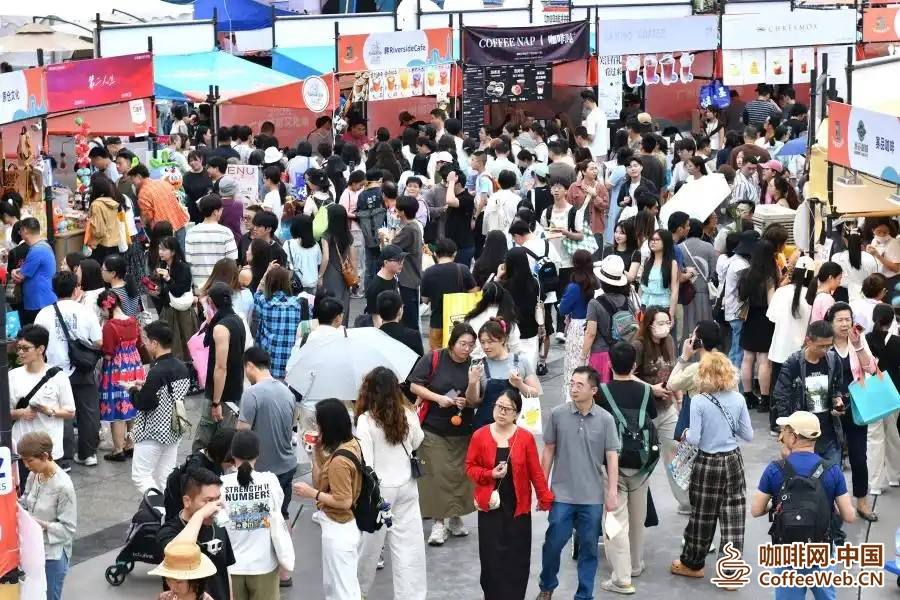
May 4, 2026, at the main venue of the Guangzhou Coffee Culture Season, numerous citizens and tourists came to participate in the event.
The dietary gene of “eating in Guangzhou” has shaped local consumers’ demanding yet inclusive consumption traits, becoming the core driving force that compels the industry to refine itself. Old Guangzhou natives pursue flavor, mouthfeel, and quality to the extreme, and are willing to pay for good quality and genuine value for money, which at the root filters out frivolous internet-famous business models and retains quality brands that steadfastly make products and earnestly innovate. At the same time, Guangzhou’s consumption market is highly inclusive: classic pour-over, Lingnan specialty drinks, mass-market chain beverages, and niche specialty coffee—every format can find its dedicated audience, forming a healthy market pattern of “quality as king, innovation as breakthrough.”
The open, sharing, and mutually advancing industry ecosystem endows Guangzhou coffee with an endless stream of innovative vitality. Guangzhou’s coffee circle has always maintained a pure atmosphere of mutual achievement and altruistic progress. Practitioners routinely exchange roasting techniques, share R&D ideas, and discuss operational experience; industry veterans teach without reservation, while emerging entrepreneurs boldly experiment. When top competitors prepare for events, peers assist voluntarily and tackle challenges jointly; when small and medium brands cultivate their specialties, leading brands deepen industrial infrastructure—each performing its role and developing in coordination. The multiple advantages of a diverse and inclusive urban atmosphere, a demanding and quality-driven consumption market, and a mutually supportive industry ecosystem combine to create the one-of-a-kind “Guangzhou coffee phenomenon.”
Breaking New Ground, Iterating and Upgrading
The uniquely endowed urban endowments and industrial advantages have solidified the development confidence of Guangzhou’s coffee industry, yet local brands have never rested on their laurels, always carrying forward the pioneering spirit of Cantonese enterprises—pragmatic and enterprising, with long-term positioning. Breaking free from the limitations of single-store operation and single-product sales, they continuously deepen the industry chain, open new tracks, and unlock new scenarios, steadily advancing the industry from “flavor going viral” to “industry growing stronger.” The citywide rollout of the 2026 Guangzhou Coffee Culture Season has further built a quality platform for local brands to showcase, attract traffic, and empower, effectively activating the consumption market and boosting brand growth.
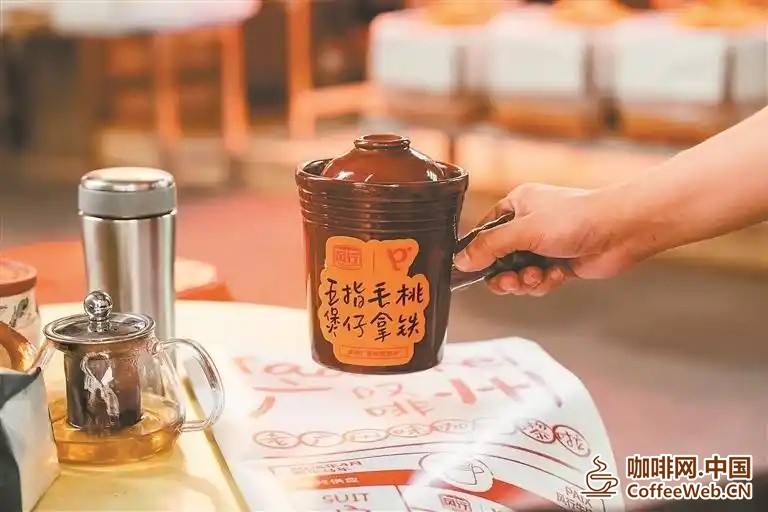
During the 2026 Guangzhou Coffee Culture Season, the Wuzhimaotao clay-pot latte was quite distinctive.
During the 2026 Guangzhou Coffee Culture Season, the “Wuzhimaotao clay-pot latte” launched by PAIXCOFFEE was far more popular than before; its sales increased by 30% compared with the first two seasonal limited editions this year, confirming the market potential of localized innovative products.
Traffic empowerment is short-term assistance; deep industrial cultivation is the lasting foundation. At present, Guangzhou’s leading local coffee brands are going all out to tackle the upstream of the industry chain, breaking development bottlenecks and amplifying industrial advantages. Tili Coffee continues to advance proprietary coffee bean R&D and standardized roasting capacity upgrades, actively planning a joint-venture professional roasting factory, and with the advantages of source autonomy and production scaling, continuously consolidates quality and cost competitiveness. At the same time, in line with urban renewal and livelihood needs, it is laying out new formats in old-city communities, letting coffee’s everyday vibrancy deeply integrate into the urban fabric.
The entire industry continues to explore diversified innovation paths, constantly iterating Lingnan-characteristic coffee products and digging deep into new tracks of scenario experience, cultural creativity, and local integration. New formats such as intangible-heritage coffee, countryside coffee aroma, and cultural-creative coffee keep emerging. The intangible-heritage-concept cafe in Yongqing Fang blends Cantonese opera, lion dance, bamboo weaving, and other Cantonese intangible cultural heritages with coffee, regularly holding intangible-heritage experience activities; each district relies on local flavors to create its own distinctive coffee products, making coffee an important carrier bearing Lingnan culture and showcasing urban charm. Continuous innovation and iteration effectively resolve the industry’s homogenization problem, constantly enhancing the market competitiveness and urban influence of Guangzhou coffee, and propelling the industry into a new stage of high-quality development.
A cup of coffee aroma from the City of Flowers precipitates the heritage of the century-old trading metropolis and reflects a city’s new breeze of pragmatic action. On the competitive stage, artisans break through themselves; among the streets and alleys, brands deepen and innovate. The growth of Guangzhou coffee is a vivid answer sheet of the two-way empowerment of urban heritage and pragmatic innovation. Upholding a pragmatic original aspiration, forever preserving innovative vitality, the Cantonese-style coffee rooted in Lingnan’s everyday life will surely continue to renew its brilliance and spread its fragrance far and wide.
Text / Guangzhou Daily Xinhuacheng reporters: Zeng Fanying, Zhao Wantong
Photos / Guangzhou Daily Xinhuacheng reporters: Liu Yu, Su Junjie, Luo Changwei, Yang Yaoye, Mo Weinong
Guangzhou Daily Xinhuacheng editor: Zhang Yingwu
Reprint Notice & Disclaimer
- This article has been edited and compiled by China Coffee Network. The information and images therein come from public sources and the copyright belongs to the original author. This reprint is intended solely for information sharing within the coffee industry and does not represent the views of this website; all data and opinions are subject to the original article. Our thanks to the original author for creating and sharing it.
- For matters concerning content licensing, attribution, copyright or otherwise, please contact us promptly and we will verify and cooperate in handling them as soon as possible. We also welcome coffee origins, brands and industry media to exchange ideas and contribute articles.
- Contact China Coffee Network: Tel 400-0000-641 (+86-18288016826) | Email 478203668@qq.com
Related Reading
 Tim Hortons China Q3: System Sales Up 6.3% Quarter on Quarter
- CRH Plans OATLY Exit, Nayuki Leaves Wenzhou | Tea & Coffee Weekly
 The 2026 Asian Coffee Association Annual Meeting will be held in Dehong, Yunnan, and the Asia ABODY Coffee System Standard will be officially released
 The President of Brazil's Victoria Coffee Business Center (CCCV) led a delegation of four people to Pu'er, Yunnan to conduct a special inspection of the coffee industry
 Behind the 1836 yuan "King of Brands": The Full Industry Chain and Offline Layout of Xinlu Coffee
 From a raw bean to a fragrant cup, Xiamen International Coffee Exhibition unlocks a new picture of the entire industry chain


 Liaoning ICP Security No. 21122402000217